




The geometry of $[Ni{{(CO)}_{4}}]\text{ and }\!\![\!\!\text{ PdC}{{\text{l}}_{4}}{{]}^{2-}}$ respectively are:
a.) Both are tetrahedral
b.) Both are square planar
c.) Square planar and tetrahedral
d.) Tetrahedral and square planar
Answer
 Verified
608.4k+ views
Hint:. The 3-D arrangement of atoms in a molecule is known as its molecular geometry. The molecular geometry includes the shape of the molecule as well as the bond length and bond angles of the molecule. All these factors help to determine the position of each atom in the geometry.
Complete step by step answer:
In $[Ni{{(CO)}_{4}}]$
The oxidation number or Ni = 0
Electronic configuration of Ni = $1{{s}^{2}}2{{s}^{2}}2{{p}^{6}}3{{s}^{2}}3{{p}^{6}}4{{s}^{2}}3{{d}^{8}}$
And in the excited state the electronic configuration of Ni = $1{{s}^{2}}2{{s}^{2}}2{{p}^{6}}3{{s}^{2}}3{{p}^{6}}3{{d}^{10}}$
CO is a strong ligand and does the pairing which leaves an empty d orbital and in the excited state the electrons jump to the d orbitals leaving the 4s orbital empty to accommodate the electrons from CO.
Hence the hybridization is $s{{p}^{3}}$ and geometry is tetrahedral

In ${{\text{ }\!\![\!\!\text{ PdC}{{\text{l}}_{4}}]}^{2-}}$
Electronic configuration of Pd= $1{{s}^{2}}2{{s}^{2}}2{{p}^{6}}3{{s}^{2}}3{{p}^{6}}4{{s}^{2}}3{{d}^{10}}4{{p}^{6}}5{{s}^{2}}4{{d}^{8}}$
Pd is present in +2 oxidation state here the 4d orbital of Pd gets diffused and therefore forms a strong overlap with the orbitals of the chlorine and this leads to a larger splitting in the d orbital.
Hence the geometry of ${{\text{ }\!\![\!\!\text{ PdC}{{\text{l}}_{4}}]}^{2-}}$ is square planar.
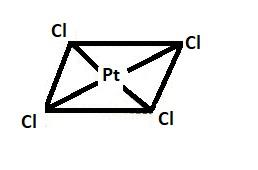
Additional Information:
The general formula which we use to calculate the hybridization of a molecule is
Hybridization number =$\dfrac{1}{2}\left[ V+M-C+A \right]$
Here V = the number of valence electrons of the central atom
C = charge on cation
A= charge on anion
M is the number of atoms linked to the central atom
So, the correct answer is “Option A”.
Note: The geometry and shape of a molecule can be the same or different as geometry of the molecule depends on the arrangement of lone pair and bond Pair while the shape of a molecule excludes the lone pair on the central atom.
Complete step by step answer:
In $[Ni{{(CO)}_{4}}]$
The oxidation number or Ni = 0
Electronic configuration of Ni = $1{{s}^{2}}2{{s}^{2}}2{{p}^{6}}3{{s}^{2}}3{{p}^{6}}4{{s}^{2}}3{{d}^{8}}$
And in the excited state the electronic configuration of Ni = $1{{s}^{2}}2{{s}^{2}}2{{p}^{6}}3{{s}^{2}}3{{p}^{6}}3{{d}^{10}}$
CO is a strong ligand and does the pairing which leaves an empty d orbital and in the excited state the electrons jump to the d orbitals leaving the 4s orbital empty to accommodate the electrons from CO.
Hence the hybridization is $s{{p}^{3}}$ and geometry is tetrahedral
In ${{\text{ }\!\![\!\!\text{ PdC}{{\text{l}}_{4}}]}^{2-}}$
Electronic configuration of Pd= $1{{s}^{2}}2{{s}^{2}}2{{p}^{6}}3{{s}^{2}}3{{p}^{6}}4{{s}^{2}}3{{d}^{10}}4{{p}^{6}}5{{s}^{2}}4{{d}^{8}}$
Pd is present in +2 oxidation state here the 4d orbital of Pd gets diffused and therefore forms a strong overlap with the orbitals of the chlorine and this leads to a larger splitting in the d orbital.
Hence the geometry of ${{\text{ }\!\![\!\!\text{ PdC}{{\text{l}}_{4}}]}^{2-}}$ is square planar.
Additional Information:
The general formula which we use to calculate the hybridization of a molecule is
Hybridization number =$\dfrac{1}{2}\left[ V+M-C+A \right]$
Here V = the number of valence electrons of the central atom
C = charge on cation
A= charge on anion
M is the number of atoms linked to the central atom
So, the correct answer is “Option A”.
Note: The geometry and shape of a molecule can be the same or different as geometry of the molecule depends on the arrangement of lone pair and bond Pair while the shape of a molecule excludes the lone pair on the central atom.
Recently Updated Pages
Master Class 9 General Knowledge: Engaging Questions & Answers for Success

Master Class 9 Maths: Engaging Questions & Answers for Success
Master Class 9 Science: Engaging Questions & Answers for Success
Master Class 9 English: Engaging Questions & Answers for Success
Master Class 9 Social Science: Engaging Questions & Answers for Success
Class 9 Question and Answer - Your Ultimate Solutions Guide
Trending doubts
One Metric ton is equal to kg A 10000 B 1000 C 100 class 11 physics CBSE
Difference Between Prokaryotic Cells and Eukaryotic Cells
Two of the body parts which do not appear in MRI are class 11 biology CBSE
1 ton equals to A 100 kg B 1000 kg C 10 kg D 10000 class 11 physics CBSE
10 examples of friction in our daily life
Name the Largest and the Smallest Cell in the Human Body ?