




The geometrical arrangement and shape of \[\text{I}_ {3} ^ {-} \] are respectively:
(A) trigonal bipyramidal geometry, linear shape
(B) hexagonal geometry, T-shape
(C) triangular planar geometry, triangular shape
(D) tetrahedral geometry, pyramidal shape
Answer
 Verified
606k+ views
Hint: We can calculate the structure or the geometry and the shape of the \[\text{I}_ {3} ^ {-} \] molecule by knowing its hybridization (it is the process of inter-mixing of the orbitals to form new orbitals of equivalent energy). The hybridization can be calculated by the formula:
$H=$ $\dfrac {1}{2} $ $(V+M-C+A)$
Here, V represents the number of electrons in the valence shell of the atom, M represents the monovalent atoms attached to that atom and C and A represents the charges of the cations and anions. Identify the structure.
Complete step by step solution:
To know the structure and shape of any molecule, we should know its hybridization. By the term hybridization, we mean the phenomenon of inter-mixing of the orbitals of slightly different energies so as to redistribute their energies and to give a new set of orbitals of equivalent energies and shape.
First, we have to find the hybridization of \[\text{I}_ {3} ^ {-} \] molecule by the formula as:
$H=$ $\dfrac {1}{2} $ $(V+M-C+A)$ ---------(1)
Here, V= number of the valence electrons in the atom, M= number of the monovalent atoms bonded to the central atom, C=the charge on the cation and A= the charge on the anion.
So, in case of the molecule; V in I=7
M =2
A=1
Put all these values in equation (1), we get
$H=$ $\dfrac {1}{2} $ $(7+2+1)$
$=$ $\dfrac {1}{2} $ $(10)$
$=5$
So, the \[\text{I}_{3}^{-}\]involves the $\text{s}{{\text{p}}^{3}}\text{d}$ hybridization i.e. it has trigonal bipyramidal geometry or the structure and it involves the mixing of the one s, three p and one d-orbitals but its shape is linear because it consists of three iodine atoms and the central iodine atom ion it consists of three lone pair of electrons and two bonds pair of electrons with the two other iodine atoms as;
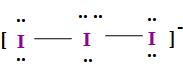
So, thus the \[\text{I}_ {3} ^ {-} \] has linear shape.
Hence, the option (A) is correct.
Note: For the orbitals which undergo hybridization, they should have only small differences in their energies and only those orbitals are hybridized which are present in the valence shell of the atom.
$H=$ $\dfrac {1}{2} $ $(V+M-C+A)$
Here, V represents the number of electrons in the valence shell of the atom, M represents the monovalent atoms attached to that atom and C and A represents the charges of the cations and anions. Identify the structure.
Complete step by step solution:
To know the structure and shape of any molecule, we should know its hybridization. By the term hybridization, we mean the phenomenon of inter-mixing of the orbitals of slightly different energies so as to redistribute their energies and to give a new set of orbitals of equivalent energies and shape.
First, we have to find the hybridization of \[\text{I}_ {3} ^ {-} \] molecule by the formula as:
$H=$ $\dfrac {1}{2} $ $(V+M-C+A)$ ---------(1)
Here, V= number of the valence electrons in the atom, M= number of the monovalent atoms bonded to the central atom, C=the charge on the cation and A= the charge on the anion.
So, in case of the molecule; V in I=7
M =2
A=1
Put all these values in equation (1), we get
$H=$ $\dfrac {1}{2} $ $(7+2+1)$
$=$ $\dfrac {1}{2} $ $(10)$
$=5$
So, the \[\text{I}_{3}^{-}\]involves the $\text{s}{{\text{p}}^{3}}\text{d}$ hybridization i.e. it has trigonal bipyramidal geometry or the structure and it involves the mixing of the one s, three p and one d-orbitals but its shape is linear because it consists of three iodine atoms and the central iodine atom ion it consists of three lone pair of electrons and two bonds pair of electrons with the two other iodine atoms as;
So, thus the \[\text{I}_ {3} ^ {-} \] has linear shape.
Hence, the option (A) is correct.
Note: For the orbitals which undergo hybridization, they should have only small differences in their energies and only those orbitals are hybridized which are present in the valence shell of the atom.
Recently Updated Pages
Master Class 11 Economics: Engaging Questions & Answers for Success

Master Class 11 English: Engaging Questions & Answers for Success
Master Class 11 Maths: Engaging Questions & Answers for Success
Class 11 Question and Answer - Your Ultimate Solutions Guide
Master Class 11 Social Science: Engaging Questions & Answers for Success
Master Class 11 Business Studies: Engaging Questions & Answers for Success
Trending doubts
Differentiate between an exothermic and an endothermic class 11 chemistry CBSE
One Metric ton is equal to kg A 10000 B 1000 C 100 class 11 physics CBSE
There are 720 permutations of the digits 1 2 3 4 5 class 11 maths CBSE
In what year Guru Nanak Dev ji was born A15 April 1469 class 11 social science CBSE
Difference Between Prokaryotic Cells and Eukaryotic Cells
Draw a diagram of a plant cell and label at least eight class 11 biology CBSE