




The fruit of samara has
A. Reduced pericarp
B. Winged pericarp
C. Woody pericarp
D. Fleshy pericarp
Answer
 Verified
607.2k+ views
Hint: The pericarp i.e., ovary wall is often differentiated into two or three distinct layers called the exocarp, mesocarp, and endocarp. Pericarp can be fleshy or hard.
Complete answer:
A fruit results from the maturation of one or more flowers, and the gynoecium of the flower forms all or part of the fruit. Inside the ovary, there are one or more ovules where the megagametophyte contains the egg cell. After double fertilization, these ovules will become seeds. The ovules are fertilized in a process that starts with pollination, which involves the movement of pollen from the stamens to the stigma of flowers. As the ovules develop into seeds, the ovary begins to ripen and the ovary wall, the pericarp, may become fleshy (as in berries or drupes), or form a hard outer covering.
A samara is a winged achene, a type of fruit in which a flattened wing of fibrous, papery tissue develops from the ovary wall. A samara is a simple dry fruit and indehiscent. The shape of a samara enables the wind to carry the seed farther away than regular seeds from the parent tree and is thus a form of anemochory.
In some cases, the seed is in the center of the wing, as in the elms, the hoptree, and the bushwillows. In other cases the seed is on one side, with the wing extending to the other side, making the seed auto rotate as it falls, as in the maples and ash trees.
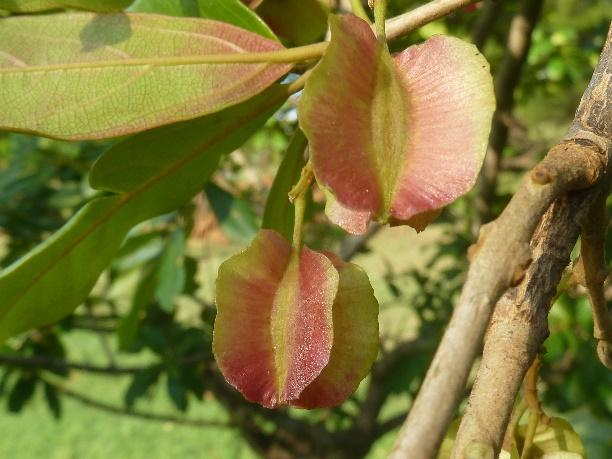
Hence, the correct option is (B) Winged pericarp.
Note: A samara is sometimes called a key and is often referred to as a wingnut or helicopter. During the autumn months, they are a popular source of amusement for children who enjoy tossing them in the air and watching them spin to the ground. Some species that normally produce paired samaras, such as Acer pseudoplatanus.
Complete answer:
A fruit results from the maturation of one or more flowers, and the gynoecium of the flower forms all or part of the fruit. Inside the ovary, there are one or more ovules where the megagametophyte contains the egg cell. After double fertilization, these ovules will become seeds. The ovules are fertilized in a process that starts with pollination, which involves the movement of pollen from the stamens to the stigma of flowers. As the ovules develop into seeds, the ovary begins to ripen and the ovary wall, the pericarp, may become fleshy (as in berries or drupes), or form a hard outer covering.
A samara is a winged achene, a type of fruit in which a flattened wing of fibrous, papery tissue develops from the ovary wall. A samara is a simple dry fruit and indehiscent. The shape of a samara enables the wind to carry the seed farther away than regular seeds from the parent tree and is thus a form of anemochory.
In some cases, the seed is in the center of the wing, as in the elms, the hoptree, and the bushwillows. In other cases the seed is on one side, with the wing extending to the other side, making the seed auto rotate as it falls, as in the maples and ash trees.
Hence, the correct option is (B) Winged pericarp.
Note: A samara is sometimes called a key and is often referred to as a wingnut or helicopter. During the autumn months, they are a popular source of amusement for children who enjoy tossing them in the air and watching them spin to the ground. Some species that normally produce paired samaras, such as Acer pseudoplatanus.
Recently Updated Pages
Master Class 11 English: Engaging Questions & Answers for Success

Master Class 11 Social Science: Engaging Questions & Answers for Success
Master Class 11 Maths: Engaging Questions & Answers for Success
Master Class 11 Biology: Engaging Questions & Answers for Success
Master Class 11 Physics: Engaging Questions & Answers for Success
Master Class 11 Chemistry: Engaging Questions & Answers for Success
Trending doubts
One Metric ton is equal to kg A 10000 B 1000 C 100 class 11 physics CBSE
Difference Between Prokaryotic Cells and Eukaryotic Cells
Difference between physical and chemical change class 11 chemistry CBSE
Find the value of the expression given below sin 30circ class 11 maths CBSE
Two of the body parts which do not appear in MRI are class 11 biology CBSE
Draw a diagram of a plant cell and label at least eight class 11 biology CBSE