




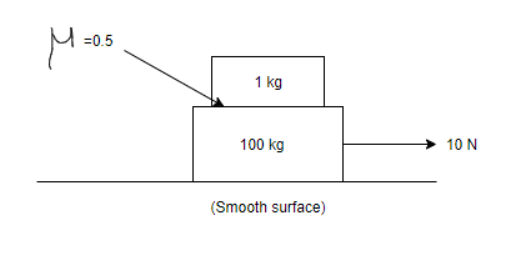
The frictional force acting on 1 kg block is
$
A.0.1N \\
B.2N \\
C.0.5N \\
D.5N \\
$
Answer
 Verified
625.5k+ views
Hint – Here we will proceed by using the formula of force (Newton’s second law) with S.I. unit kg into meter per second square. Then by applying the condition given in the diagram of 1 kg block we will get our answer.
Formula used, $F = M \times A$
Where, F = force
M = mass
A = acceleration
Complete step-by-step answer:
Friction Force – The friction force is a type of repulsive force due to rough surfaces between the blocks which restricts or opposes the motion of the object.
Total mass of the system = 1+100=101kg
Force acting on system(F) = 10N
Then, Acceleration of the system
$M \times a = F$ (M=101, F= 10)
We have to find
101$ \times a$=10
$a = \dfrac{{10}}{{101}}$ meter per second$^2$
Maximum friction between two blocks is
$\mu mg = 0.5 \times 1 \times 10$ ( where g= 10 meter per sec$^2$)
$F\max = 5N$
But the external force that is $1 \times \dfrac{{10}}{{101}}$ is less than $F\max $.
Hence, both of them move together.
Therefore, the correction answer is option D.
Note – Whenever we come up with this type of question, one must know that Newton's second law of motion pertains to the behaviour of objects for which all existing forces are not balanced. The second law states that the acceleration of an object depends upon two variables – the mass of the object and the net force acting upon the object.
Formula used, $F = M \times A$
Where, F = force
M = mass
A = acceleration
Complete step-by-step answer:
Friction Force – The friction force is a type of repulsive force due to rough surfaces between the blocks which restricts or opposes the motion of the object.
Total mass of the system = 1+100=101kg
Force acting on system(F) = 10N
Then, Acceleration of the system
$M \times a = F$ (M=101, F= 10)
We have to find
101$ \times a$=10
$a = \dfrac{{10}}{{101}}$ meter per second$^2$
Maximum friction between two blocks is
$\mu mg = 0.5 \times 1 \times 10$ ( where g= 10 meter per sec$^2$)
$F\max = 5N$
But the external force that is $1 \times \dfrac{{10}}{{101}}$ is less than $F\max $.
Hence, both of them move together.
Therefore, the correction answer is option D.
Note – Whenever we come up with this type of question, one must know that Newton's second law of motion pertains to the behaviour of objects for which all existing forces are not balanced. The second law states that the acceleration of an object depends upon two variables – the mass of the object and the net force acting upon the object.
Recently Updated Pages
Master Class 11 Social Science: Engaging Questions & Answers for Success

Master Class 11 English: Engaging Questions & Answers for Success
Master Class 11 Maths: Engaging Questions & Answers for Success
Master Class 11 Chemistry: Engaging Questions & Answers for Success
Master Class 11 Biology: Engaging Questions & Answers for Success
Master Class 11 Physics: Engaging Questions & Answers for Success
Trending doubts
One Metric ton is equal to kg A 10000 B 1000 C 100 class 11 physics CBSE
Difference Between Prokaryotic Cells and Eukaryotic Cells
How many of the following diseases can be studied with class 11 biology CBSE
Which of the following enzymes is used for carboxylation class 11 biology CBSE
Draw a diagram of a plant cell and label at least eight class 11 biology CBSE
Two of the body parts which do not appear in MRI are class 11 biology CBSE