




The friction of air causes vertical retardation equal to \[10\% \]of the acceleration due to gravity (Take\[g = {10^{{\text{ m se}}{{\text{c}}^{ - 2}}}}\]). The maximum height will be decreased by
A. \[8\% \]
B. \[9\% \]
C. \[10\% \]
D. \[11\% \]
Answer
 Verified
602.4k+ views
Hint: When an object is thrown in the air it reaches a height and then fall back, but when the object is thrown in the air where there is friction in the air then the ball will not gain the same height its trajectory will be short.
In this question find the ratio of maximum height reached by an object without air friction to the maximum height reached by the object when there is friction in the air.
Complete step by step answer:
Retardation\[ = 10\% \]
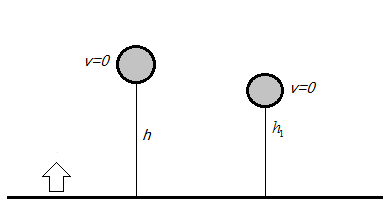
When an object reaches its maximum height, then the objects stop moving up, and then it tends to fall down hence we can say at a maximum height which will be the final velocity point of an object, the velocity is \[v = 0\].
So the in the equation of the motion can be written as:
\[{v^2} = {u^2} + 2gh\]
As, \[v = 0\] so, the above equation can be re-written as:
\[
{0^2} = {u^2} + 2gh \\
h = \dfrac{{ - {u^2}}}{{2g}} \\
h \propto \dfrac{-1}{g} - - - - (i) \\
\]
Now when there is air resistance \[10\% \] of the gravity, new gravity will be
\[
{g_{ef}} = g + 0.1g \\
= 1.1g \\
= \dfrac{{11g}}{{10}} \\
\]
Hence the new maximum height reached will be given as:
\[
{h_1} = \dfrac{{ - {u^2}}}{{2{g_{ef}}}} \\
{h_1} \propto \dfrac{-1}{{{g_{ef}}}} - - - - (ii) \\
\]
Since height reached by an object is inversely proportional to the gravity, hence we can write from the equations (i) and (ii) as:
\[\dfrac{{{h_1}}}{h} = \dfrac{g}{{{g_{ef}}}} - - - - (iii)\]
Equation (iii) can also be written as:
\[
1 - \dfrac{{{h_1}}}{h} = 1 - \dfrac{g}{{{g_{ef}}}} \\
\dfrac{{h - {h_1}}}{h} = \dfrac{{{g_{ef}} - g}}{{{g_{ef}}}} \\
\dfrac{{\vartriangle h}}{h} = \dfrac{{\left( {\dfrac{{11}}{{10}}g} \right) - g}}{{\left( {\dfrac{{11}}{{10}}g} \right)}} \\
= \dfrac{{\left( {\dfrac{1}{{10}}g} \right)}}{{\left( {\dfrac{{11}}{{10}}g} \right)}} \\
= \dfrac{1}{{11}} \\
\]
Therefore the percentage change in maximum height will be
\[
\dfrac{{\vartriangle h}}{h} = \dfrac{1}{{11}} \times 100\% \\
= 9.09\% \\
\approx 9\% \\
\]
Hence, the maximum height of the ball will be decreased by 9%.
So, the correct answer is “Option B”.
Note:
Students must note that whenever there is friction, then the natural trajectory of any object falls short as a backward force (resisting the forward motion) acts on the object.Also When an object reaches its maximum height, then the objects stop moving up, and then it tends to fall down
In this question find the ratio of maximum height reached by an object without air friction to the maximum height reached by the object when there is friction in the air.
Complete step by step answer:
Retardation\[ = 10\% \]
When an object reaches its maximum height, then the objects stop moving up, and then it tends to fall down hence we can say at a maximum height which will be the final velocity point of an object, the velocity is \[v = 0\].
So the in the equation of the motion can be written as:
\[{v^2} = {u^2} + 2gh\]
As, \[v = 0\] so, the above equation can be re-written as:
\[
{0^2} = {u^2} + 2gh \\
h = \dfrac{{ - {u^2}}}{{2g}} \\
h \propto \dfrac{-1}{g} - - - - (i) \\
\]
Now when there is air resistance \[10\% \] of the gravity, new gravity will be
\[
{g_{ef}} = g + 0.1g \\
= 1.1g \\
= \dfrac{{11g}}{{10}} \\
\]
Hence the new maximum height reached will be given as:
\[
{h_1} = \dfrac{{ - {u^2}}}{{2{g_{ef}}}} \\
{h_1} \propto \dfrac{-1}{{{g_{ef}}}} - - - - (ii) \\
\]
Since height reached by an object is inversely proportional to the gravity, hence we can write from the equations (i) and (ii) as:
\[\dfrac{{{h_1}}}{h} = \dfrac{g}{{{g_{ef}}}} - - - - (iii)\]
Equation (iii) can also be written as:
\[
1 - \dfrac{{{h_1}}}{h} = 1 - \dfrac{g}{{{g_{ef}}}} \\
\dfrac{{h - {h_1}}}{h} = \dfrac{{{g_{ef}} - g}}{{{g_{ef}}}} \\
\dfrac{{\vartriangle h}}{h} = \dfrac{{\left( {\dfrac{{11}}{{10}}g} \right) - g}}{{\left( {\dfrac{{11}}{{10}}g} \right)}} \\
= \dfrac{{\left( {\dfrac{1}{{10}}g} \right)}}{{\left( {\dfrac{{11}}{{10}}g} \right)}} \\
= \dfrac{1}{{11}} \\
\]
Therefore the percentage change in maximum height will be
\[
\dfrac{{\vartriangle h}}{h} = \dfrac{1}{{11}} \times 100\% \\
= 9.09\% \\
\approx 9\% \\
\]
Hence, the maximum height of the ball will be decreased by 9%.
So, the correct answer is “Option B”.
Note:
Students must note that whenever there is friction, then the natural trajectory of any object falls short as a backward force (resisting the forward motion) acts on the object.Also When an object reaches its maximum height, then the objects stop moving up, and then it tends to fall down
Recently Updated Pages
Master Class 11 Social Science: Engaging Questions & Answers for Success

Master Class 11 Physics: Engaging Questions & Answers for Success
Master Class 11 Maths: Engaging Questions & Answers for Success
Master Class 11 Economics: Engaging Questions & Answers for Success
Master Class 11 Computer Science: Engaging Questions & Answers for Success
Master Class 11 Chemistry: Engaging Questions & Answers for Success
Trending doubts
One Metric ton is equal to kg A 10000 B 1000 C 100 class 11 physics CBSE
There are 720 permutations of the digits 1 2 3 4 5 class 11 maths CBSE
1 Quintal is equal to a 110 kg b 10 kg c 100kg d 1000 class 11 physics CBSE
State and prove Bernoullis theorem class 11 physics CBSE
Difference Between Prokaryotic Cells and Eukaryotic Cells
Discuss the various forms of bacteria class 11 biology CBSE