




The four vertices of a quadrilateral are (1, 2), (-5, 6), (7, -4) and (k, -2) taken in order. If the area of the quadrilateral is zero, find the value of k.
Answer
 Verified
595.2k+ views
Hint: In this particular question use the concept that the area of the quadrilateral is the sum of the area of the two triangles as shown in the above figure so calculate the area of each triangle and then add up, so use these concepts to reach the solution of the question.
Complete step-by-step answer:
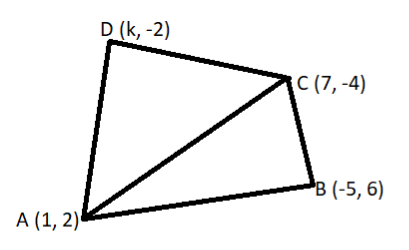
Let us consider the quadrilateral ABCD as shown above.
Let,
A = (${x_1},{y_1}$) = (1, 2)
B = (${x_2},{y_2}$) = (-5, 6)
C = (${x_3},{y_3}$) = (7, -4)
D = (${x_4},{y_4}$) = (k, -2)
So first calculate area of triangle ABC
So area of triangle ABC = $\dfrac{1}{2}\left| {\begin{array}{*{20}{c}}
{{x_1}}&{{y_1}}&1 \\
{{x_2}}&{{y_2}}&1 \\
{{x_3}}&{{y_3}}&1
\end{array}} \right|$
Now substitute the values we have,
The area of triangle ABC = $\dfrac{1}{2}\left| {\begin{array}{*{20}{c}}
1&2&1 \\
{ - 5}&6&1 \\
7&{ - 4}&1
\end{array}} \right|$
Now expand the determinant we have,
$ \Rightarrow {A_1} = \dfrac{1}{2}\left[ {1\left| {\begin{array}{*{20}{c}}
6&1 \\
{ - 4}&1
\end{array}} \right| - \left( 2 \right)\left| {\begin{array}{*{20}{c}}
{ - 5}&1 \\
7&1
\end{array}} \right| + 1\left| {\begin{array}{*{20}{c}}
{ - 5}&6 \\
7&{ - 4}
\end{array}} \right|} \right]$
Now simplify it we have,
$ \Rightarrow {A_1} = \dfrac{1}{2}\left[ {1\left( {6 - \left( { - 4} \right)} \right) - 2\left( { - 5 - 7} \right) + 1\left( {20 - 42} \right)} \right]$
$ \Rightarrow {A_1} = \dfrac{1}{2}\left[ {10 + 24 - 22} \right] = \dfrac{{12}}{2} = 6$ sq. units.
Now the area of the triangle ACD
So area of triangle ACD = $\dfrac{1}{2}\left| {\begin{array}{*{20}{c}}
{{x_1}}&{{y_1}}&1 \\
{{x_3}}&{{y_3}}&1 \\
{{x_4}}&{{y_4}}&1
\end{array}} \right|$
Now substitute the values we have,
The area of triangle ABC = $\dfrac{1}{2}\left| {\begin{array}{*{20}{c}}
1&2&1 \\
7&{ - 4}&1 \\
k&{ - 2}&1
\end{array}} \right|$
Now expand the determinant we have,
$ \Rightarrow {A_2} = \dfrac{1}{2}\left[ {1\left| {\begin{array}{*{20}{c}}
{ - 4}&1 \\
{ - 2}&1
\end{array}} \right| - \left( 2 \right)\left| {\begin{array}{*{20}{c}}
7&1 \\
k&1
\end{array}} \right| + 1\left| {\begin{array}{*{20}{c}}
7&{ - 4} \\
k&{ - 2}
\end{array}} \right|} \right]$
Now simplify it we have,
$ \Rightarrow {A_2} = \dfrac{1}{2}\left[ {1\left( { - 4 - \left( { - 2} \right)} \right) - 2\left( {7 - k} \right) + 1\left( { - 14 - \left( { - 4k} \right)} \right)} \right]$
$ \Rightarrow {A_2} = \dfrac{1}{2}\left[ { - 2 - 14 + 2k - 14 + 4k} \right] = \dfrac{{ - 30 + 6k}}{2} = - 15 + 3k$ sq. units.
Now the total area (A) of the quadrilateral is the sum of the above calculated areas.
$ \Rightarrow A = {A_1} + {A_2}$
$ \Rightarrow A = 6 + \left( { - 15 + 3k} \right)$
Now it is given that the area of the quadrilateral is zero.
So equate the above equation to zero we have,
$ \Rightarrow A = 6 + \left( { - 15 + 3k} \right) = 0$
$ \Rightarrow 6 - 15 + 3k = 0$
$ \Rightarrow 3k = 9$
$ \Rightarrow k = 3$
So this is the required value of k.
Note: Whenever we face such types of questions the key concept we have to remember is that always recall the formula of the area of the triangle in determinant format which is stated above, so just substitute the values in the formula as above we will get the required answer.
Complete step-by-step answer:
Let us consider the quadrilateral ABCD as shown above.
Let,
A = (${x_1},{y_1}$) = (1, 2)
B = (${x_2},{y_2}$) = (-5, 6)
C = (${x_3},{y_3}$) = (7, -4)
D = (${x_4},{y_4}$) = (k, -2)
So first calculate area of triangle ABC
So area of triangle ABC = $\dfrac{1}{2}\left| {\begin{array}{*{20}{c}}
{{x_1}}&{{y_1}}&1 \\
{{x_2}}&{{y_2}}&1 \\
{{x_3}}&{{y_3}}&1
\end{array}} \right|$
Now substitute the values we have,
The area of triangle ABC = $\dfrac{1}{2}\left| {\begin{array}{*{20}{c}}
1&2&1 \\
{ - 5}&6&1 \\
7&{ - 4}&1
\end{array}} \right|$
Now expand the determinant we have,
$ \Rightarrow {A_1} = \dfrac{1}{2}\left[ {1\left| {\begin{array}{*{20}{c}}
6&1 \\
{ - 4}&1
\end{array}} \right| - \left( 2 \right)\left| {\begin{array}{*{20}{c}}
{ - 5}&1 \\
7&1
\end{array}} \right| + 1\left| {\begin{array}{*{20}{c}}
{ - 5}&6 \\
7&{ - 4}
\end{array}} \right|} \right]$
Now simplify it we have,
$ \Rightarrow {A_1} = \dfrac{1}{2}\left[ {1\left( {6 - \left( { - 4} \right)} \right) - 2\left( { - 5 - 7} \right) + 1\left( {20 - 42} \right)} \right]$
$ \Rightarrow {A_1} = \dfrac{1}{2}\left[ {10 + 24 - 22} \right] = \dfrac{{12}}{2} = 6$ sq. units.
Now the area of the triangle ACD
So area of triangle ACD = $\dfrac{1}{2}\left| {\begin{array}{*{20}{c}}
{{x_1}}&{{y_1}}&1 \\
{{x_3}}&{{y_3}}&1 \\
{{x_4}}&{{y_4}}&1
\end{array}} \right|$
Now substitute the values we have,
The area of triangle ABC = $\dfrac{1}{2}\left| {\begin{array}{*{20}{c}}
1&2&1 \\
7&{ - 4}&1 \\
k&{ - 2}&1
\end{array}} \right|$
Now expand the determinant we have,
$ \Rightarrow {A_2} = \dfrac{1}{2}\left[ {1\left| {\begin{array}{*{20}{c}}
{ - 4}&1 \\
{ - 2}&1
\end{array}} \right| - \left( 2 \right)\left| {\begin{array}{*{20}{c}}
7&1 \\
k&1
\end{array}} \right| + 1\left| {\begin{array}{*{20}{c}}
7&{ - 4} \\
k&{ - 2}
\end{array}} \right|} \right]$
Now simplify it we have,
$ \Rightarrow {A_2} = \dfrac{1}{2}\left[ {1\left( { - 4 - \left( { - 2} \right)} \right) - 2\left( {7 - k} \right) + 1\left( { - 14 - \left( { - 4k} \right)} \right)} \right]$
$ \Rightarrow {A_2} = \dfrac{1}{2}\left[ { - 2 - 14 + 2k - 14 + 4k} \right] = \dfrac{{ - 30 + 6k}}{2} = - 15 + 3k$ sq. units.
Now the total area (A) of the quadrilateral is the sum of the above calculated areas.
$ \Rightarrow A = {A_1} + {A_2}$
$ \Rightarrow A = 6 + \left( { - 15 + 3k} \right)$
Now it is given that the area of the quadrilateral is zero.
So equate the above equation to zero we have,
$ \Rightarrow A = 6 + \left( { - 15 + 3k} \right) = 0$
$ \Rightarrow 6 - 15 + 3k = 0$
$ \Rightarrow 3k = 9$
$ \Rightarrow k = 3$
So this is the required value of k.
Note: Whenever we face such types of questions the key concept we have to remember is that always recall the formula of the area of the triangle in determinant format which is stated above, so just substitute the values in the formula as above we will get the required answer.
Recently Updated Pages
Master Class 10 Computer Science: Engaging Questions & Answers for Success

Master Class 10 General Knowledge: Engaging Questions & Answers for Success
Master Class 10 English: Engaging Questions & Answers for Success
Master Class 10 Social Science: Engaging Questions & Answers for Success
Master Class 10 Maths: Engaging Questions & Answers for Success
Master Class 10 Science: Engaging Questions & Answers for Success
Trending doubts
What is the median of the first 10 natural numbers class 10 maths CBSE
Which women's tennis player has 24 Grand Slam singles titles?
Who is the Brand Ambassador of Incredible India?
Why is there a time difference of about 5 hours between class 10 social science CBSE
Write a letter to the principal requesting him to grant class 10 english CBSE
A moving boat is observed from the top of a 150 m high class 10 maths CBSE