




The four points are on a line segment. If ${\text{AB}}:{\text{BC}} = 1:2$ and ${\text{BC}}:{\text{CD}} = 8:5$. Then find the values of ${\text{AB}}:{\text{BD}}$.
${\text{A}}$. $4:13$
${\text{B}}$ . $1:13$
${\text{C}}$ . $1:7$
${\text{D}}$ . $3:13$
Answer
 Verified
629.1k+ views
Hint: From the given question, we have to find the values of ${\text{AB}}:{\text{BD}}$ and choose the correct option. Now, we are going to find the values by the given data. First we have to change the given data into multiple variables and further proceed the solution by using the diagram. Diagrams are drawn by the given data, it will help to find the required solution.
Ratio is a quantity which represents the relationship between two similar quantities. If the two quantities are ${\text{a}}$ and ${\text{b}}$, then the ratio of ${\text{a}}$ and ${\text{b}}$ represented as ${\text{a}}:{\text{b}}$ or $\dfrac{{\text{a}}}{{\text{b}}}$ . Here ${\text{a}}$ is called antecedent and ${\text{b}}$ is called consequent.
Formula used: Let the ratio of ${\text{A}}:{\text{B}} = {\text{m}}:{\text{n}}$. Then it can also be written with variable term as ${\text{A}} = {\text{mx}}$ and ${\text{B}} = {\text{nx}}$.
Complete step-by-step solution:
By the given, let us write the ratio ${\text{AB}}:{\text{BC}} = 1:2$as ${\text{AB}} = 1\left( {\text{x}} \right) = {\text{x}}$ and ${\text{BC}} = 2{\text{x}}$.
Likewise, ${\text{BC}}:{\text{CD}} = 8:5$ $ \Rightarrow {\text{BC}}:{\text{CD}} = 2:\dfrac{5}{4}$ as ${\text{BC}} = 2x$ and ${\text{CD}} = \dfrac{{5{\text{x}}}}{4}$.
Now, we are going to find the term \[{\text{BD}}\] by the property of collinear.
${\text{BD}} = {\text{BC}} + {\text{CD}} = 2{\text{x}} + \dfrac{{5{\text{x}}}}{4}$
Now, taking Least Common Multiple (LCM) on the above term. Then, we get
${\text{BD}} = \dfrac{{8{\text{x}} + 5{\text{x}}}}{4}$
$ \Rightarrow {\text{BD}} = \dfrac{{13{\text{x}}}}{4}$
Already, we gave that ${\text{AB}} = {\text{x}}$ from the given.
Our question is to find the ratio ${\text{AB}}:{\text{BD}}$. Now, substitute the above terms in the ${\text{AB}}:{\text{BD}}$. Then, we get
\[{\text{AB}}:{\text{BD}} = \dfrac{{{\text{AB}}}}{{{\text{BD}}}} = \dfrac{{\dfrac{{\text{x}}}{1}}}{{\dfrac{{13{\text{x}}}}{4}}}\]
\[ \Rightarrow \dfrac{{{\text{AB}}}}{{{\text{BD}}}} = \dfrac{{4{\text{x}}}}{{13{\text{x}}}}\]
Hence,
$ \Rightarrow {\text{AB}}:{\text{BD}} = 4:13$
$\therefore $ The correct option is ${\text{A}}$.
Note: We have to remember that, in geometry, two or more points are said to be collinear, if they lie on the same line. The points which do not lie on the same line are called non-collinear points.
Now, we have to draw a figure for \[{\text{A}},{\text{B}},{\text{C}}\] and ${\text{D}}$ as collinear points.
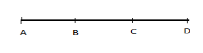
In general, four points \[{\text{A}},{\text{B}},{\text{C}}\] and ${\text{D}}$ are collinear if the sum of the length of any two line segments among ${\text{AB,AC,AD,BC,BD,CD}}$ is equal to the length of the remaining line segment, that is, either ${\text{AB}} + {\text{BC}} = {\text{AC}}$ or ${\text{BC}} + {\text{CD}} = {\text{BD}}$ or ${\text{AB}} + {\text{BD}} = {\text{AD}}$ etc.,
Ratio is a quantity which represents the relationship between two similar quantities. If the two quantities are ${\text{a}}$ and ${\text{b}}$, then the ratio of ${\text{a}}$ and ${\text{b}}$ represented as ${\text{a}}:{\text{b}}$ or $\dfrac{{\text{a}}}{{\text{b}}}$ . Here ${\text{a}}$ is called antecedent and ${\text{b}}$ is called consequent.
Formula used: Let the ratio of ${\text{A}}:{\text{B}} = {\text{m}}:{\text{n}}$. Then it can also be written with variable term as ${\text{A}} = {\text{mx}}$ and ${\text{B}} = {\text{nx}}$.
Complete step-by-step solution:
By the given, let us write the ratio ${\text{AB}}:{\text{BC}} = 1:2$as ${\text{AB}} = 1\left( {\text{x}} \right) = {\text{x}}$ and ${\text{BC}} = 2{\text{x}}$.
Likewise, ${\text{BC}}:{\text{CD}} = 8:5$ $ \Rightarrow {\text{BC}}:{\text{CD}} = 2:\dfrac{5}{4}$ as ${\text{BC}} = 2x$ and ${\text{CD}} = \dfrac{{5{\text{x}}}}{4}$.
Now, we are going to find the term \[{\text{BD}}\] by the property of collinear.
${\text{BD}} = {\text{BC}} + {\text{CD}} = 2{\text{x}} + \dfrac{{5{\text{x}}}}{4}$
Now, taking Least Common Multiple (LCM) on the above term. Then, we get
${\text{BD}} = \dfrac{{8{\text{x}} + 5{\text{x}}}}{4}$
$ \Rightarrow {\text{BD}} = \dfrac{{13{\text{x}}}}{4}$
Already, we gave that ${\text{AB}} = {\text{x}}$ from the given.
Our question is to find the ratio ${\text{AB}}:{\text{BD}}$. Now, substitute the above terms in the ${\text{AB}}:{\text{BD}}$. Then, we get
\[{\text{AB}}:{\text{BD}} = \dfrac{{{\text{AB}}}}{{{\text{BD}}}} = \dfrac{{\dfrac{{\text{x}}}{1}}}{{\dfrac{{13{\text{x}}}}{4}}}\]
\[ \Rightarrow \dfrac{{{\text{AB}}}}{{{\text{BD}}}} = \dfrac{{4{\text{x}}}}{{13{\text{x}}}}\]
Hence,
$ \Rightarrow {\text{AB}}:{\text{BD}} = 4:13$
$\therefore $ The correct option is ${\text{A}}$.
Note: We have to remember that, in geometry, two or more points are said to be collinear, if they lie on the same line. The points which do not lie on the same line are called non-collinear points.
Now, we have to draw a figure for \[{\text{A}},{\text{B}},{\text{C}}\] and ${\text{D}}$ as collinear points.
In general, four points \[{\text{A}},{\text{B}},{\text{C}}\] and ${\text{D}}$ are collinear if the sum of the length of any two line segments among ${\text{AB,AC,AD,BC,BD,CD}}$ is equal to the length of the remaining line segment, that is, either ${\text{AB}} + {\text{BC}} = {\text{AC}}$ or ${\text{BC}} + {\text{CD}} = {\text{BD}}$ or ${\text{AB}} + {\text{BD}} = {\text{AD}}$ etc.,
Recently Updated Pages
Differentiate between voluntary action and reflex class 10 biology CBSE

The uses of bleaching powder are A It is used bleaching class 10 chemistry CBSE
Fill in the blanks with abstract nouns of the words class 10 english CBSE
How many threedigit numbers are there class 10 maths CBSE
What is a reflex arc class 10 biology CBSE
Construct a square whose diagonal is 6cm Measure the class 10 maths CBSE
Trending doubts
Explain the Treaty of Vienna of 1815 class 10 social science CBSE
The slogan Jai Hind was given by A Lal Bahadur Shastri class 10 social science CBSE
10 examples of evaporation in daily life with explanations
What is the full form of POSCO class 10 social science CBSE
Identify the feminine form of noun nephew a shenephew class 10 english CBSE
Make a sketch of the human nerve cell What function class 10 biology CBSE