




The formula of lateral surface area of cylinder is……..
$\begin{align}
& \text{A}\text{. }A=2\pi rh \\
& \text{B}\text{. }A=2\pi r \\
& \text{C}\text{. }A=\pi {{r}^{2}} \\
& \text{D}\text{. }A=2\pi {{r}^{2}}h \\
\end{align}$
Answer
 Verified
603.3k+ views
Hint: As we know that the area of a cylinder is divided into two parts – curved surface area and total surface area. The curved surface area of a cylinder is known as the lateral surface area and it is defined as the area obtained after excluding the area of its circular bases. We will use this concept to get the answer to this question.
Complete step by step answer:
We have to find the formula of the lateral surface area of the cylinder.
We know that a cylinder is a solid shape having two circular parallel bases joined by a curved surface at a particular distance. A cylinder consists of two surfaces one is a curved surface and the other is a circular base.
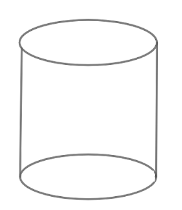
Now, we know that the lateral surface area of a cylinder is defined as the area of its curved surface after excluding the area of its top and bottom circular surface.
So, if we consider the circumference of the circular base of a cylinder equal to $2\pi r$ where r= radius, then the length of the rectangular sheet for a cylinder is equal to the circumference of the circular base, and breadth is considered as the height of the rectangular sheet.
So, we have lateral surface area $=\text{circumference of the circular base }\times \text{h}$
$\begin{align}
& \Rightarrow 2\pi r\times h \\
& \Rightarrow 2\pi rh \\
\end{align}$
So, we get the formula of lateral surface area of cylinder is $2\pi rh$.
Option A is the correct answer.
Note:
As the options given are quite similar so be careful while choosing the options. The best way is to eliminate the wrong options one by one and choose the correct one. As we know that lateral surface area includes height so we can eliminate options B and option C.
Complete step by step answer:
We have to find the formula of the lateral surface area of the cylinder.
We know that a cylinder is a solid shape having two circular parallel bases joined by a curved surface at a particular distance. A cylinder consists of two surfaces one is a curved surface and the other is a circular base.
Now, we know that the lateral surface area of a cylinder is defined as the area of its curved surface after excluding the area of its top and bottom circular surface.
So, if we consider the circumference of the circular base of a cylinder equal to $2\pi r$ where r= radius, then the length of the rectangular sheet for a cylinder is equal to the circumference of the circular base, and breadth is considered as the height of the rectangular sheet.
So, we have lateral surface area $=\text{circumference of the circular base }\times \text{h}$
$\begin{align}
& \Rightarrow 2\pi r\times h \\
& \Rightarrow 2\pi rh \\
\end{align}$
So, we get the formula of lateral surface area of cylinder is $2\pi rh$.
Option A is the correct answer.
Note:
As the options given are quite similar so be careful while choosing the options. The best way is to eliminate the wrong options one by one and choose the correct one. As we know that lateral surface area includes height so we can eliminate options B and option C.
Recently Updated Pages
Master Class 11 English: Engaging Questions & Answers for Success

Master Class 11 Social Science: Engaging Questions & Answers for Success
Master Class 11 Maths: Engaging Questions & Answers for Success
Master Class 11 Biology: Engaging Questions & Answers for Success
Master Class 11 Physics: Engaging Questions & Answers for Success
Master Class 11 Chemistry: Engaging Questions & Answers for Success
Trending doubts
Explain the Treaty of Vienna of 1815 class 10 social science CBSE
What is the full form of CNG A Complete Natural Gas class 10 social science CBSE
In cricket, what is a "Yorker" designed to do?
What is the full form of POSCO class 10 social science CBSE
Define Potential, Developed, Stock and Reserved resources
What were the majoritarian measures taken in Sri Lanka class 10 social science CBSE