




The force responsible for raising water in 100 ft tall plant
A. Transpiration pull
B. Root pressure
C. Air pressure
D. Capillary action
Answer
 Verified
637.8k+ views
Hint: The rate of water transport through xylem vessels is 15 meter per hour. The negative pressure that causes water movement in an upward direction from the lower part to the upper part of the plant is called transpiration pull.
This is caused due to the loss of water from cells of leaves in form of vapor, through stomatal openings.
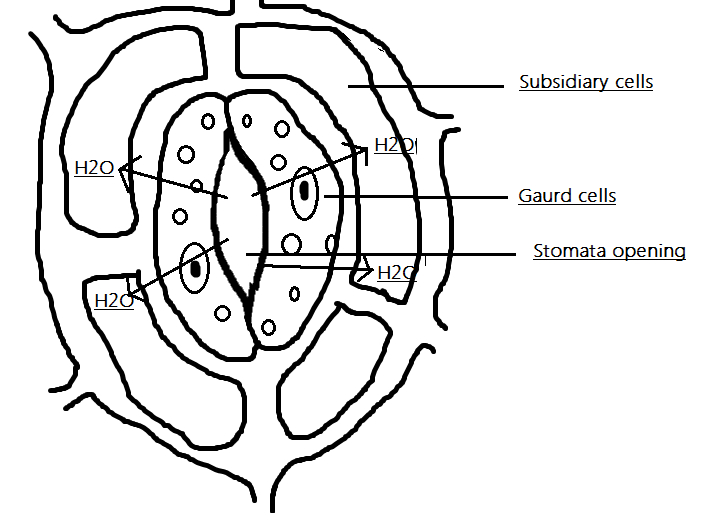
Complete answer:The transpiration pull is responsible to raise water upside through xylem vessels.
1. This concept was given by scientist Dixon and Jolly. This concept is known as the transpiration pull or cohesion tension theory.
2. In plants the leaves lose water from the surface in the form of vapor, this process is called transpiration. Due to this loss of water, the DPD of mesophyll cells is increased and these cells absorb water from their nearby cells.
3. These nearby cells absorb water from veins.
4. In this way, tension or negative pressure is generated in xylem vessels, called transpiration pull. This negative force is possible due to the cohesion force between water molecules.
5. Ultimately, water is pulled or raised upward in xylem vessels.
6. The value of this pressure in xylem vessels is around 45 atm. This is enough to pull water upside even in the plants that have a height of up to 100 ft.
Additional information: Root pressure is caused due to the absorption of minerals and water from the soil.
Root pressure can only raise water up to 60 ft, so it is only important in plants with small height.
Capillary action and atmospheric pressure can only raise water up to 10 meters.
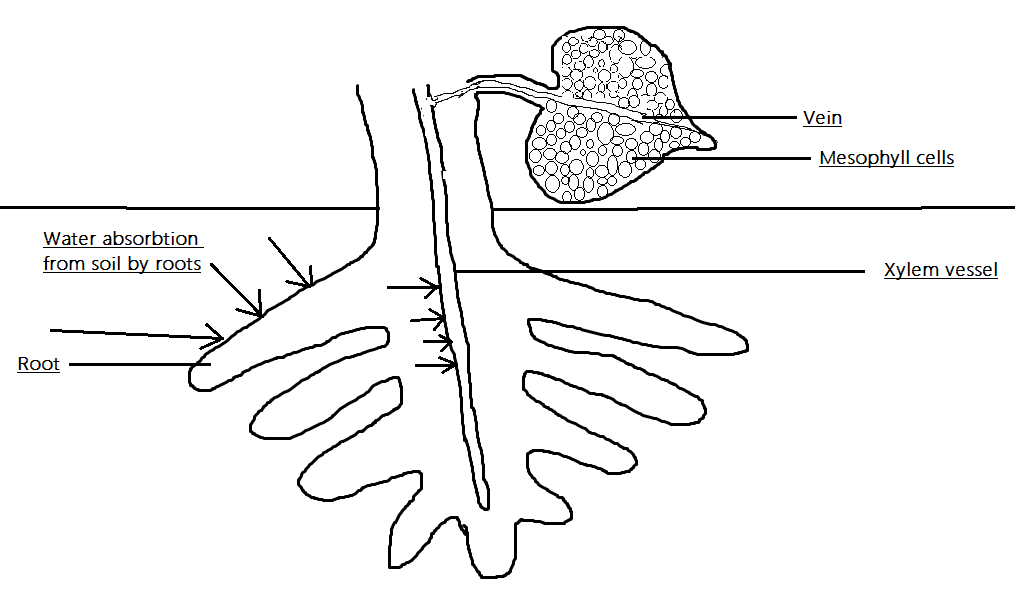
So the correct answer is A. Transpiration pull
Note: Rate of transpiration is always proportional to the ascent of sap.
The ascent of sap is meant by moving water upward in plants. Transpiration pull is a physical force and osmosis has no role in it.
Water moves according to the mass flow in the xylem.
The rate of transpiration is affected by humidity, temp, light, and airflow.
This is caused due to the loss of water from cells of leaves in form of vapor, through stomatal openings.
Complete answer:The transpiration pull is responsible to raise water upside through xylem vessels.
1. This concept was given by scientist Dixon and Jolly. This concept is known as the transpiration pull or cohesion tension theory.
2. In plants the leaves lose water from the surface in the form of vapor, this process is called transpiration. Due to this loss of water, the DPD of mesophyll cells is increased and these cells absorb water from their nearby cells.
3. These nearby cells absorb water from veins.
4. In this way, tension or negative pressure is generated in xylem vessels, called transpiration pull. This negative force is possible due to the cohesion force between water molecules.
5. Ultimately, water is pulled or raised upward in xylem vessels.
6. The value of this pressure in xylem vessels is around 45 atm. This is enough to pull water upside even in the plants that have a height of up to 100 ft.
Additional information: Root pressure is caused due to the absorption of minerals and water from the soil.
Root pressure can only raise water up to 60 ft, so it is only important in plants with small height.
Capillary action and atmospheric pressure can only raise water up to 10 meters.
So the correct answer is A. Transpiration pull
Note: Rate of transpiration is always proportional to the ascent of sap.
The ascent of sap is meant by moving water upward in plants. Transpiration pull is a physical force and osmosis has no role in it.
Water moves according to the mass flow in the xylem.
The rate of transpiration is affected by humidity, temp, light, and airflow.
Recently Updated Pages
Basicity of sulphurous acid and sulphuric acid are

Master Class 12 Economics: Engaging Questions & Answers for Success
Master Class 12 Biology: Engaging Questions & Answers for Success
Master Class 11 English: Engaging Questions & Answers for Success
Master Class 11 Physics: Engaging Questions & Answers for Success
Master Class 11 Computer Science: Engaging Questions & Answers for Success
Trending doubts
Which are the Top 10 Largest Countries of the World?
Differentiate between homogeneous and heterogeneous class 12 chemistry CBSE
Give 10 examples of unisexual and bisexual flowers
Draw the diagram of the chloroplast class 12 biology CBSE
Lipids are insoluble in water because they are A Neutral class 12 biology CBSE
Decomposer also called as ATransducers BReducers CMicroconsumer class 12 biology CBSE