




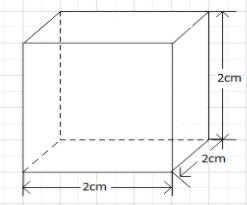
The force needed to punch a hole in a shape of square of edge length 2cm in a steel sheet 2mm thick is , ( Given: \[\text{Shearing stress}=3.5\times {{10}^{8}}N/{{m}^{2}}\])
\[\begin{align}
& \text{A}\text{. 5}\text{.6}\times {{10}^{3}}N \\
& \text{B}\text{. 6}\text{.2}\times {{10}^{4}}N \\
& \text{C}\text{. 5}\text{.6}\times {{10}^{4}}N \\
& \text{D}\text{. 7}\text{.6}\times {{10}^{4}}N \\
\end{align}\]
Answer
 Verified
585.3k+ views
Hint: We have given the shearing stress and asked the force needed to punch a hole, the shearing stress is given as the ratio of force and the cross sectional area. With the help of shearing stress formulas we can find the force required. Before substituting the values the quantity should be changed in metre as the length is in cm and sheet thickness is in mm.
Formula used:
\[\tau =\dfrac{F}{A}\]
Complete answer:
Shear stress is the force applied along the plane or parallel to the plane such that it deforms the shape of the object. The shearing stress is given as
\[\tau =\dfrac{F}{A}\]
Where F is force and A is the cross sectional area on which force is applied.
Cross-sectional area is the 2-D area we get after slicing or cutting a 3-D object, it can be sliced in any way either perpendicular to its axis or parallel. Here cross sectional area can be given as
\[A=4l\times t\]
4l is the perimeter of the cube, l is the edge length and t is the thickness of the steel sheet.
Now the force required here is given as
\[\begin{align}
& F=\tau A \\
& F=\tau (4lt) \\
& F=4\tau lt \\
\end{align}\]
Given values are\[\tau =3.5\times {{10}^{8}}N/{{m}^{2}},\text{ }l=2cm=2\times {{10}^{-2}}m,\text{ }t=2mm=2\times {{10}^{-3}}m\]. Substituting the values in the above equation, we get
\[\begin{align}
& F=4\times 3.5\times {{10}^{8}}\times 2\times {{10}^{-2}}m\times 2\times {{10}^{-3}} \\
& F=56\times {{10}^{3}}N \\
& F=5.6\times {{10}^{-4}}N \\
\end{align}\]
Hence the correct option is C.
Note:
It is given that the hole is in the shape of a square, if it was given just hole with a diameter then we have the cross-sectional area will be changed. Generally, the hole is considered as a cylindrical shape then the cross-sectional is the product of area of circumference and the height of the cylinder or the thickness of the sheet.
Formula used:
\[\tau =\dfrac{F}{A}\]
Complete answer:
Shear stress is the force applied along the plane or parallel to the plane such that it deforms the shape of the object. The shearing stress is given as
\[\tau =\dfrac{F}{A}\]
Where F is force and A is the cross sectional area on which force is applied.
Cross-sectional area is the 2-D area we get after slicing or cutting a 3-D object, it can be sliced in any way either perpendicular to its axis or parallel. Here cross sectional area can be given as
\[A=4l\times t\]
4l is the perimeter of the cube, l is the edge length and t is the thickness of the steel sheet.
Now the force required here is given as
\[\begin{align}
& F=\tau A \\
& F=\tau (4lt) \\
& F=4\tau lt \\
\end{align}\]
Given values are\[\tau =3.5\times {{10}^{8}}N/{{m}^{2}},\text{ }l=2cm=2\times {{10}^{-2}}m,\text{ }t=2mm=2\times {{10}^{-3}}m\]. Substituting the values in the above equation, we get
\[\begin{align}
& F=4\times 3.5\times {{10}^{8}}\times 2\times {{10}^{-2}}m\times 2\times {{10}^{-3}} \\
& F=56\times {{10}^{3}}N \\
& F=5.6\times {{10}^{-4}}N \\
\end{align}\]
Hence the correct option is C.
Note:
It is given that the hole is in the shape of a square, if it was given just hole with a diameter then we have the cross-sectional area will be changed. Generally, the hole is considered as a cylindrical shape then the cross-sectional is the product of area of circumference and the height of the cylinder or the thickness of the sheet.
Recently Updated Pages
Master Class 11 Computer Science: Engaging Questions & Answers for Success

Master Class 11 Business Studies: Engaging Questions & Answers for Success
Master Class 11 Economics: Engaging Questions & Answers for Success
Master Class 11 English: Engaging Questions & Answers for Success
Master Class 11 Maths: Engaging Questions & Answers for Success
Master Class 11 Biology: Engaging Questions & Answers for Success
Trending doubts
One Metric ton is equal to kg A 10000 B 1000 C 100 class 11 physics CBSE
There are 720 permutations of the digits 1 2 3 4 5 class 11 maths CBSE
Discuss the various forms of bacteria class 11 biology CBSE
Draw a diagram of a plant cell and label at least eight class 11 biology CBSE
State the laws of reflection of light
Explain zero factorial class 11 maths CBSE