




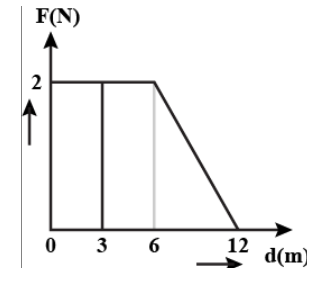
The force F on a particle moving in a straight line varies with distance d as shown in figure. The work done on the particle during its displacement of $12m$ is:
$\begin{align}
& \text{A}\text{. 18J} \\
& \text{B}\text{. 21J} \\
& \text{C}\text{. 26J} \\
& \text{D}\text{. 13J} \\
\end{align}$
Answer
 Verified
584.4k+ views
Hint: The area under force and displacement graph will give the work done during the displacement. The total area is the area of the rectangle of length \[6\] and breadth\[2\], and the area of the right angle triangle of base length $6$and height\[2\]. After finding an area add them to get the work done.
Formulas used:
Area of rectangle of length $l$ and breadth $b$ is $A=lb\text{ sq units}$
Area of right-angled triangle with base length $b$ and height $h$ is $A=\dfrac{1}{2}bh\text{ sq units}$
Complete answer:
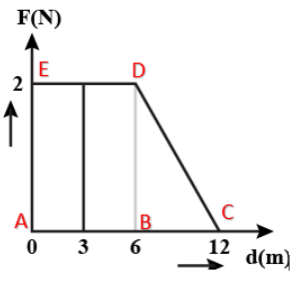
The area under the force and displacement curve will give the work done during the displacement.
So the area under the curve is the sum of area of rectangle $ABDE$ and area of right-angled triangle$BCD$
Area of rectangle $ABDE$ is ${{A}_{1}}=length\times breadth=6\times 2=12=12$
Area of triangle $BCD$is ${{A}_{2}}=\dfrac{1}{2}\times base\times height=\dfrac{1}{2}\times 6\times 2 = 6$
Total area $A={{A}_{1}}+{{A}_{2}}=12+6=18$
So the work done on the particle during its displacement of $12m$ is $18J$
So the correct option is $\text{A}\text{. 18J}$.
Note:
Just like this the graph between position-time, velocity-time, can be plotted and also the equation of motions can be derived from these graphs.
Taking position is taken in y-axis and the time is taken in x-axis then the graph of a stationary object will give a straight line parallel to time axis.
The position-time graph for an object with uniform motion will give a straight line and the slope of the graph will give the velocity of the particle.
The position-time graph for a uniformly accelerated motion is a parabola and the slope of this graph will give the instantaneous velocity at that instant.
If you take time in x-axis and the velocity in y-axis then the graph for a uniform motion will give a straight line parallel to the time axis. The area under the velocity-time curve will give displacement.
The velocity-time graph for a uniformly accelerated motion is a straight line and the slope will give the acceleration and the area under the line will give the displacement.
Formulas used:
Area of rectangle of length $l$ and breadth $b$ is $A=lb\text{ sq units}$
Area of right-angled triangle with base length $b$ and height $h$ is $A=\dfrac{1}{2}bh\text{ sq units}$
Complete answer:
The area under the force and displacement curve will give the work done during the displacement.
So the area under the curve is the sum of area of rectangle $ABDE$ and area of right-angled triangle$BCD$
Area of rectangle $ABDE$ is ${{A}_{1}}=length\times breadth=6\times 2=12=12$
Area of triangle $BCD$is ${{A}_{2}}=\dfrac{1}{2}\times base\times height=\dfrac{1}{2}\times 6\times 2 = 6$
Total area $A={{A}_{1}}+{{A}_{2}}=12+6=18$
So the work done on the particle during its displacement of $12m$ is $18J$
So the correct option is $\text{A}\text{. 18J}$.
Note:
Just like this the graph between position-time, velocity-time, can be plotted and also the equation of motions can be derived from these graphs.
Taking position is taken in y-axis and the time is taken in x-axis then the graph of a stationary object will give a straight line parallel to time axis.
The position-time graph for an object with uniform motion will give a straight line and the slope of the graph will give the velocity of the particle.
The position-time graph for a uniformly accelerated motion is a parabola and the slope of this graph will give the instantaneous velocity at that instant.
If you take time in x-axis and the velocity in y-axis then the graph for a uniform motion will give a straight line parallel to the time axis. The area under the velocity-time curve will give displacement.
The velocity-time graph for a uniformly accelerated motion is a straight line and the slope will give the acceleration and the area under the line will give the displacement.
Recently Updated Pages
Master Class 11 Computer Science: Engaging Questions & Answers for Success

Master Class 11 Business Studies: Engaging Questions & Answers for Success
Master Class 11 Economics: Engaging Questions & Answers for Success
Master Class 11 English: Engaging Questions & Answers for Success
Master Class 11 Maths: Engaging Questions & Answers for Success
Master Class 11 Biology: Engaging Questions & Answers for Success
Trending doubts
There are 720 permutations of the digits 1 2 3 4 5 class 11 maths CBSE
Discuss the various forms of bacteria class 11 biology CBSE
Explain zero factorial class 11 maths CBSE
What organs are located on the left side of your body class 11 biology CBSE
Draw a diagram of nephron and explain its structur class 11 biology CBSE
How do I convert ms to kmh Give an example class 11 physics CBSE