




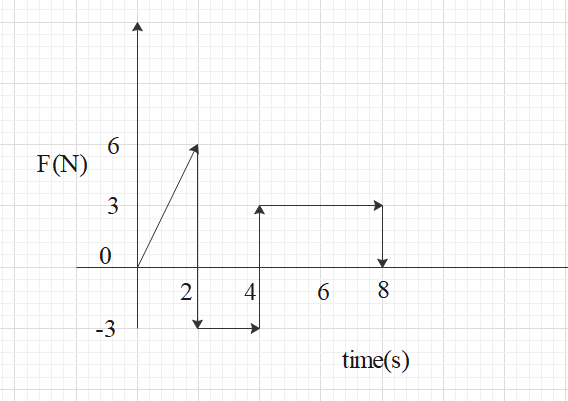
The force F acting on a particle of mass m is indicated by the force-time graph shown below. The change in momentum of the particle over time interval from zero to 8 s is
A.)24 Ns
B.)20 Ns
C.)12 Ns
D.)6 Ns
Answer
 Verified
635.7k+ views
Hint: try to understand the graph given in the question and see what details it can give us. We have a force-time graph where we have the change of force with time. We need to find the change in momentum. For it we need to multiply the force with the time interval. From the graph we can find this value by finding the area under the curve.
Complete step by step answer:
A particle of mass m is subjected to a force F. change in force with time is given by the graph in the question.
change in momentum of the particle is given by the area under the curve.
Change in momentum is equal to
$\begin{align}
& =\dfrac{1}{2}\times 2\times 6+\left( -3 \right)\times 2+3\times 4 \\
& =6-6+12 \\
& =12 \\
\end{align}$
So, the change in momentum of the particle is 12 Ns
The correct option is (C).
Additional information:
Force can be defined as the action that is needed to make a body at rest to move or accelerate a body. Mathematically force can be expressed as the product of mass of the body on which the force is applied and the acceleration of the body. The unit of force is Newton. Dimension of force is given as, $\left[ {{M}^{1}}{{L}^{1}}{{T}^{-2}} \right]$
Linear momentum of an object can be defined as the product of the mass and linear velocity of the body. The unit of linear momentum is $kgm{{s}^{-1}}$. Dimension of linear momentum is given as, $\left[ {{M}^{1}}{{L}^{1}}{{T}^{-1}} \right]$
Note: impulse can be defined as the integral of force over the time interval for which the force is acting on the body. It is equal to the change in momentum of the body. In the above question if we are asked to calculate the impulse on the object, we need to follow the same procedure as above.
Complete step by step answer:
A particle of mass m is subjected to a force F. change in force with time is given by the graph in the question.
change in momentum of the particle is given by the area under the curve.
Change in momentum is equal to
$\begin{align}
& =\dfrac{1}{2}\times 2\times 6+\left( -3 \right)\times 2+3\times 4 \\
& =6-6+12 \\
& =12 \\
\end{align}$
So, the change in momentum of the particle is 12 Ns
The correct option is (C).
Additional information:
Force can be defined as the action that is needed to make a body at rest to move or accelerate a body. Mathematically force can be expressed as the product of mass of the body on which the force is applied and the acceleration of the body. The unit of force is Newton. Dimension of force is given as, $\left[ {{M}^{1}}{{L}^{1}}{{T}^{-2}} \right]$
Linear momentum of an object can be defined as the product of the mass and linear velocity of the body. The unit of linear momentum is $kgm{{s}^{-1}}$. Dimension of linear momentum is given as, $\left[ {{M}^{1}}{{L}^{1}}{{T}^{-1}} \right]$
Note: impulse can be defined as the integral of force over the time interval for which the force is acting on the body. It is equal to the change in momentum of the body. In the above question if we are asked to calculate the impulse on the object, we need to follow the same procedure as above.
Recently Updated Pages
Master Class 12 Economics: Engaging Questions & Answers for Success

Master Class 12 English: Engaging Questions & Answers for Success
Master Class 12 Social Science: Engaging Questions & Answers for Success
Master Class 12 Maths: Engaging Questions & Answers for Success
Master Class 12 Physics: Engaging Questions & Answers for Success
Master Class 9 General Knowledge: Engaging Questions & Answers for Success
Trending doubts
One Metric ton is equal to kg A 10000 B 1000 C 100 class 11 physics CBSE
Difference Between Prokaryotic Cells and Eukaryotic Cells
Two of the body parts which do not appear in MRI are class 11 biology CBSE
Find the value of the expression given below sin 30circ class 11 maths CBSE
1 ton equals to A 100 kg B 1000 kg C 10 kg D 10000 class 11 physics CBSE
Draw a diagram of nephron and explain its structur class 11 biology CBSE