




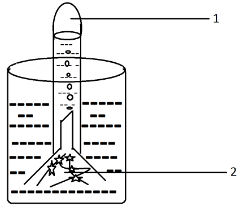
The following diagram demonstrates a physiological process taking place in green plants. The whole setup was placed in the bright sunlight for several hours. Study the diagram and answer the question that follow; what aspect of physiological process is being examined?
Answer
 Verified
568.2k+ views
Hint: The life sustaining process in which the organs, cells and tissues work together to accomplish the goal of life sustainability. Photosynthesis is also a physiological process which consumes carbon dioxide, water, light and minerals to produce oxygen and glucose.
Complete step-by-step answer:The process or the ways in which the organs, tissues, bio molecules and cell work together to accomplish the difficult goal of sustaining life are known as physiological process. Small physiological mechanisms combine together to make a large physiological process.
In the above given diagram it shows that oxygen is released during photosynthesis process.
Photosynthesis process: It is a certain process in which green plants and organisms convert light energy into chemical energy. The inputs of the photosynthesis process are carbon dioxide, water, minerals, chlorophyll and light. All these components come together to form oxygen and organic rich compounds.
In this problem the physiological process is photosynthesis.
The chemical reaction involved in the photosynthesis is as follows:
${\text{6C}}{{\text{O}}_{\text{2}}}{\text{ + 12}}{{\text{H}}_{\text{2}}}{\text{O}}\xrightarrow[{{\text{chlorophyll}}}]{{{\text{sunlight}}}}{{\text{C}}_{\text{6}}}{{\text{H}}_{{\text{12}}}}{{\text{O}}_{\text{6}}}{\text{ + 6}}{{\text{O}}_{\text{2}}} \uparrow {\text{ + 6}}{{\text{H}}_{\text{2}}}{\text{O}}$
Carbon dioxide and water reacts in presence of sunlight and chlorophyll to form oxygen, water molecules and glucose.
The complete diagram is as follows:
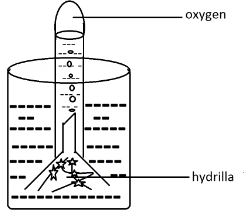
As we can see in the diagram (1) represents the oxygen gas and (2) represents the hydrilla twigs.
Note: In this whole experimental setup sodium bicarbonate plays an important role. If we add sodium bicarbonate in it the carbon dioxide release rate will increase and it will also help to increase the photosynthesis rate and hence the oxygen production rate will be automatically increased.
Complete step-by-step answer:The process or the ways in which the organs, tissues, bio molecules and cell work together to accomplish the difficult goal of sustaining life are known as physiological process. Small physiological mechanisms combine together to make a large physiological process.
In the above given diagram it shows that oxygen is released during photosynthesis process.
Photosynthesis process: It is a certain process in which green plants and organisms convert light energy into chemical energy. The inputs of the photosynthesis process are carbon dioxide, water, minerals, chlorophyll and light. All these components come together to form oxygen and organic rich compounds.
In this problem the physiological process is photosynthesis.
The chemical reaction involved in the photosynthesis is as follows:
${\text{6C}}{{\text{O}}_{\text{2}}}{\text{ + 12}}{{\text{H}}_{\text{2}}}{\text{O}}\xrightarrow[{{\text{chlorophyll}}}]{{{\text{sunlight}}}}{{\text{C}}_{\text{6}}}{{\text{H}}_{{\text{12}}}}{{\text{O}}_{\text{6}}}{\text{ + 6}}{{\text{O}}_{\text{2}}} \uparrow {\text{ + 6}}{{\text{H}}_{\text{2}}}{\text{O}}$
Carbon dioxide and water reacts in presence of sunlight and chlorophyll to form oxygen, water molecules and glucose.
The complete diagram is as follows:
As we can see in the diagram (1) represents the oxygen gas and (2) represents the hydrilla twigs.
Note: In this whole experimental setup sodium bicarbonate plays an important role. If we add sodium bicarbonate in it the carbon dioxide release rate will increase and it will also help to increase the photosynthesis rate and hence the oxygen production rate will be automatically increased.
Recently Updated Pages
Master Class 11 Social Science: Engaging Questions & Answers for Success

Master Class 11 English: Engaging Questions & Answers for Success
Master Class 11 Maths: Engaging Questions & Answers for Success
Master Class 11 Chemistry: Engaging Questions & Answers for Success
Master Class 11 Biology: Engaging Questions & Answers for Success
Master Class 11 Physics: Engaging Questions & Answers for Success
Trending doubts
One Metric ton is equal to kg A 10000 B 1000 C 100 class 11 physics CBSE
Difference Between Prokaryotic Cells and Eukaryotic Cells
Draw a diagram of a plant cell and label at least eight class 11 biology CBSE
Two of the body parts which do not appear in MRI are class 11 biology CBSE
Which gas is abundant in air class 11 chemistry CBSE
10 examples of friction in our daily life