




The focus of an ellipse is at the origin. The directrix is the line \[x=4\] and its eccentricity is \[\dfrac{1}{2}\] then length of its semi major axis is
(a) \[\dfrac{2}{3}\]
(b) \[\dfrac{4}{3}\]
(c) \[\dfrac{5}{3}\]
(d) \[\dfrac{8}{3}\]
Answer
 Verified
608.4k+ views
Hint: We solve this problem by using the conditions for the standard ellipse.
The general representation of standard equation of ellipse having centre at origin is
\[\dfrac{{{x}^{2}}}{{{a}^{2}}}+\dfrac{{{y}^{2}}}{{{b}^{2}}}=1\]
For this standard equation of an ellipse, we have the conditions that
(1) Focus is at \[\left( ae,0 \right)\]
(2) Distance between entre and directrix is \[\dfrac{a}{e}\]
We have the formula of distance of point \[\left( h,k \right)\] to the line \[ax+by+c=0\] is given as
\[d=\dfrac{\left| ah+bk+c \right|}{\sqrt{{{a}^{2}}+{{b}^{2}}}}\]
We convert the given ellipse to standard equation by using the transformation of axes so that we can solve the required value.
Complete step by step answer:
We are given that the focus is at the origin.
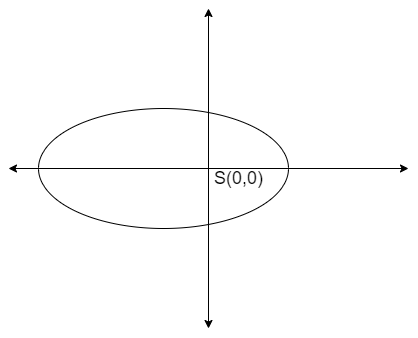
Let us assume that the focus as \[S\left( 0,0 \right)\]
We are given that the equation of directrix as \[x=4\]
We know that if the directrix is parallel to Y-axis then the co – ordinate axes are the axes of the ellipse.
Let us take the rough figure of the given ellipse as follows
We know that the focus for the standard equation of ellipse \[\dfrac{{{x}^{2}}}{{{a}^{2}}}+\dfrac{{{y}^{2}}}{{{b}^{2}}}=1\] is at \[\left( ae,0 \right)\]
Now, let us use the transformation of axes that is let us transform the given ellipse such that the focus becomes \[\left( ae,0 \right)\]
Now, let us take the equation of ellipse according to transformation of axes as \[\dfrac{{{X}^{2}}}{{{a}^{2}}}+\dfrac{{{Y}^{2}}}{{{b}^{2}}}=1\]
Here, we can see that we increased the X co – ordinate by \[ae\] to get the new equation
By converting the above equation to mathematical equation then we get
\[\begin{align}
& \Rightarrow x+ae=X \\
& \Rightarrow x=X-ae \\
\end{align}\]
We are given that the equation of directrix as \[x=4\] for old ellipse
By converting the above equation to new form of ellipse then we get
\[\begin{align}
& \Rightarrow X-ae=4 \\
& \Rightarrow X=4+ae \\
\end{align}\]
Now, let us find the distance between focus and directrix of the new equation
Let us assume that the distance between centre and directrix as \[d\]
We know that the formula of distance of point \[\left( h,k \right)\] to the line \[ax+by+c=0\] is given as
\[d=\dfrac{\left| ah+bk+c \right|}{\sqrt{{{a}^{2}}+{{b}^{2}}}}\]
By using the above formula we get the distance between centre \[\left( 0,0 \right)\] and directrix of the new ellipse as
\[\begin{align}
& \Rightarrow d=\dfrac{\left| 0-\left( 4+ae \right) \right|}{\sqrt{{{1}^{2}}+{{0}^{2}}}} \\
& \Rightarrow d=4+ae............equation(i) \\
\end{align}\]
We know that the distance between the centre of ellipse and directrix is \[\dfrac{a}{e}\]
By substituting the above value in equation (i) we get
\[\Rightarrow \dfrac{a}{e}=4+ae\]
We are given that the eccentricity of ellipse as \[e=\dfrac{1}{2}\]
By substituting the required values in above equation then we get
\[\begin{align}
& \Rightarrow \dfrac{a}{\left( \dfrac{1}{2} \right)}=4+a\left( \dfrac{1}{2} \right) \\
& \Rightarrow 2a-\dfrac{a}{2}=4 \\
& \Rightarrow \dfrac{3a}{2}=4 \\
& \Rightarrow a=\dfrac{8}{3} \\
\end{align}\]
Therefore, we can conclude that the length of semi major axis is \[\dfrac{8}{3}\]
So, option (d) is correct answer.
Note:
We need to note that when we use the axes transformation for a point then, the equation of directrix also need to be transformed with respect to the transformation.
Here, we are given that the equation of directrix as
\[x=4\]
When we transformed the focus from origin to \[\left( ae,0 \right)\] then the directrix changes to
\[\Rightarrow X=4+ae\]
But some students do not transform the equation of directrix.
The general representation of standard equation of ellipse having centre at origin is
\[\dfrac{{{x}^{2}}}{{{a}^{2}}}+\dfrac{{{y}^{2}}}{{{b}^{2}}}=1\]
For this standard equation of an ellipse, we have the conditions that
(1) Focus is at \[\left( ae,0 \right)\]
(2) Distance between entre and directrix is \[\dfrac{a}{e}\]
We have the formula of distance of point \[\left( h,k \right)\] to the line \[ax+by+c=0\] is given as
\[d=\dfrac{\left| ah+bk+c \right|}{\sqrt{{{a}^{2}}+{{b}^{2}}}}\]
We convert the given ellipse to standard equation by using the transformation of axes so that we can solve the required value.
Complete step by step answer:
We are given that the focus is at the origin.
Let us assume that the focus as \[S\left( 0,0 \right)\]
We are given that the equation of directrix as \[x=4\]
We know that if the directrix is parallel to Y-axis then the co – ordinate axes are the axes of the ellipse.
Let us take the rough figure of the given ellipse as follows
We know that the focus for the standard equation of ellipse \[\dfrac{{{x}^{2}}}{{{a}^{2}}}+\dfrac{{{y}^{2}}}{{{b}^{2}}}=1\] is at \[\left( ae,0 \right)\]
Now, let us use the transformation of axes that is let us transform the given ellipse such that the focus becomes \[\left( ae,0 \right)\]
Now, let us take the equation of ellipse according to transformation of axes as \[\dfrac{{{X}^{2}}}{{{a}^{2}}}+\dfrac{{{Y}^{2}}}{{{b}^{2}}}=1\]
Here, we can see that we increased the X co – ordinate by \[ae\] to get the new equation
By converting the above equation to mathematical equation then we get
\[\begin{align}
& \Rightarrow x+ae=X \\
& \Rightarrow x=X-ae \\
\end{align}\]
We are given that the equation of directrix as \[x=4\] for old ellipse
By converting the above equation to new form of ellipse then we get
\[\begin{align}
& \Rightarrow X-ae=4 \\
& \Rightarrow X=4+ae \\
\end{align}\]
Now, let us find the distance between focus and directrix of the new equation
Let us assume that the distance between centre and directrix as \[d\]
We know that the formula of distance of point \[\left( h,k \right)\] to the line \[ax+by+c=0\] is given as
\[d=\dfrac{\left| ah+bk+c \right|}{\sqrt{{{a}^{2}}+{{b}^{2}}}}\]
By using the above formula we get the distance between centre \[\left( 0,0 \right)\] and directrix of the new ellipse as
\[\begin{align}
& \Rightarrow d=\dfrac{\left| 0-\left( 4+ae \right) \right|}{\sqrt{{{1}^{2}}+{{0}^{2}}}} \\
& \Rightarrow d=4+ae............equation(i) \\
\end{align}\]
We know that the distance between the centre of ellipse and directrix is \[\dfrac{a}{e}\]
By substituting the above value in equation (i) we get
\[\Rightarrow \dfrac{a}{e}=4+ae\]
We are given that the eccentricity of ellipse as \[e=\dfrac{1}{2}\]
By substituting the required values in above equation then we get
\[\begin{align}
& \Rightarrow \dfrac{a}{\left( \dfrac{1}{2} \right)}=4+a\left( \dfrac{1}{2} \right) \\
& \Rightarrow 2a-\dfrac{a}{2}=4 \\
& \Rightarrow \dfrac{3a}{2}=4 \\
& \Rightarrow a=\dfrac{8}{3} \\
\end{align}\]
Therefore, we can conclude that the length of semi major axis is \[\dfrac{8}{3}\]
So, option (d) is correct answer.
Note:
We need to note that when we use the axes transformation for a point then, the equation of directrix also need to be transformed with respect to the transformation.
Here, we are given that the equation of directrix as
\[x=4\]
When we transformed the focus from origin to \[\left( ae,0 \right)\] then the directrix changes to
\[\Rightarrow X=4+ae\]
But some students do not transform the equation of directrix.
Recently Updated Pages
Master Class 11 English: Engaging Questions & Answers for Success

Master Class 11 Social Science: Engaging Questions & Answers for Success
Master Class 11 Maths: Engaging Questions & Answers for Success
Master Class 11 Biology: Engaging Questions & Answers for Success
Master Class 11 Physics: Engaging Questions & Answers for Success
Master Class 11 Chemistry: Engaging Questions & Answers for Success
Trending doubts
Explain the Treaty of Vienna of 1815 class 10 social science CBSE
What is the Total Duration of Football Match?
The shortest day of the year in India
In which year voting age was reduced from 21 to 18?
10 examples of evaporation in daily life with explanations
What planets have no moons Which one has only one moon class 10 physics CBSE