




The focal length of a plane mirror is ______
A. Positive
B. Negative
C. Zero
D. Infinite
Answer
 Verified
642.9k+ views
Hint: Study about both plane and spherical mirrors. Study about the reflection laws. Learn the mirror equation and try to get the focal length of the plane mirror using the equation.
Formula used:
$\dfrac{1}{f}=\dfrac{1}{u}+\dfrac{1}{v}$
Complete Step-by-Step solution:
A mirror is a reflecting surface that can reflect light. A plane mirror can be defined as a mirror with infinite radius of curvature.
Consider a spherical mirror. If we keep on increasing the radius of curvature of the spherical mirror the curvature of the mirror will decrease. If we get the infinite radius of curvature, we will get a plane mirror.
Now, the radius of curvature of a plane mirror is infinite. We can define focal length as the half of the radius of curvature. Then if the radius of curvature is infinite then the focal length will also be infinite.
We can get this by using the mirror equation for plane mirrors.
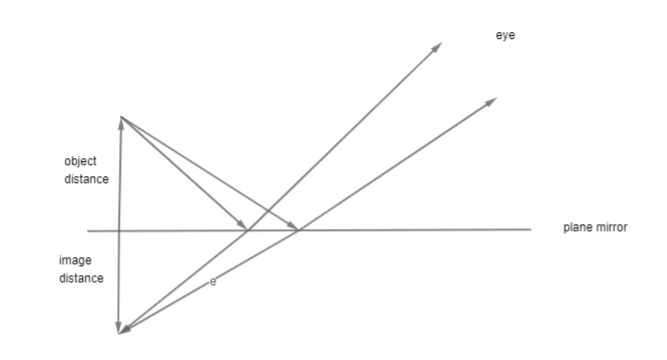
Here, light rays from the object reflected in the plane mirror and went to the observer's eye. For the observer it seems to come from behind the mirror and he sees the image formed. All of this follows the laws of reflection.
For a plane mirror,
\[\begin{align}
& Object\text{ }distance\text{ }=\text{ - }Image\text{ }distance \\
& u=-v \\
\end{align}\]
Using this in the mirror equation,
$\begin{align}
& \dfrac{1}{f}=\dfrac{1}{u}+\dfrac{1}{v} \\
& \dfrac{1}{f}=\dfrac{1}{-v}+\dfrac{1}{v} \\
& \dfrac{1}{f}=0 \\
& f=\dfrac{1}{0} \\
& f=\infty \\
\end{align}$
So, the focal length of the plane mirror is infinite.
Note: The laws of reflection are the same for both plane mirrors and the spherical mirror. For spherical mirrors we get a definite radius of curvature. That’s why we never get infinite focal length in case of spherical mirrors.
Formula used:
$\dfrac{1}{f}=\dfrac{1}{u}+\dfrac{1}{v}$
Complete Step-by-Step solution:
A mirror is a reflecting surface that can reflect light. A plane mirror can be defined as a mirror with infinite radius of curvature.
Consider a spherical mirror. If we keep on increasing the radius of curvature of the spherical mirror the curvature of the mirror will decrease. If we get the infinite radius of curvature, we will get a plane mirror.
Now, the radius of curvature of a plane mirror is infinite. We can define focal length as the half of the radius of curvature. Then if the radius of curvature is infinite then the focal length will also be infinite.
We can get this by using the mirror equation for plane mirrors.
Here, light rays from the object reflected in the plane mirror and went to the observer's eye. For the observer it seems to come from behind the mirror and he sees the image formed. All of this follows the laws of reflection.
For a plane mirror,
\[\begin{align}
& Object\text{ }distance\text{ }=\text{ - }Image\text{ }distance \\
& u=-v \\
\end{align}\]
Using this in the mirror equation,
$\begin{align}
& \dfrac{1}{f}=\dfrac{1}{u}+\dfrac{1}{v} \\
& \dfrac{1}{f}=\dfrac{1}{-v}+\dfrac{1}{v} \\
& \dfrac{1}{f}=0 \\
& f=\dfrac{1}{0} \\
& f=\infty \\
\end{align}$
So, the focal length of the plane mirror is infinite.
Note: The laws of reflection are the same for both plane mirrors and the spherical mirror. For spherical mirrors we get a definite radius of curvature. That’s why we never get infinite focal length in case of spherical mirrors.
Recently Updated Pages
Master Class 11 English: Engaging Questions & Answers for Success

Master Class 11 Social Science: Engaging Questions & Answers for Success
Master Class 11 Maths: Engaging Questions & Answers for Success
Master Class 11 Biology: Engaging Questions & Answers for Success
Master Class 11 Physics: Engaging Questions & Answers for Success
Master Class 11 Chemistry: Engaging Questions & Answers for Success
Trending doubts
Explain the Treaty of Vienna of 1815 class 10 social science CBSE
First Cotton Mill of India
In which year voting age was reduced from 21 to 18?
What planets have no moons Which one has only one moon class 10 physics CBSE
What is the full form of POSCO class 10 social science CBSE
10 examples of evaporation in daily life with explanations