




The fluid present in the anterior part of the eye in front of the eye lens is _________.
Answer
 Verified
611.4k+ views
Hint: Human eye is a sophisticated sensory organ capable of capturing visual images, which are then sent to the brain. A human eye can see over 10 million different colours. The human eye is really not a perfect sphere and is composed of two separate structured portions, the cornea, and sclera.
Complete answer: The aqueous humour is a liquid-like clear watery material, but containing a low percentage of protein. It is metabolized from the ciliary body, a lens-supporting structure. The ciliary body, particularly the ciliary body's non-pigmented epithelium, secretes aqueous humour into its posterior chamber. It is naturally produced from the ciliary body, a lens-supporting framework. It lines the eyes anterior and even the posterior chambers. As it supplements the cornea and the lens by supplying nutrients such as amino acids and glucose, it plays an essential part in ensuring the health of the eyes. It is composed of 99.9 percent water and the other 0.1 percent comprises carbohydrates, vitamins, proteins, and other nutrients. The ciliary processes continue to produce aqueous humour and this rate of production must be regulated by an equivalent rate of drainage of aqueous humour. Intraocular pressure can be severely impacted by slight differences in the prevalence of outflow of aqueous humour. The aqueous humour flow diffusion path is first through the posterior chamber, then through narrow space between the posterior iris and the anterior lens to reach the anterior chamber through the pupil.
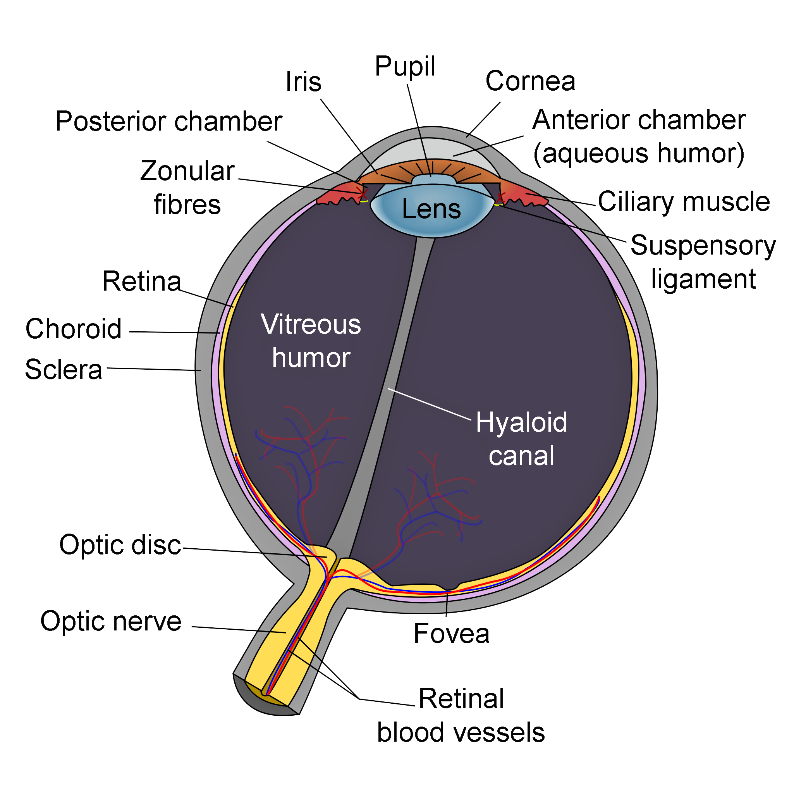
So, the correct answer is Aqueous Humour.
Note: Even small variations in the aqueous humour’s development or leakage are critical because they can have a significant effect on your intraocular pressure. This could lead to glaucoma, a significant cause of vision loss when the intraocular pressure is raised. It is one of the fundamental features of ensuring proper preservation of the optical physics and safety of your retina. Continuous aqueous humour production is crucial to both the shape and size of the eye and the picture quality it gives.
Complete answer: The aqueous humour is a liquid-like clear watery material, but containing a low percentage of protein. It is metabolized from the ciliary body, a lens-supporting structure. The ciliary body, particularly the ciliary body's non-pigmented epithelium, secretes aqueous humour into its posterior chamber. It is naturally produced from the ciliary body, a lens-supporting framework. It lines the eyes anterior and even the posterior chambers. As it supplements the cornea and the lens by supplying nutrients such as amino acids and glucose, it plays an essential part in ensuring the health of the eyes. It is composed of 99.9 percent water and the other 0.1 percent comprises carbohydrates, vitamins, proteins, and other nutrients. The ciliary processes continue to produce aqueous humour and this rate of production must be regulated by an equivalent rate of drainage of aqueous humour. Intraocular pressure can be severely impacted by slight differences in the prevalence of outflow of aqueous humour. The aqueous humour flow diffusion path is first through the posterior chamber, then through narrow space between the posterior iris and the anterior lens to reach the anterior chamber through the pupil.
So, the correct answer is Aqueous Humour.
Note: Even small variations in the aqueous humour’s development or leakage are critical because they can have a significant effect on your intraocular pressure. This could lead to glaucoma, a significant cause of vision loss when the intraocular pressure is raised. It is one of the fundamental features of ensuring proper preservation of the optical physics and safety of your retina. Continuous aqueous humour production is crucial to both the shape and size of the eye and the picture quality it gives.
Recently Updated Pages
Master Class 11 English: Engaging Questions & Answers for Success

Master Class 11 Social Science: Engaging Questions & Answers for Success
Master Class 11 Maths: Engaging Questions & Answers for Success
Master Class 11 Biology: Engaging Questions & Answers for Success
Master Class 11 Physics: Engaging Questions & Answers for Success
Master Class 11 Chemistry: Engaging Questions & Answers for Success
Trending doubts
One Metric ton is equal to kg A 10000 B 1000 C 100 class 11 physics CBSE
Difference Between Prokaryotic Cells and Eukaryotic Cells
Find the value of the expression given below sin 30circ class 11 maths CBSE
Difference between physical and chemical change class 11 chemistry CBSE
Two of the body parts which do not appear in MRI are class 11 biology CBSE
Draw a diagram of a plant cell and label at least eight class 11 biology CBSE