




The fluid part of the blood is known as
Answer
 Verified
629.7k+ views
Hint: The fluid part of the blood is the medium through which 7% of carbon dioxide in dissolved form is transported from the tissues to the lung alveoli. It has several factors known as clotting factors dissolved in it.
Complete answer:
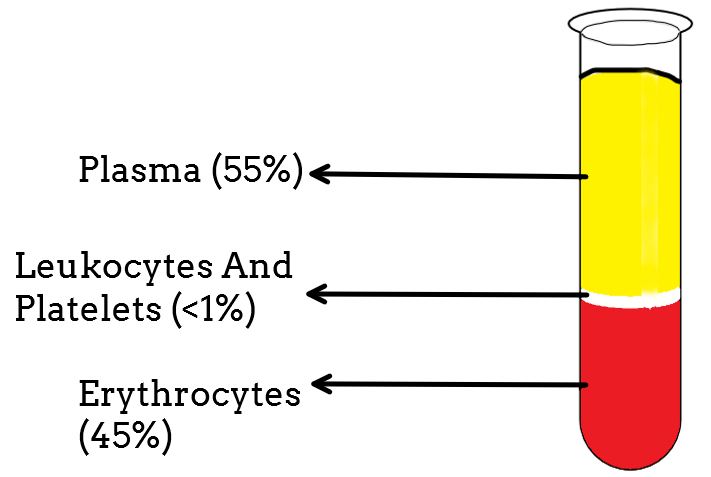
The fluid part of the blood is known as the plasma. It is a moderately viscous fluid, and it constitutes 55-58% of the total blood. Characteristics of the fluid plasma are as follows:
-Straw-colored appearance
-91.5% of it is water.
-8.5% contain dissolved solutes including clotting factors and plasma proteins.
Additional Information:
-Plasma Proteins: This includes globular proteins like albumin, globulin, and fibrinogen. The synthesis of plasma proteins occurs in the hepatocytes or liver cells. The albumin functions as a water-retaining substance. Globulins are antibodies mostly, including the immunoglobulins IgG, IgA, IgM, IgD, and IgE. Fibrinogen is an important factor in clot formation. Prothrombin is another plasma protein that helps in the coagulation of blood. Its main function is the conversion of fibrinogen (insoluble form) to fibrin (soluble form)
-Plasma Inorganic Substances: This includes mineral ions of sodium (Na$^+$), calcium (Ca$^{2+}$), magnesium (Mg$^{2+}$), bicarbonate (${HCO_3}^-$), chloride(Cl$^-$), etc.
-Rest 32-35% of the total blood consists of formed elements. It includes erythrocytes or red blood cells, and leukocytes or white blood cells. The erythrocytes form the major part of formed elements.
-The leukocytes are further classified into granulocytes and agranulocytes which is based on the visibility of certain granules under the microscope.
-Granulocytes are mainly of three types, eosinophils, basophils, and neutrophils. Agranulocytes are of two types, leucocyte, and monocyte.
Note: It should be remembered that the plasma without the clotting factors is known as serum. There are a total of thirteen clotting factors that are known, out of which factor six is no longer considered. The first clotting factor is fibrinogen. It should be noted that these clotting factors are only present in our blood plasma but all of them are synthesized in the liver.
Complete answer:
The fluid part of the blood is known as the plasma. It is a moderately viscous fluid, and it constitutes 55-58% of the total blood. Characteristics of the fluid plasma are as follows:
-Straw-colored appearance
-91.5% of it is water.
-8.5% contain dissolved solutes including clotting factors and plasma proteins.
Additional Information:
-Plasma Proteins: This includes globular proteins like albumin, globulin, and fibrinogen. The synthesis of plasma proteins occurs in the hepatocytes or liver cells. The albumin functions as a water-retaining substance. Globulins are antibodies mostly, including the immunoglobulins IgG, IgA, IgM, IgD, and IgE. Fibrinogen is an important factor in clot formation. Prothrombin is another plasma protein that helps in the coagulation of blood. Its main function is the conversion of fibrinogen (insoluble form) to fibrin (soluble form)
-Plasma Inorganic Substances: This includes mineral ions of sodium (Na$^+$), calcium (Ca$^{2+}$), magnesium (Mg$^{2+}$), bicarbonate (${HCO_3}^-$), chloride(Cl$^-$), etc.
-Rest 32-35% of the total blood consists of formed elements. It includes erythrocytes or red blood cells, and leukocytes or white blood cells. The erythrocytes form the major part of formed elements.
-The leukocytes are further classified into granulocytes and agranulocytes which is based on the visibility of certain granules under the microscope.
-Granulocytes are mainly of three types, eosinophils, basophils, and neutrophils. Agranulocytes are of two types, leucocyte, and monocyte.
Note: It should be remembered that the plasma without the clotting factors is known as serum. There are a total of thirteen clotting factors that are known, out of which factor six is no longer considered. The first clotting factor is fibrinogen. It should be noted that these clotting factors are only present in our blood plasma but all of them are synthesized in the liver.
Recently Updated Pages
Master Class 11 English: Engaging Questions & Answers for Success

Master Class 11 Social Science: Engaging Questions & Answers for Success
Master Class 11 Maths: Engaging Questions & Answers for Success
Master Class 11 Biology: Engaging Questions & Answers for Success
Master Class 11 Physics: Engaging Questions & Answers for Success
Master Class 11 Chemistry: Engaging Questions & Answers for Success
Trending doubts
One Metric ton is equal to kg A 10000 B 1000 C 100 class 11 physics CBSE
Difference Between Prokaryotic Cells and Eukaryotic Cells
Find the value of the expression given below sin 30circ class 11 maths CBSE
Difference between physical and chemical change class 11 chemistry CBSE
Two of the body parts which do not appear in MRI are class 11 biology CBSE
Draw a diagram of a plant cell and label at least eight class 11 biology CBSE