




The five d-orbitals are designated as ${{d}_{xy}},{{d}_{yz}},{{d}_{zx}},{{d}_{{{x}^{2}}-{{y}^{2}}}},{{d}_{{{z}^{2}}}}$ . Choose the correct statement from the given options.
[A] The shape of the first three orbits is similar but that of the fourth and fifth orbitals are different.
[B] The shape of all the five d-orbitals are similar.
[C] The shape of the first four orbitals are similar and that of the fifth orbital is different.
[D] The shapes of all the five d-orbitals are different.
Answer
 Verified
622.5k+ views
Hint: d-orbitals have a double dumbbell shape. The subscripts in the designation of the d-orbitals depict the orientation of the orbitals along the axes. Their shape is often known as clover like.
Complete step by step answer:
We know that the d sublevel has 5 energy orbitals. The maximum number of electrons in one orbital is 2 and thus the 5 orbitals can fit in maximum 10 electrons.
The five d-orbitals are designated as ${{d}_{xy}},{{d}_{yz}},{{d}_{zx}},{{d}_{{{x}^{2}}-{{y}^{2}}}},{{d}_{{{z}^{2}}}}$ depending upon the plane they are lying upon. The d-orbitals have a double dumbbell shape and thus they are named differently depending upon how the double dumbbell is oriented in the axes.
Now, let us discuss their shapes and their orientation-
- The orbital lying in the xy-plane is designated as ${{d}_{xy}}$.
- The orbital lying in the yz-plane is designated as ${{d}_{yz}}$.
- The orbital lying in the xy-plane is designated as ${{d}_{zx}}$.
- The ${{d}_{{{x}^{2}}-{{y}^{2}}}}$ orbital lies on the x-y axes.
- The ${{d}_{{{z}^{2}}}}$ orbital has a single dumbbell shape and it lies along the z-axis. There is a ring of negative charge around it along the xy-plane.
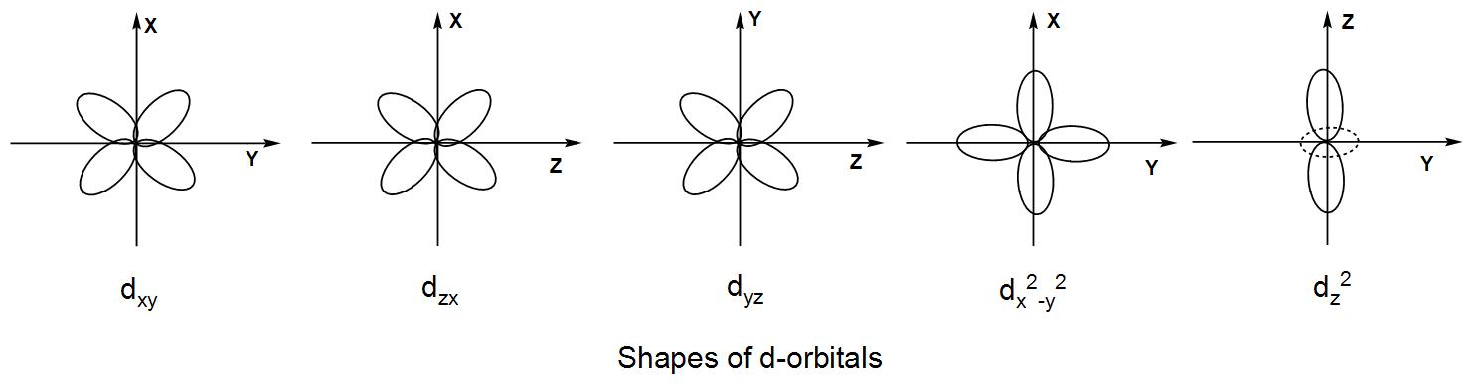
The four d-orbitals have similar double dumbbell shape just in the fourth orbital the structure is oriented along the axes instead of a plane and the fifth orbital has a single dumbbell shape with a ring around it and it is often called a donut shaped orbital.
We can understand from the above discussion that all the orbitals have different orientations but the four d-orbitals have a similar shape and the fifth one has a different shape compared to the others.
So, the correct answer is “Option C”.
Note: The orbitals differ in shape due to having different probabilities of finding electrons around the nucleus. The point where there is no possibility of finding a nucleus is known as a node. In d-orbitals, there are 2 nodal planes. This is due to their double dumbbell shape.
Complete step by step answer:
We know that the d sublevel has 5 energy orbitals. The maximum number of electrons in one orbital is 2 and thus the 5 orbitals can fit in maximum 10 electrons.
The five d-orbitals are designated as ${{d}_{xy}},{{d}_{yz}},{{d}_{zx}},{{d}_{{{x}^{2}}-{{y}^{2}}}},{{d}_{{{z}^{2}}}}$ depending upon the plane they are lying upon. The d-orbitals have a double dumbbell shape and thus they are named differently depending upon how the double dumbbell is oriented in the axes.
Now, let us discuss their shapes and their orientation-
- The orbital lying in the xy-plane is designated as ${{d}_{xy}}$.
- The orbital lying in the yz-plane is designated as ${{d}_{yz}}$.
- The orbital lying in the xy-plane is designated as ${{d}_{zx}}$.
- The ${{d}_{{{x}^{2}}-{{y}^{2}}}}$ orbital lies on the x-y axes.
- The ${{d}_{{{z}^{2}}}}$ orbital has a single dumbbell shape and it lies along the z-axis. There is a ring of negative charge around it along the xy-plane.
The four d-orbitals have similar double dumbbell shape just in the fourth orbital the structure is oriented along the axes instead of a plane and the fifth orbital has a single dumbbell shape with a ring around it and it is often called a donut shaped orbital.
We can understand from the above discussion that all the orbitals have different orientations but the four d-orbitals have a similar shape and the fifth one has a different shape compared to the others.
So, the correct answer is “Option C”.
Note: The orbitals differ in shape due to having different probabilities of finding electrons around the nucleus. The point where there is no possibility of finding a nucleus is known as a node. In d-orbitals, there are 2 nodal planes. This is due to their double dumbbell shape.
Recently Updated Pages
Master Class 11 English: Engaging Questions & Answers for Success

Master Class 11 Social Science: Engaging Questions & Answers for Success
Master Class 11 Maths: Engaging Questions & Answers for Success
Master Class 11 Biology: Engaging Questions & Answers for Success
Master Class 11 Physics: Engaging Questions & Answers for Success
Master Class 11 Chemistry: Engaging Questions & Answers for Success
Trending doubts
One Metric ton is equal to kg A 10000 B 1000 C 100 class 11 physics CBSE
Difference Between Prokaryotic Cells and Eukaryotic Cells
Find the value of the expression given below sin 30circ class 11 maths CBSE
1 ton equals to A 100 kg B 1000 kg C 10 kg D 10000 class 11 physics CBSE
Two of the body parts which do not appear in MRI are class 11 biology CBSE
What are hard magnetic materials class 11 physics CBSE