




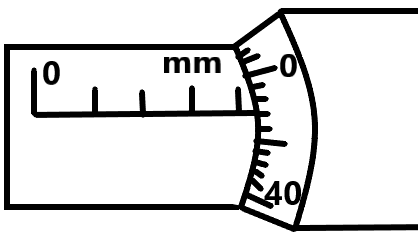
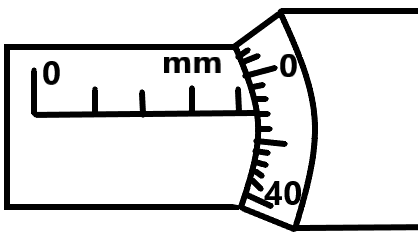
The figure shows the reading obtained while measuring the diameter of a wire with a screw gauge. The screw advances by 1 division on the main scale when the circular head is rotated once the diameter of the wire. Find the diameter of the wire.
Answer
 Verified
571.8k+ views
Hint: We need to understand the relation between the main scale divisions, the head scale divisions and the rotations involved in the given screw gauge. We can relate these in order to get the relation between those and the diameter of the given wire.
Complete step by step answer:
We are given a screw gauge which is used to measure the diameter of a wire. We know that the screw gauge has a main scale and a pitch scale which are calibrated such as to provide accurate measurements. The pitch scale is designed to be rotated so as to fix a given material between the two jaws of the screw gauge. One complete rotation of the pitch scale results in the forward movement of the head scale reading. This is called the pitch of the screw gauge.
We can find the pitch of the given screw gauge using the given information. It is said that one complete rotation of the pitch scale will advance the head scale by 1 division. So, the pitch of the screw gauge is –
\[\begin{align}
& \text{Pitch = 1 division of main scale reading} \\
& \text{1 division of main scale = 1mm} \\
& \therefore Pitch\text{ }=1mm \\
\end{align}\]
Now, we can find the least count of the screw gauge using this information. We know that the least count of the screw gauge is defined as the ratio of the pitch to the number of divisions on the pitch scale.
i.e.,
\[\begin{align}
& \text{Least count, LC =}\dfrac{Pitch}{\text{No}\text{. of divisions on pitch scale}} \\
& \Rightarrow LC=\dfrac{1mm}{50} \\
& \therefore LC=0.02mm \\
\end{align}\]
Now, we are given the figure for the reading of the diameter of the wire. From the figure, we know that the main scale reading (MSR) is 4 mm and the pitch scale reading (PSR) is 47. So, we can find the diameter of the wire using the formula –
\[\begin{align}
& Diameter=(MSR)+\{LC\times (PSR)\} \\
& \Rightarrow Diameter=4mm+\{0.02mm\times 47\} \\
& \Rightarrow Diameter=4mm+0.94mm \\
& \therefore Diameter=4.94mm \\
\end{align}\]
The diameter of the wire is 4.94 mm.
Note: The least count, the pitch and the other physical parameter of a screw gauge or a vernier callipers is dependent on the manufacturer. Although, we have a standard least count for these. We should be careful with these before taking measurements.
Complete step by step answer:
We are given a screw gauge which is used to measure the diameter of a wire. We know that the screw gauge has a main scale and a pitch scale which are calibrated such as to provide accurate measurements. The pitch scale is designed to be rotated so as to fix a given material between the two jaws of the screw gauge. One complete rotation of the pitch scale results in the forward movement of the head scale reading. This is called the pitch of the screw gauge.
We can find the pitch of the given screw gauge using the given information. It is said that one complete rotation of the pitch scale will advance the head scale by 1 division. So, the pitch of the screw gauge is –
\[\begin{align}
& \text{Pitch = 1 division of main scale reading} \\
& \text{1 division of main scale = 1mm} \\
& \therefore Pitch\text{ }=1mm \\
\end{align}\]
Now, we can find the least count of the screw gauge using this information. We know that the least count of the screw gauge is defined as the ratio of the pitch to the number of divisions on the pitch scale.
i.e.,
\[\begin{align}
& \text{Least count, LC =}\dfrac{Pitch}{\text{No}\text{. of divisions on pitch scale}} \\
& \Rightarrow LC=\dfrac{1mm}{50} \\
& \therefore LC=0.02mm \\
\end{align}\]
Now, we are given the figure for the reading of the diameter of the wire. From the figure, we know that the main scale reading (MSR) is 4 mm and the pitch scale reading (PSR) is 47. So, we can find the diameter of the wire using the formula –
\[\begin{align}
& Diameter=(MSR)+\{LC\times (PSR)\} \\
& \Rightarrow Diameter=4mm+\{0.02mm\times 47\} \\
& \Rightarrow Diameter=4mm+0.94mm \\
& \therefore Diameter=4.94mm \\
\end{align}\]
The diameter of the wire is 4.94 mm.
Note: The least count, the pitch and the other physical parameter of a screw gauge or a vernier callipers is dependent on the manufacturer. Although, we have a standard least count for these. We should be careful with these before taking measurements.
Recently Updated Pages
Master Class 11 Computer Science: Engaging Questions & Answers for Success

Master Class 11 Business Studies: Engaging Questions & Answers for Success
Master Class 11 Economics: Engaging Questions & Answers for Success
Master Class 11 English: Engaging Questions & Answers for Success
Master Class 11 Maths: Engaging Questions & Answers for Success
Master Class 11 Biology: Engaging Questions & Answers for Success
Trending doubts
One Metric ton is equal to kg A 10000 B 1000 C 100 class 11 physics CBSE
There are 720 permutations of the digits 1 2 3 4 5 class 11 maths CBSE
Discuss the various forms of bacteria class 11 biology CBSE
Draw a diagram of a plant cell and label at least eight class 11 biology CBSE
State the laws of reflection of light
Explain zero factorial class 11 maths CBSE