




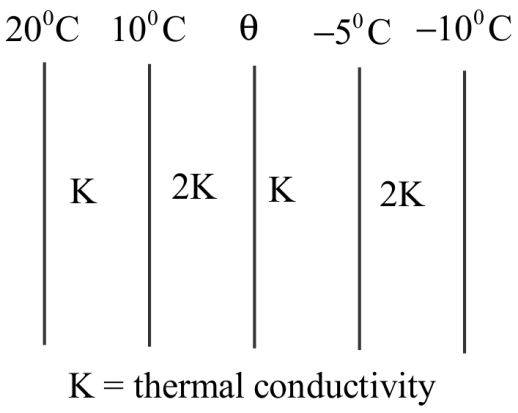
The figure shows the face and interface of a composite slab consisting of four lagers of two materials having identical thickness under steady state condition, find the value of temperature $\theta $ in $^0C:$
Answer
 Verified
661.8k+ views
Hint: Under steady state, amount of heat $dQ$ flows between the faces in time $dt$ will be same for all faces i.e. the rate of flow of heat will be same in all the faces because all are in series combination. Series configuration in slabs defined by the same heat flow in the two conductors across all cross sections though they are different conductivity and temperature difference. On equating the rate of heat flow through slabs we can easily find out the required temperature.
Complete step by step solution:
According to question
The amount of heat $dQ$ that flows between two faces in time $dt$ is given by :
$\dfrac{{dQ}}{{dt}} = \dfrac{{KA\Delta t}}{d}$
Where
$k \to $Thermal conductivity
$A \to $Area of cross section of the face
$\Delta T \to $Difference in temperature of the faces
$d \to $Thickness of the slab.
We know that the rate of flow of heat will be the same in all the faces because all are in series combination therefore in steady state the amount of heat $dQ$ flows in the $dt$ will be the same for all the faces.
${\left( {\dfrac{{dQ}}{{dt}}} \right)_k} = {\left( {\dfrac{{dQ}}{{dt}}} \right)_{2k}}$
On putting the values we get
$\dfrac{{KA\left( {20 - 10} \right)}}{d} = \dfrac{{2KA\left( {10 - \theta } \right)}}{d}$
On simplification we get
$\left( {20 - 10} \right) = 2\left( {10 - \theta } \right)$
$10 = 20 - 2\theta $
$\therefore 2\theta = 10$
On further solving we get
$\theta = 5$
Hence the value of temperature is ${5^ \circ }C$.
Note: The rate of heat flow is the amount of heat that is transferred per unit of time in some material, usually measured in watt. Heat is the flow of thermal energy driven by thermal non-equilibrium, so that 'heat flow' is a redundancy. If the slabs are placed in parallel then the rate of heat flow will be different.
Complete step by step solution:
According to question
The amount of heat $dQ$ that flows between two faces in time $dt$ is given by :
$\dfrac{{dQ}}{{dt}} = \dfrac{{KA\Delta t}}{d}$
Where
$k \to $Thermal conductivity
$A \to $Area of cross section of the face
$\Delta T \to $Difference in temperature of the faces
$d \to $Thickness of the slab.
We know that the rate of flow of heat will be the same in all the faces because all are in series combination therefore in steady state the amount of heat $dQ$ flows in the $dt$ will be the same for all the faces.
${\left( {\dfrac{{dQ}}{{dt}}} \right)_k} = {\left( {\dfrac{{dQ}}{{dt}}} \right)_{2k}}$
On putting the values we get
$\dfrac{{KA\left( {20 - 10} \right)}}{d} = \dfrac{{2KA\left( {10 - \theta } \right)}}{d}$
On simplification we get
$\left( {20 - 10} \right) = 2\left( {10 - \theta } \right)$
$10 = 20 - 2\theta $
$\therefore 2\theta = 10$
On further solving we get
$\theta = 5$
Hence the value of temperature is ${5^ \circ }C$.
Note: The rate of heat flow is the amount of heat that is transferred per unit of time in some material, usually measured in watt. Heat is the flow of thermal energy driven by thermal non-equilibrium, so that 'heat flow' is a redundancy. If the slabs are placed in parallel then the rate of heat flow will be different.
Recently Updated Pages
If x a + bt + ct2 where x is in meters and t is in class 11 physics CBSE

A car covers the first half distance between two places class 11 physics CBSE
The resultant of two vectors overrightarrow P and overrightarrow class 11 physics CBSE
Find the value of cos 135 class 11 maths CBSE
A mass M is held in place by an applied force F and class 11 physics CBSE
A solution of glucose in water is labelled as 10 dfracwv class 11 chemistry CBSE
Trending doubts
One Metric ton is equal to kg A 10000 B 1000 C 100 class 11 physics CBSE
Find the value of the expression given below sin 30circ class 11 maths CBSE
What do you mean by retardation What is its SI uni class 11 physics CBSE
Draw a diagram of nephron and explain its structur class 11 biology CBSE
10 examples of friction in our daily life
Difference between physical and chemical change class 11 chemistry CBSE