




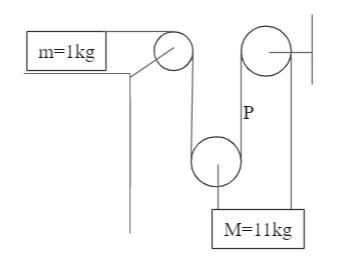
The figure shows an ideal pulley block of mass m (1 kg), resting on a rough ground with friction coefficient $ \mu = 1.5 $ . Another block of mass M (11 kg) is hanging as shown. When the system is released, it is found that the magnitude of acceleration of point P on string is a. Find the value of 4a in $ m/{s^2} $ . (Assume $ g = 10m/{s^2} $ )
Answer
 Verified
577.5k+ views
Hint:
In a pulley system attached with masses, the total force acting on the body depends on the tension exerted on the strings of the pulley. When the system is released, different components of the pulley experience different acceleration depending on their position.
Complete step by step answer:
Let us assume four points on the pulley-mass system. We know that the acceleration at point P is a. Let us suppose this acceleration is in the upwards direction, then the acceleration of point R will also be a, but in the downward direction as they are attached with the same string. This implies the body M will be going down with acceleration a.
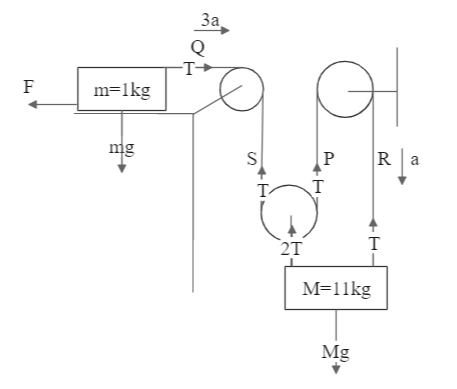
Now, the acceleration at point S will be given as:
$ \dfrac{{{a_s} + {a_p}}}{2} = - a $ [Negative because the direction of a is opposite to the accelerations at S and P]
$ \Rightarrow \dfrac{{{a_s} + a}}{2} = - a $
Hence, $ {a_s} = - 3a $
This implies that the direction of acceleration at S is in the downward direction. The block m will be under the same acceleration as they are connected with the same string joined by a fixed pulley.
Now, let us consider the block M with mass 11 kg. Doing the force balance on it, we get:
$ \Rightarrow Mg - T - 2T = Ma $
Putting in the values of M and g, we get:
$ \Rightarrow 11 \times 10 - 3T = 11a $ [Eq. 1]
Moving on to the block m, we know that it experiences a frictional force which will be given as:
$ \Rightarrow F = \mu mg = 1.5 \times 1 \times 10 = 15N $
Performing the force balance on this block:
$ \Rightarrow T - F = m \times 3a $
$ \Rightarrow T - 15 = 3a $
Substituting this value of T in the Eq. 1, we get:
$ \Rightarrow 110 - 3(3a + 15) = 11a $
$ \Rightarrow 110 - 9a - 45 = 11a $
Solving for a:
$ \Rightarrow 65 = 20a $
Dividing both sides by 5
$ \Rightarrow 13 = 4a $
Hence, the value of 4a is $ 13m/{s^2} $ .
Note:
The pulley-system is used in mechanical systems to reduce the amount of force acting on heavy bodies so that they can be lifted easily. It works by redistributing the direction of the force acting on all the components of the system.
In a pulley system attached with masses, the total force acting on the body depends on the tension exerted on the strings of the pulley. When the system is released, different components of the pulley experience different acceleration depending on their position.
Complete step by step answer:
Let us assume four points on the pulley-mass system. We know that the acceleration at point P is a. Let us suppose this acceleration is in the upwards direction, then the acceleration of point R will also be a, but in the downward direction as they are attached with the same string. This implies the body M will be going down with acceleration a.
Now, the acceleration at point S will be given as:
$ \dfrac{{{a_s} + {a_p}}}{2} = - a $ [Negative because the direction of a is opposite to the accelerations at S and P]
$ \Rightarrow \dfrac{{{a_s} + a}}{2} = - a $
Hence, $ {a_s} = - 3a $
This implies that the direction of acceleration at S is in the downward direction. The block m will be under the same acceleration as they are connected with the same string joined by a fixed pulley.
Now, let us consider the block M with mass 11 kg. Doing the force balance on it, we get:
$ \Rightarrow Mg - T - 2T = Ma $
Putting in the values of M and g, we get:
$ \Rightarrow 11 \times 10 - 3T = 11a $ [Eq. 1]
Moving on to the block m, we know that it experiences a frictional force which will be given as:
$ \Rightarrow F = \mu mg = 1.5 \times 1 \times 10 = 15N $
Performing the force balance on this block:
$ \Rightarrow T - F = m \times 3a $
$ \Rightarrow T - 15 = 3a $
Substituting this value of T in the Eq. 1, we get:
$ \Rightarrow 110 - 3(3a + 15) = 11a $
$ \Rightarrow 110 - 9a - 45 = 11a $
Solving for a:
$ \Rightarrow 65 = 20a $
Dividing both sides by 5
$ \Rightarrow 13 = 4a $
Hence, the value of 4a is $ 13m/{s^2} $ .
Note:
The pulley-system is used in mechanical systems to reduce the amount of force acting on heavy bodies so that they can be lifted easily. It works by redistributing the direction of the force acting on all the components of the system.
Recently Updated Pages
Master Class 11 Computer Science: Engaging Questions & Answers for Success

Master Class 11 Business Studies: Engaging Questions & Answers for Success
Master Class 11 Economics: Engaging Questions & Answers for Success
Master Class 11 English: Engaging Questions & Answers for Success
Master Class 11 Maths: Engaging Questions & Answers for Success
Master Class 11 Biology: Engaging Questions & Answers for Success
Trending doubts
One Metric ton is equal to kg A 10000 B 1000 C 100 class 11 physics CBSE
There are 720 permutations of the digits 1 2 3 4 5 class 11 maths CBSE
Discuss the various forms of bacteria class 11 biology CBSE
Draw a diagram of a plant cell and label at least eight class 11 biology CBSE
State the laws of reflection of light
10 examples of friction in our daily life