




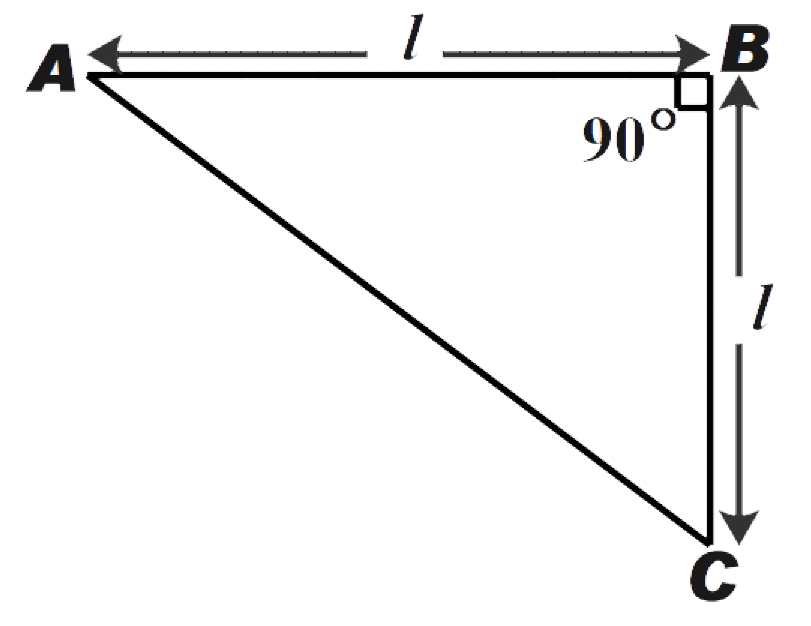
The figure shows a thin metallic triangular sheet ABC. The mass of sheet is M. The moment of sheet about side AC is:
A. \[\dfrac{M{{I}^{2}}}{18}\]
B. \[\dfrac{M{{I}^{2}}}{12}\]
C. \[\dfrac{M{{I}^{2}}}{6}\]
D. \[\dfrac{M{{I}^{2}}}{4}\]
Answer
 Verified
596.4k+ views
Hint: In this question we have been asked to calculate the moment of inertia about side AC in the given triangular sheet. To solve this question, we shall convert the triangle into square with sides of length l. Later, we shall calculate the MOI about the axis passing through the centre of mass and perpendicular to the sheet. We shall then use a perpendicular axis theorem to calculate the MOI about side AC.
Complete answer:
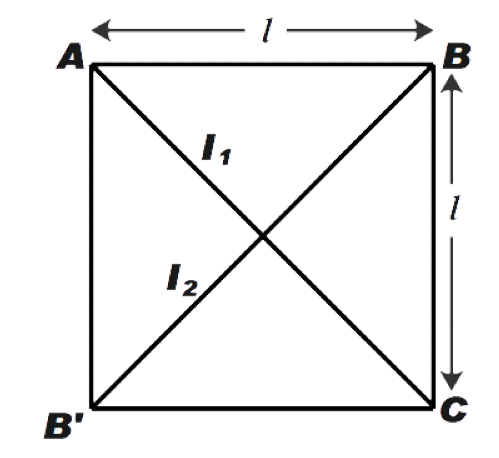
First let us convert the triangle into a square as shown in the figure below. So, if the triangle is unfolded as shown its mass can be said to be 2M as the given mass is M.
Now, we know that the moment of inertia of a square plate say I is given by
\[I=\dfrac{(2M)\times {{l}^{2}}}{6}\]
Therefore,
\[I=\dfrac{M{{l}^{2}}}{3}\] …………….. (1)
Now, as shown in the figure above we know that \[{{I}_{1}}\] and \[{{I}_{2}}\] are perpendicular to each other.
Therefore,
From perpendicular axis theorem
We get,
\[I={{I}_{1}}+{{I}_{2}}\]
Since \[{{I}_{1}}\] and \[{{I}_{2}}\] are symmetric, we can say that,
\[{{I}_{1}}={{I}_{2}}\]
Therefore,
\[I=2{{I}_{1}}\]
After substituting for I
We get,
\[{{I}_{1}}=\dfrac{M{{l}^{2}}}{6}\]
Now \[{{I}_{1}}\] is the moment of inertia of the square plate about the diagonal AC. Therefore, if the square is converted back into triangle we can say that the moment of inertia about the side AC say \[{{I}_{AC}}\]will be half the calculated value of \[{{I}_{1}}\]
Therefore,
\[{{I}_{AC}}=\dfrac{1}{2}{{I}_{1}}\]
After substituting the value
We get,
\[{{I}_{AC}}=\dfrac{1}{2}\times \dfrac{M{{l}^{2}}}{6}\]
Therefore,
\[{{I}_{AC}}=\dfrac{M{{l}^{2}}}{12}\]
So, the correct answer is “Option B”.
Note:
Moment of inertia is the tendency of a body to resist any angular acceleration of the body. Moment of inertia also known as angular mass is given as the product of mass of the body and the square of its perpendicular distance from the axis about which the body is said to rotate. The perpendicular axis theorem states that moment of inertia of a planar body about an axis perpendicular to plane of body is equal to the sum of moment of inertia of two perpendicular axes, in the same plane as the body.
Complete answer:
First let us convert the triangle into a square as shown in the figure below. So, if the triangle is unfolded as shown its mass can be said to be 2M as the given mass is M.
Now, we know that the moment of inertia of a square plate say I is given by
\[I=\dfrac{(2M)\times {{l}^{2}}}{6}\]
Therefore,
\[I=\dfrac{M{{l}^{2}}}{3}\] …………….. (1)
Now, as shown in the figure above we know that \[{{I}_{1}}\] and \[{{I}_{2}}\] are perpendicular to each other.
Therefore,
From perpendicular axis theorem
We get,
\[I={{I}_{1}}+{{I}_{2}}\]
Since \[{{I}_{1}}\] and \[{{I}_{2}}\] are symmetric, we can say that,
\[{{I}_{1}}={{I}_{2}}\]
Therefore,
\[I=2{{I}_{1}}\]
After substituting for I
We get,
\[{{I}_{1}}=\dfrac{M{{l}^{2}}}{6}\]
Now \[{{I}_{1}}\] is the moment of inertia of the square plate about the diagonal AC. Therefore, if the square is converted back into triangle we can say that the moment of inertia about the side AC say \[{{I}_{AC}}\]will be half the calculated value of \[{{I}_{1}}\]
Therefore,
\[{{I}_{AC}}=\dfrac{1}{2}{{I}_{1}}\]
After substituting the value
We get,
\[{{I}_{AC}}=\dfrac{1}{2}\times \dfrac{M{{l}^{2}}}{6}\]
Therefore,
\[{{I}_{AC}}=\dfrac{M{{l}^{2}}}{12}\]
So, the correct answer is “Option B”.
Note:
Moment of inertia is the tendency of a body to resist any angular acceleration of the body. Moment of inertia also known as angular mass is given as the product of mass of the body and the square of its perpendicular distance from the axis about which the body is said to rotate. The perpendicular axis theorem states that moment of inertia of a planar body about an axis perpendicular to plane of body is equal to the sum of moment of inertia of two perpendicular axes, in the same plane as the body.
Recently Updated Pages
Master Class 11 Social Science: Engaging Questions & Answers for Success

Master Class 11 Physics: Engaging Questions & Answers for Success
Master Class 11 Maths: Engaging Questions & Answers for Success
Master Class 11 Economics: Engaging Questions & Answers for Success
Master Class 11 Computer Science: Engaging Questions & Answers for Success
Master Class 11 Chemistry: Engaging Questions & Answers for Success
Trending doubts
One Metric ton is equal to kg A 10000 B 1000 C 100 class 11 physics CBSE
There are 720 permutations of the digits 1 2 3 4 5 class 11 maths CBSE
1 Quintal is equal to a 110 kg b 10 kg c 100kg d 1000 class 11 physics CBSE
State and prove Bernoullis theorem class 11 physics CBSE
Difference Between Prokaryotic Cells and Eukaryotic Cells
Which among the following are examples of coming together class 11 social science CBSE