




The figure shows a smooth circular path of radius R in a vertical plane which subtends an angle $\dfrac{\pi }{2}$ at O. A block of mass M is taken from position A to B under the action of a constant horizontal force F.
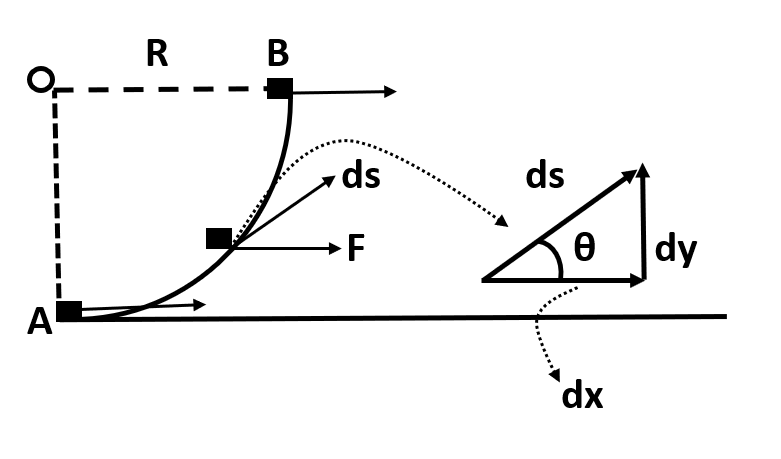
(a) Find the work done by this force
(b) In part (a), if the block is being pulled by a force F of constant magnitude which is always tangential to the surface, find the work done by the force F between A and B.
Answer
 Verified
533.7k+ views
Hint: The work done by a force over a displacement is given as the scalar product of the force vector and the displacement vector. This means that if the force applied and displacement are along the same direction, then the net work done is simply their product. Also, if the force applied and displacement are perpendicular to each other, then by vector formula the net work done by that force is equal to zero.
Complete answer:
(a) In the first part of the question we have been asked to find out the work done by the constant force F in taking the block from A to B. To find this quantity, we can use the work formula stated as below:
$\begin{align}
& \Rightarrow W=\int \overrightarrow{F}.\overrightarrow{dx} \\
& \Rightarrow W=\overrightarrow{F}\int \overrightarrow{dx} \\
\end{align}$
Here,
$\overrightarrow{F}$ is the applied force which is given to be constant.
$\overrightarrow{dx}$ is the displacement vector.
Since, work is the scalar product of these two vectors, the displacement along the direction of force will come into account in the equation and the displacement perpendicular to the direction of force will be equal to zero, that is:
$\Rightarrow \int \overrightarrow{dx}=R$
Therefore, the net work done is equal to:
$\Rightarrow W=FR$
Hence, the work done by the constant force F in taking the block from A to B is FR.
(b) In the second part we have, the force is always tangential to the surface. This means that at all times Force and displacement are parallel.
In this case, the displacement of the block along the direction of force is the length of the arc which is given by:
$\begin{align}
& \Rightarrow \int \overrightarrow{dx}=\dfrac{2\pi R}{4} \\
& \Rightarrow \int \overrightarrow{dx}=\dfrac{\pi R}{2} \\
\end{align}$
So, the work done can be calculated using the same formula, that is:
$\Rightarrow W=\overrightarrow{F}\overrightarrow{\int dx}$
Putting the values of vector F and displacement, we get:
$\begin{align}
& \Rightarrow W=F\left( \dfrac{\pi R}{2} \right) \\
& \Rightarrow W=\dfrac{\pi FR}{2} \\
\end{align}$
Hence, the work by the Force in taking the block from A to B when acting along the surface is equal to $\dfrac{\pi FR}{2}$.
Note:
One should easily tell the direction of displacement of any particle in the question as doing so will solve the hardest part of our question. For example, if the particle would have been hanging from O, then the net work done by tension would have been zero. As, tension and displacement at any instant would be perpendicular. This is how we need to visualize problems quickly and correctly.
Complete answer:
(a) In the first part of the question we have been asked to find out the work done by the constant force F in taking the block from A to B. To find this quantity, we can use the work formula stated as below:
$\begin{align}
& \Rightarrow W=\int \overrightarrow{F}.\overrightarrow{dx} \\
& \Rightarrow W=\overrightarrow{F}\int \overrightarrow{dx} \\
\end{align}$
Here,
$\overrightarrow{F}$ is the applied force which is given to be constant.
$\overrightarrow{dx}$ is the displacement vector.
Since, work is the scalar product of these two vectors, the displacement along the direction of force will come into account in the equation and the displacement perpendicular to the direction of force will be equal to zero, that is:
$\Rightarrow \int \overrightarrow{dx}=R$
Therefore, the net work done is equal to:
$\Rightarrow W=FR$
Hence, the work done by the constant force F in taking the block from A to B is FR.
(b) In the second part we have, the force is always tangential to the surface. This means that at all times Force and displacement are parallel.
In this case, the displacement of the block along the direction of force is the length of the arc which is given by:
$\begin{align}
& \Rightarrow \int \overrightarrow{dx}=\dfrac{2\pi R}{4} \\
& \Rightarrow \int \overrightarrow{dx}=\dfrac{\pi R}{2} \\
\end{align}$
So, the work done can be calculated using the same formula, that is:
$\Rightarrow W=\overrightarrow{F}\overrightarrow{\int dx}$
Putting the values of vector F and displacement, we get:
$\begin{align}
& \Rightarrow W=F\left( \dfrac{\pi R}{2} \right) \\
& \Rightarrow W=\dfrac{\pi FR}{2} \\
\end{align}$
Hence, the work by the Force in taking the block from A to B when acting along the surface is equal to $\dfrac{\pi FR}{2}$.
Note:
One should easily tell the direction of displacement of any particle in the question as doing so will solve the hardest part of our question. For example, if the particle would have been hanging from O, then the net work done by tension would have been zero. As, tension and displacement at any instant would be perpendicular. This is how we need to visualize problems quickly and correctly.
Recently Updated Pages
Master Class 11 Computer Science: Engaging Questions & Answers for Success

Master Class 11 Business Studies: Engaging Questions & Answers for Success
Master Class 11 Economics: Engaging Questions & Answers for Success
Master Class 11 English: Engaging Questions & Answers for Success
Master Class 11 Maths: Engaging Questions & Answers for Success
Master Class 11 Biology: Engaging Questions & Answers for Success
Trending doubts
One Metric ton is equal to kg A 10000 B 1000 C 100 class 11 physics CBSE
There are 720 permutations of the digits 1 2 3 4 5 class 11 maths CBSE
Discuss the various forms of bacteria class 11 biology CBSE
Draw a diagram of a plant cell and label at least eight class 11 biology CBSE
State the laws of reflection of light
Explain zero factorial class 11 maths CBSE