




The figure shows a mechanical set-up. The mechanism can be suitably described as:
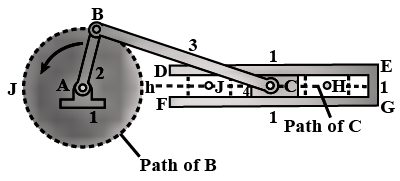
(A) conversion of the rotational motion of crank into linear motion of slider
(B) conversion of linear motion of slider into rotational motion of crank
(C) conversion of the rotational motion of slider into linear motion of crank
(D) conversion of linear motion of crank into rotational motion of slider
Answer
 Verified
552.9k+ views
Hint: In the above diagram, the crank is fixed about an axis. This crank is attached to an arm which extends up to the slider, that is, both the crank and the slider are connected through this common arm. This means that if one of them is given a certain velocity or acceleration, the other one is also affected. We shall use this analogy to proceed ahead in our solution.
Complete step-by-step answer:
We will make two separate cases for this problem.
Case (1): When the crank is moving initially:
In this case, the crank is moving, that is, it is performing rotational motion. This rotational motion will affect the stationary slider. Since the slider is restricted from two opposite sides, it can only move linearly from H to J and then J to H. Assuming these two points are the points of maximum displacement.
Thus, in this case, conversion of the rotational motion of the crank into linear motion of the slider takes place.
Case (2): When the slider is moving initially:
In this case, the slider is moving, that is, it is performing linear oscillatory motion. This linear motion will affect the stationary crank. Since the crank is restricted on its axis, it can only move about it in circles from A to B and then B to A continuously.
Thus, in this case, conversion of linear motion of the slider into rotational motion of crank takes place.
Since, in our problem, the crank has been given as moving, therefore it comes under case (1).
Hence, conversion of the rotational motion of the crank into linear motion of the slider takes place.
So, the correct answer is “Option A”.
Note: In these types of practical questions, one should be able to visualize the outcome or dependence of one type of motion on another. Also, the mechanism shown in the problem is the basis on which pistons inside an engine work. These pistons run the gears in the gearbox which in turn are connected to shafts that rotate the wheels.
Complete step-by-step answer:
We will make two separate cases for this problem.
Case (1): When the crank is moving initially:
In this case, the crank is moving, that is, it is performing rotational motion. This rotational motion will affect the stationary slider. Since the slider is restricted from two opposite sides, it can only move linearly from H to J and then J to H. Assuming these two points are the points of maximum displacement.
Thus, in this case, conversion of the rotational motion of the crank into linear motion of the slider takes place.
Case (2): When the slider is moving initially:
In this case, the slider is moving, that is, it is performing linear oscillatory motion. This linear motion will affect the stationary crank. Since the crank is restricted on its axis, it can only move about it in circles from A to B and then B to A continuously.
Thus, in this case, conversion of linear motion of the slider into rotational motion of crank takes place.
Since, in our problem, the crank has been given as moving, therefore it comes under case (1).
Hence, conversion of the rotational motion of the crank into linear motion of the slider takes place.
So, the correct answer is “Option A”.
Note: In these types of practical questions, one should be able to visualize the outcome or dependence of one type of motion on another. Also, the mechanism shown in the problem is the basis on which pistons inside an engine work. These pistons run the gears in the gearbox which in turn are connected to shafts that rotate the wheels.
Recently Updated Pages
Three beakers labelled as A B and C each containing 25 mL of water were taken A small amount of NaOH anhydrous CuSO4 and NaCl were added to the beakers A B and C respectively It was observed that there was an increase in the temperature of the solutions contained in beakers A and B whereas in case of beaker C the temperature of the solution falls Which one of the following statements isarecorrect i In beakers A and B exothermic process has occurred ii In beakers A and B endothermic process has occurred iii In beaker C exothermic process has occurred iv In beaker C endothermic process has occurred

Master Class 11 Social Science: Engaging Questions & Answers for Success
Master Class 11 Physics: Engaging Questions & Answers for Success
Master Class 11 Maths: Engaging Questions & Answers for Success
Master Class 11 Economics: Engaging Questions & Answers for Success
Master Class 11 Computer Science: Engaging Questions & Answers for Success
Three beakers labelled as A B and C each containing 25 mL of water were taken A small amount of NaOH anhydrous CuSO4 and NaCl were added to the beakers A B and C respectively It was observed that there was an increase in the temperature of the solutions contained in beakers A and B whereas in case of beaker C the temperature of the solution falls Which one of the following statements isarecorrect i In beakers A and B exothermic process has occurred ii In beakers A and B endothermic process has occurred iii In beaker C exothermic process has occurred iv In beaker C endothermic process has occurred
Master Class 11 Social Science: Engaging Questions & Answers for Success
Master Class 11 Physics: Engaging Questions & Answers for Success
Trending doubts
There are 720 permutations of the digits 1 2 3 4 5 class 11 maths CBSE
State and prove Bernoullis theorem class 11 physics CBSE
1 Quintal is equal to a 110 kg b 10 kg c 100kg d 1000 class 11 physics CBSE
Discuss the various forms of bacteria class 11 biology CBSE
10 examples of friction in our daily life
1 ton equals to A 100 kg B 1000 kg C 10 kg D 10000 class 11 physics CBSE