




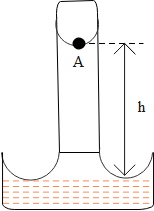
The figure shows a capillary tube of radius r dipped into water. The atmospheric pressure is\[{{P}_{o}}\] and the capillary rise of water is h. S is the surface tension for water-glass. Initially, \[h=10\,cm\]. If the capillary tube is now inclined at \[45{}^\circ \], the length of water rising in the tube will be
\[\begin{align}
& A\,.\,\,10\,cm \\
& B.\,10\sqrt{2}\,cm \\
& C\,.\,\dfrac{10}{\sqrt{2}}\,cm \\
& D.\,\,\text{None of}\,\text{these} \\
\end{align}\]
Answer
 Verified
601.2k+ views
Hint: We will make use of the height formula, that is, the capillary rise of liquid to compute the value of the rise in the liquid. The rise of the liquid formula is the initial height of the liquid present in the cube by the cosine of the angle by which the tube is tilted.
Formulae used:
\[\begin{align}
& h=\dfrac{2S\cos \theta }{\rho gr} \\
& l=\dfrac{h}{\sin \theta } \\
\end{align}\]
Complete step-by-step solution:
The diagram representing the before and after positioning of the capillary tube.
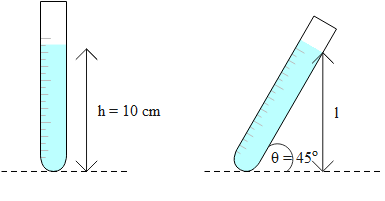
The formula for computing the capillary rise of liquid is given as follows.
\[h=\dfrac{2S\cos \theta }{\rho gr}\]
Where \[h\]is the height of the liquid, \[S\]is the surface tension, \[\theta \]is the angle of inclination, \[\rho \]is the density, \[g\]is the acceleration due to gravity and \[r\]is the radius of curvature.
Firstly, we will compute the value of the constants when the tube was not inclined.
Consider the formula
\[h=\dfrac{2S\cos \theta }{\rho gr}\]
Substitute the values in the above formula
\[\begin{align}
& 10=\dfrac{2S\cos 0{}^\circ }{\rho gr} \\
& 10=\dfrac{2S}{\rho gr} \\
\end{align}\]
Consider the above equation for further computation.
Now, we will compute the value of the length of water rising in the tube when the tube is inclined by an angle of \[45{}^\circ \] .
\[h=\dfrac{2S\cos 45{}^\circ }{\rho gr}\]
Continue further computation.
\[\begin{align}
& h=\dfrac{2S\times {}^{1}/{}_{\sqrt{2}}}{\rho gr} \\
& \Rightarrow h=\dfrac{1}{\sqrt{2}}\left( \dfrac{2S}{\rho gr} \right) \\
\end{align}\]
Now substitute the value of the constant in the above equation.
\[h=10\sqrt{2}\]
\[\therefore \]The value of the length of water rising in the tube will be, \[10\sqrt{2}\,cm\], thus, the option (B) is correct.
Note: Sometimes the other parameters, such as, the density of the liquid will be given to create confusion. But, while computing the rise in liquid for the tilted tube, there will be a need of only the initial height of the liquid and the angle by which the tube is tilted.
Formulae used:
\[\begin{align}
& h=\dfrac{2S\cos \theta }{\rho gr} \\
& l=\dfrac{h}{\sin \theta } \\
\end{align}\]
Complete step-by-step solution:
The diagram representing the before and after positioning of the capillary tube.
The formula for computing the capillary rise of liquid is given as follows.
\[h=\dfrac{2S\cos \theta }{\rho gr}\]
Where \[h\]is the height of the liquid, \[S\]is the surface tension, \[\theta \]is the angle of inclination, \[\rho \]is the density, \[g\]is the acceleration due to gravity and \[r\]is the radius of curvature.
Firstly, we will compute the value of the constants when the tube was not inclined.
Consider the formula
\[h=\dfrac{2S\cos \theta }{\rho gr}\]
Substitute the values in the above formula
\[\begin{align}
& 10=\dfrac{2S\cos 0{}^\circ }{\rho gr} \\
& 10=\dfrac{2S}{\rho gr} \\
\end{align}\]
Consider the above equation for further computation.
Now, we will compute the value of the length of water rising in the tube when the tube is inclined by an angle of \[45{}^\circ \] .
\[h=\dfrac{2S\cos 45{}^\circ }{\rho gr}\]
Continue further computation.
\[\begin{align}
& h=\dfrac{2S\times {}^{1}/{}_{\sqrt{2}}}{\rho gr} \\
& \Rightarrow h=\dfrac{1}{\sqrt{2}}\left( \dfrac{2S}{\rho gr} \right) \\
\end{align}\]
Now substitute the value of the constant in the above equation.
\[h=10\sqrt{2}\]
\[\therefore \]The value of the length of water rising in the tube will be, \[10\sqrt{2}\,cm\], thus, the option (B) is correct.
Note: Sometimes the other parameters, such as, the density of the liquid will be given to create confusion. But, while computing the rise in liquid for the tilted tube, there will be a need of only the initial height of the liquid and the angle by which the tube is tilted.
Recently Updated Pages
If x a + bt + ct2 where x is in meters and t is in class 11 physics CBSE

A car covers the first half distance between two places class 11 physics CBSE
The resultant of two vectors overrightarrow P and overrightarrow class 11 physics CBSE
Find the value of cos 135 class 11 maths CBSE
A mass M is held in place by an applied force F and class 11 physics CBSE
A solution of glucose in water is labelled as 10 dfracwv class 11 chemistry CBSE
Trending doubts
Find the value of the expression given below sin 30circ class 11 maths CBSE
One Metric ton is equal to kg A 10000 B 1000 C 100 class 11 physics CBSE
Draw a diagram of nephron and explain its structur class 11 biology CBSE
10 examples of friction in our daily life
Proton was discovered by A Thomson B Rutherford C Chadwick class 11 chemistry CBSE
Bond order ofO2 O2+ O2 and O22 is in order A O2 langle class 11 chemistry CBSE