




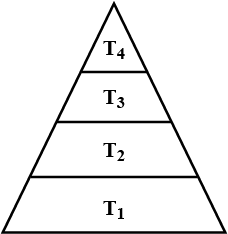
The figure given below represents a food pyramid. Study it and answer the following questions.
i) Which trophic level has maximum energy?
ii) Give one example for trophic level.
Answer
 Verified
618.6k+ views
Hint:With each progressing trophic level, the energy level keeps on decreasing. The width of each bar represents the units of energy available within each trophic level. The flow of energy moves through the layers of the energy pyramid from the bottom-up and is gradually reduced as energy is used up by the organisms at each level.
Complete answer:An energy pyramid which is also at times known as a trophic pyramid or ecological pyramid is basically a graphical way of representing the flow of energy from one trophic level in an ecosystem to the next one. Primary producers, also known as autotrophs, are organisms that create their own food by taking their energy from nonliving sources of energy. All other levels in the energy pyramid consist of the heterotrophs which are organisms that obtain their nutrition from organic carbon, usually in the form of other plants and animals. The second trophic level consists of primary consumers. These are the herbivores that feed solely on primary producers. The third and fourth levels are made up of what we call secondary consumers and tertiary consumers. These are essentially carnivores and omnivores, which can feed on any of the organisms belonging to first or second trophic levels. However, they mainly consume organisms belonging to the trophic level directly beneath them. The top layer of the energy pyramid contains the apex predators. These are mostly carnivorous animals that have no natural predators.
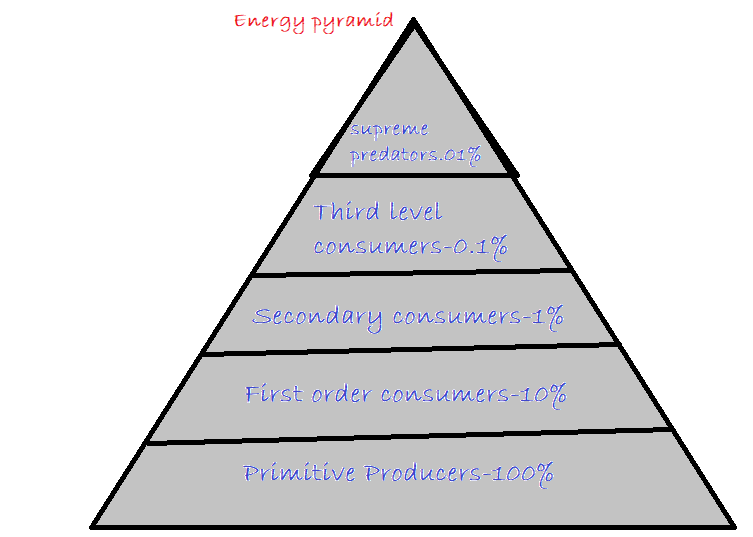
So, the correct answer is:
i.e. the first trophic level has the maximum energy.
trophic levels include organisms such as the hawk.
Note: It is noteworthy that the height of each bar representing a trophic level always remains constant. The base of the energy pyramid indicates the energy available within primary producers.
Complete answer:An energy pyramid which is also at times known as a trophic pyramid or ecological pyramid is basically a graphical way of representing the flow of energy from one trophic level in an ecosystem to the next one. Primary producers, also known as autotrophs, are organisms that create their own food by taking their energy from nonliving sources of energy. All other levels in the energy pyramid consist of the heterotrophs which are organisms that obtain their nutrition from organic carbon, usually in the form of other plants and animals. The second trophic level consists of primary consumers. These are the herbivores that feed solely on primary producers. The third and fourth levels are made up of what we call secondary consumers and tertiary consumers. These are essentially carnivores and omnivores, which can feed on any of the organisms belonging to first or second trophic levels. However, they mainly consume organisms belonging to the trophic level directly beneath them. The top layer of the energy pyramid contains the apex predators. These are mostly carnivorous animals that have no natural predators.
So, the correct answer is:
i.e. the first trophic level has the maximum energy.
trophic levels include organisms such as the hawk.
Note: It is noteworthy that the height of each bar representing a trophic level always remains constant. The base of the energy pyramid indicates the energy available within primary producers.
Recently Updated Pages
Basicity of sulphurous acid and sulphuric acid are

Master Class 12 Economics: Engaging Questions & Answers for Success
Master Class 12 Biology: Engaging Questions & Answers for Success
Master Class 11 English: Engaging Questions & Answers for Success
Master Class 11 Physics: Engaging Questions & Answers for Success
Master Class 11 Computer Science: Engaging Questions & Answers for Success
Trending doubts
What is the Total Duration of Football Match?
Explain the Treaty of Vienna of 1815 class 10 social science CBSE
In football, which nation is called "La Roja"?
Why is there a time difference of about 5 hours between class 10 social science CBSE
10 examples of evaporation in daily life with explanations
What is the full form of POSCO class 10 social science CBSE