




The family of straight lines \[3\left( a+1 \right)x-4\left( a-1 \right)y+3\left( a+1 \right)=0\] for different values of\['a'\] passes through a fixed point whose co – ordinates are
(a) \[\left( 1,0 \right)\]
(b) \[\left( -1,0 \right)\]
(c) \[\left( -1,-1 \right)\]
(d) None of the above.
Answer
 Verified
584.7k+ views
Hint: We solve this problem by using the family of lines. The general representation of family of lines is given as
\[\left( {{a}_{1}}x+{{b}_{1}}y+{{c}_{1}} \right)+\lambda \left( {{a}_{2}}x+{{b}_{2}}y+{{c}_{2}} \right)=0\]
The fixed point for which the above family of lines passes for different values of \['\lambda '\] is obtained by solving the lines \[\left( {{a}_{1}}x+{{b}_{1}}y+{{c}_{1}}=0 \right)\] and \[\left( {{a}_{2}}x+{{b}_{2}}y+{{c}_{2}}=0 \right)\]
By converting the given family of lines to the general representation of the family of lines we get the required co – ordinates of point.
Complete step by step answer:
We are given that the family of straight lines as
\[3\left( a+1 \right)x-4\left( a-1 \right)y+3\left( a+1 \right)=0\]
We know that the standard representation of family of straight lines is
\[\left( {{a}_{1}}x+{{b}_{1}}y+{{c}_{1}} \right)+\lambda \left( {{a}_{2}}x+{{b}_{2}}y+{{c}_{2}} \right)=0\]
By converting the given equation into this standard form we get
\[\Rightarrow \left( 3x+4y+3 \right)+a\left( 3x-4y+3 \right)=0\]
We know that the fixed point for which the above family of lines passes for different values of \['\lambda '\] is obtained by solving the lines \[\left( {{a}_{1}}x+{{b}_{1}}y+{{c}_{1}}=0 \right)\] and \[\left( {{a}_{2}}x+{{b}_{2}}y+{{c}_{2}}=0 \right)\]
Now, by separating the line equations from the given family of lines we get
\[\Rightarrow 3x+4y+3=0.......equation(i)\]
\[\Rightarrow 3x-4y+3........equation(ii)\]
Now, by adding equation (i) and equation (ii) we get
\[\begin{align}
& \Rightarrow 3x+4y+3+3x-4y+3=0 \\
& \Rightarrow 6x=-6 \\
& \Rightarrow x=-1 \\
\end{align}\]
Now, by substituting the value of \['x'\] in equation (i) we get
\[\begin{align}
& \Rightarrow 3\left( -1 \right)+4y+3=0 \\
& \Rightarrow 4y=0 \\
& \Rightarrow y=0 \\
\end{align}\]
Therefore, the co – ordinates of point for which the given family of lines passes through fixed point for different values of \['a'\] is \[\left( -1,0 \right)\]
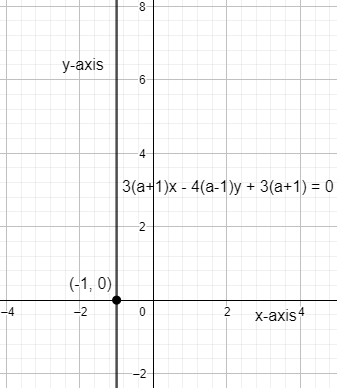
So, the correct answer is “Option b”.
Note: We can solve this problem by checking the given options.
Since we are asked to find the point such that the family of lines passes through that point
This means that the required point lies on family of lines.
We know that if the point lies on a equation of line then that point satisfies the equation of line.
By substituting the option (a) in given family of lines we get
\[\begin{align}
& \Rightarrow 3\left( a+1 \right)1-4\left( a-1 \right)0+3\left( a+1 \right)=0 \\
& \Rightarrow 6\left( a+1 \right)=0 \\
\end{align}\]
Here, we can see that the above equation satisfies for \[a=-1\] only but, we need to find the point for all values of \['a'\]
So, we can say that the option (a) is wrong answer.
Now, by substituting the option (b) in given family of lines we get
\[\begin{align}
& \Rightarrow 3\left( a+1 \right)\left( -1 \right)-4\left( a-1 \right)0+3\left( a+1 \right)=0 \\
& \Rightarrow 0=0 \\
\end{align}\]
Here, we can see that the above equation satisfied for all values of \['a'\]
So, option (b) is correct answer that is the required co – ordinates of point are \[\left( -1,0 \right)\]
\[\left( {{a}_{1}}x+{{b}_{1}}y+{{c}_{1}} \right)+\lambda \left( {{a}_{2}}x+{{b}_{2}}y+{{c}_{2}} \right)=0\]
The fixed point for which the above family of lines passes for different values of \['\lambda '\] is obtained by solving the lines \[\left( {{a}_{1}}x+{{b}_{1}}y+{{c}_{1}}=0 \right)\] and \[\left( {{a}_{2}}x+{{b}_{2}}y+{{c}_{2}}=0 \right)\]
By converting the given family of lines to the general representation of the family of lines we get the required co – ordinates of point.
Complete step by step answer:
We are given that the family of straight lines as
\[3\left( a+1 \right)x-4\left( a-1 \right)y+3\left( a+1 \right)=0\]
We know that the standard representation of family of straight lines is
\[\left( {{a}_{1}}x+{{b}_{1}}y+{{c}_{1}} \right)+\lambda \left( {{a}_{2}}x+{{b}_{2}}y+{{c}_{2}} \right)=0\]
By converting the given equation into this standard form we get
\[\Rightarrow \left( 3x+4y+3 \right)+a\left( 3x-4y+3 \right)=0\]
We know that the fixed point for which the above family of lines passes for different values of \['\lambda '\] is obtained by solving the lines \[\left( {{a}_{1}}x+{{b}_{1}}y+{{c}_{1}}=0 \right)\] and \[\left( {{a}_{2}}x+{{b}_{2}}y+{{c}_{2}}=0 \right)\]
Now, by separating the line equations from the given family of lines we get
\[\Rightarrow 3x+4y+3=0.......equation(i)\]
\[\Rightarrow 3x-4y+3........equation(ii)\]
Now, by adding equation (i) and equation (ii) we get
\[\begin{align}
& \Rightarrow 3x+4y+3+3x-4y+3=0 \\
& \Rightarrow 6x=-6 \\
& \Rightarrow x=-1 \\
\end{align}\]
Now, by substituting the value of \['x'\] in equation (i) we get
\[\begin{align}
& \Rightarrow 3\left( -1 \right)+4y+3=0 \\
& \Rightarrow 4y=0 \\
& \Rightarrow y=0 \\
\end{align}\]
Therefore, the co – ordinates of point for which the given family of lines passes through fixed point for different values of \['a'\] is \[\left( -1,0 \right)\]
So, the correct answer is “Option b”.
Note: We can solve this problem by checking the given options.
Since we are asked to find the point such that the family of lines passes through that point
This means that the required point lies on family of lines.
We know that if the point lies on a equation of line then that point satisfies the equation of line.
By substituting the option (a) in given family of lines we get
\[\begin{align}
& \Rightarrow 3\left( a+1 \right)1-4\left( a-1 \right)0+3\left( a+1 \right)=0 \\
& \Rightarrow 6\left( a+1 \right)=0 \\
\end{align}\]
Here, we can see that the above equation satisfies for \[a=-1\] only but, we need to find the point for all values of \['a'\]
So, we can say that the option (a) is wrong answer.
Now, by substituting the option (b) in given family of lines we get
\[\begin{align}
& \Rightarrow 3\left( a+1 \right)\left( -1 \right)-4\left( a-1 \right)0+3\left( a+1 \right)=0 \\
& \Rightarrow 0=0 \\
\end{align}\]
Here, we can see that the above equation satisfied for all values of \['a'\]
So, option (b) is correct answer that is the required co – ordinates of point are \[\left( -1,0 \right)\]
Recently Updated Pages
Basicity of sulphurous acid and sulphuric acid are

Master Class 11 Business Studies: Engaging Questions & Answers for Success
Master Class 11 Computer Science: Engaging Questions & Answers for Success
Master Class 11 Economics: Engaging Questions & Answers for Success
Master Class 11 Social Science: Engaging Questions & Answers for Success
Master Class 11 English: Engaging Questions & Answers for Success
Trending doubts
One Metric ton is equal to kg A 10000 B 1000 C 100 class 11 physics CBSE
The largest wind power cluster is located in the state class 11 social science CBSE
Explain zero factorial class 11 maths CBSE
State and prove Bernoullis theorem class 11 physics CBSE
Which among the following are examples of coming together class 11 social science CBSE
Can anyone list 10 advantages and disadvantages of friction