




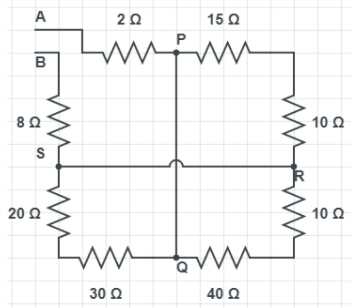
The equivalent resistance between point A and B is:
$\begin{align}
& A.\text{ }32.5\Omega \\
& B.\text{ }22.5\Omega . \\
& C.\text{ }2.5\Omega \\
& D.\text{ }42.5\Omega \\
\end{align}$
Answer
 Verified
561.3k+ views
Hint: We have been provided with a circuit in question. Three pairs of resistance in parallel to each other and two resistances from each of the pair are in series. So apply a formula of resistance in parallel for those three pairs of resistance and then use resistance in series at point AB.
Complete answer:
The above circuit can be drawn as follows to make it easy to solve.
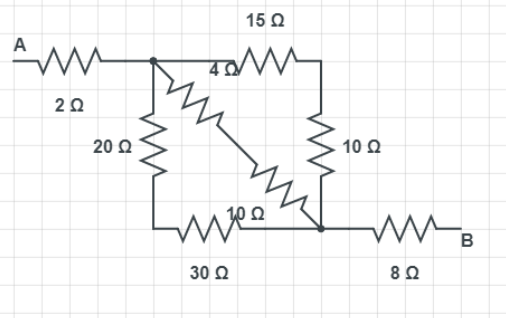
As you can see in given equivalent circuit diagram it shows the series combination of the resistance in the circuit which is $15\Omega ,\text{ 10}\Omega \text{, 40}\Omega \text{, 10}\Omega \text{, 20}\Omega \text{, 30}\Omega \text{.}$. Let ${{R}_{1}}$ be the equivalent resistance of the series combination of resistance $15\Omega ,\text{ 10}\Omega \text{.}$ Similarly ${{R}_{2}}$ be the equivalent resistance of series. Consider Combination of resistances $40\Omega ,\text{ 10}\Omega $. Consider Similarly ${{R}_{3}}\text{ for 20}\Omega ,\text{ 30}\Omega $
Then ${{R}_{1}},{{R}_{2}},{{R}_{3}}$ Is given as,
$\begin{align}
& {{R}_{1}}=10+15=25\Omega \\
& {{R}_{2}}=40+10=50\Omega \\
& {{R}_{3}}=20+30=50\Omega \\
\end{align}$
So, the circuit will look like:
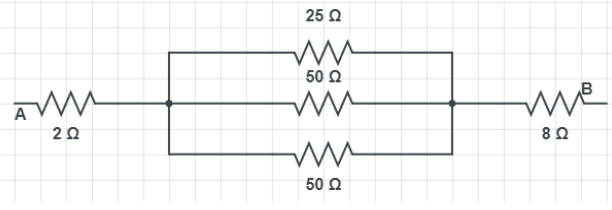
Now, these three resistances ${{R}_{1}},{{R}_{2}},{{R}_{3}}$ are parallel to each other i.e. they are connected in parallel. Therefore, equivalent resistance of parallel combination is given as,
$\dfrac{1}{{{R}_{p}}}=\dfrac{1}{{{R}_{1}}}+\dfrac{1}{{{R}_{2}}}+\dfrac{1}{{{R}_{3}}}$
Where, ${{R}_{P}}$ = equivalent resistance of parallel combination
$\begin{align}
& \therefore \dfrac{1}{{{R}_{p}}}=\dfrac{1}{25}+\dfrac{1}{50}+\dfrac{1}{50} \\
& =\dfrac{1}{25}+\dfrac{100}{2500} \\
& =\dfrac{1}{25}+\dfrac{1}{25} \\
& \Rightarrow \dfrac{1}{{{R}_{p}}}=\dfrac{2}{25} \\
& \therefore {{R}_{P}}=\dfrac{25}{2}\Omega \\
\end{align}$
Now the circuit (simplified circuit) will look like:
So, the equivalent resistance ${{R}_{P}}$is inn series with both resistances $2\Omega \text{ and }8\Omega $
$\therefore {{R}_{eq}}={{R}_{p}}+2\Omega +8\Omega $
Where, ${{R}_{P}}$ = equivalent resistance (final) of series combination
$\therefore {{R}_{eq}}=2+\dfrac{25}{2}+8=10+\dfrac{25}{2}=\dfrac{45}{2}=22.5\Omega $
Hence equivalent resistance between points A and B is 22.5Ω.
Additional information:
Resistance in series: when a several number of resistances are connected in series then the equivalent resistance is equal to sum of individual resistances. If ${{R}_{1}},{{R}_{2}},{{R}_{3}}$ be the resistor connected in series than their equivalent resistance ${{R}_{3}}$ is given by,
${{R}_{s}}={{R}_{1}}+{{R}_{2}}+{{R}_{3}}$
Resistance in parallel: when several number of resistance are connected in parallel the reciprocal of the equivalent resistance is equal to the sum of reciprocal of individual resistances
$\dfrac{1}{{{R}_{p}}}=\dfrac{1}{{{R}_{1}}}+\dfrac{1}{{{R}_{2}}}+\dfrac{1}{{{R}_{3}}}$
Note:
When a number of resistors are connected in series then the current flowing through each of them will be the same when several numbers of resistors are connected in parallel then the potential difference across each of them will be always the same. Above question can be by simplifying the circuit or by reducing it in a simplified form by using concept or formula of resistance in series or resistance in parallel.
Complete answer:
The above circuit can be drawn as follows to make it easy to solve.
As you can see in given equivalent circuit diagram it shows the series combination of the resistance in the circuit which is $15\Omega ,\text{ 10}\Omega \text{, 40}\Omega \text{, 10}\Omega \text{, 20}\Omega \text{, 30}\Omega \text{.}$. Let ${{R}_{1}}$ be the equivalent resistance of the series combination of resistance $15\Omega ,\text{ 10}\Omega \text{.}$ Similarly ${{R}_{2}}$ be the equivalent resistance of series. Consider Combination of resistances $40\Omega ,\text{ 10}\Omega $. Consider Similarly ${{R}_{3}}\text{ for 20}\Omega ,\text{ 30}\Omega $
Then ${{R}_{1}},{{R}_{2}},{{R}_{3}}$ Is given as,
$\begin{align}
& {{R}_{1}}=10+15=25\Omega \\
& {{R}_{2}}=40+10=50\Omega \\
& {{R}_{3}}=20+30=50\Omega \\
\end{align}$
So, the circuit will look like:
Now, these three resistances ${{R}_{1}},{{R}_{2}},{{R}_{3}}$ are parallel to each other i.e. they are connected in parallel. Therefore, equivalent resistance of parallel combination is given as,
$\dfrac{1}{{{R}_{p}}}=\dfrac{1}{{{R}_{1}}}+\dfrac{1}{{{R}_{2}}}+\dfrac{1}{{{R}_{3}}}$
Where, ${{R}_{P}}$ = equivalent resistance of parallel combination
$\begin{align}
& \therefore \dfrac{1}{{{R}_{p}}}=\dfrac{1}{25}+\dfrac{1}{50}+\dfrac{1}{50} \\
& =\dfrac{1}{25}+\dfrac{100}{2500} \\
& =\dfrac{1}{25}+\dfrac{1}{25} \\
& \Rightarrow \dfrac{1}{{{R}_{p}}}=\dfrac{2}{25} \\
& \therefore {{R}_{P}}=\dfrac{25}{2}\Omega \\
\end{align}$
Now the circuit (simplified circuit) will look like:
So, the equivalent resistance ${{R}_{P}}$is inn series with both resistances $2\Omega \text{ and }8\Omega $
$\therefore {{R}_{eq}}={{R}_{p}}+2\Omega +8\Omega $
Where, ${{R}_{P}}$ = equivalent resistance (final) of series combination
$\therefore {{R}_{eq}}=2+\dfrac{25}{2}+8=10+\dfrac{25}{2}=\dfrac{45}{2}=22.5\Omega $
Hence equivalent resistance between points A and B is 22.5Ω.
Additional information:
Resistance in series: when a several number of resistances are connected in series then the equivalent resistance is equal to sum of individual resistances. If ${{R}_{1}},{{R}_{2}},{{R}_{3}}$ be the resistor connected in series than their equivalent resistance ${{R}_{3}}$ is given by,
${{R}_{s}}={{R}_{1}}+{{R}_{2}}+{{R}_{3}}$
Resistance in parallel: when several number of resistance are connected in parallel the reciprocal of the equivalent resistance is equal to the sum of reciprocal of individual resistances
$\dfrac{1}{{{R}_{p}}}=\dfrac{1}{{{R}_{1}}}+\dfrac{1}{{{R}_{2}}}+\dfrac{1}{{{R}_{3}}}$
Note:
When a number of resistors are connected in series then the current flowing through each of them will be the same when several numbers of resistors are connected in parallel then the potential difference across each of them will be always the same. Above question can be by simplifying the circuit or by reducing it in a simplified form by using concept or formula of resistance in series or resistance in parallel.
Recently Updated Pages
Master Class 11 English: Engaging Questions & Answers for Success

Master Class 11 Social Science: Engaging Questions & Answers for Success
Master Class 11 Maths: Engaging Questions & Answers for Success
Master Class 11 Biology: Engaging Questions & Answers for Success
Master Class 11 Physics: Engaging Questions & Answers for Success
Master Class 11 Chemistry: Engaging Questions & Answers for Success
Trending doubts
One Metric ton is equal to kg A 10000 B 1000 C 100 class 11 physics CBSE
Difference Between Prokaryotic Cells and Eukaryotic Cells
Find the value of the expression given below sin 30circ class 11 maths CBSE
Difference between physical and chemical change class 11 chemistry CBSE
Two of the body parts which do not appear in MRI are class 11 biology CBSE
Draw a diagram of a plant cell and label at least eight class 11 biology CBSE