




The equation of the tangent to the circle ${x^2} + {y^2} = 25$ which is inclined at ${60^ \circ }$ angle with $x$- axis, will be
A. $y = \sqrt 3 x \pm 10$
B. $y = \sqrt 3 x \pm 2$
C. \[\sqrt 3 y = x \pm 10\]
D. None of these
Answer
 Verified
590.4k+ views
Hint: First, let the equation of the tangent is \[y = mx + c\], where $m$ is the slope of the line. Also, the slope of the equation can be calculated using the given angle, which is $\tan \theta $, when \[\theta \] is the angle inclined by $x$ axis. Then, substitute the value of $y$ in the equation of the circle, ${x^2} + {y^2} = 25$ to form a quadratic equation. Next, solve for $c$by putting the discriminant of the equation to zero.
Complete step-by-step answer:
We have to find the equation of the tangent to the circle ${x^2} + {y^2} = 25$ and we are given that the tangent is inclined at ${60^ \circ }$ with $x$ axis.
Let the equation of the tangent be \[y = mx + c\], where $m$ is the slope of the line.
We also know that the slope of the line which is inclined at angle \[\theta \] with the $x$ axis is $\tan \theta $.
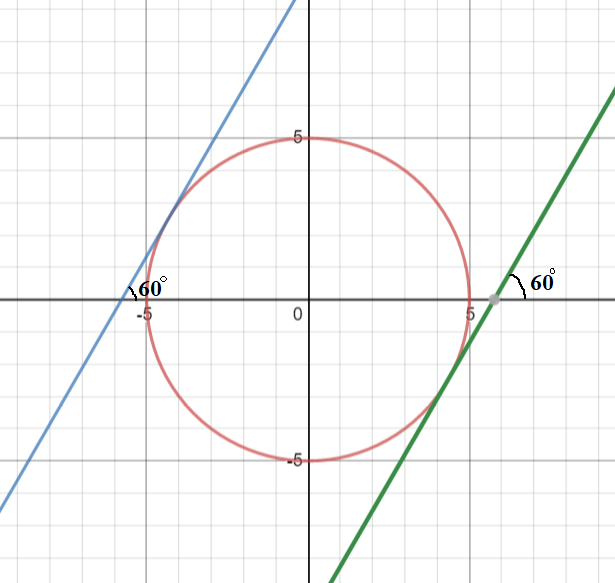
Here, the tangent is inclined at ${60^ \circ }$ with $x$ axis, therefore the slope of the tangent is $\tan {60^ \circ }$ which is equal to $\sqrt 3 $
Then, the equation of tangent is \[y = \sqrt 3 x + c\]
Now, we will substitute the value of \[y = \sqrt 3 x + c\] in the equation of circle, ${x^2} + {y^2} = 25$.
$
{x^2} + {\left( {\sqrt 3 x + c} \right)^2} = 25 \\
\Rightarrow {x^2} + 3{x^2} + {c^2} + 2\sqrt 3 cx = 25 \\
\Rightarrow 4{x^2} + 2\sqrt 3 cx + {c^2} - 25 = 0 \\
$
Also, for the equation of the tangent , the discriminant of the equation should be zero.
If \[a{x^2} + bx + c = 0\] is the equation, then the discriminant is given as $D = {b^2} - 4ac$
Then,
$
{\left( {2\sqrt 3 c} \right)^2} - 4\left( 4 \right)\left( {{c^2} - 25} \right) = 0 \\
\Rightarrow 12{c^2} - 16\left( {{c^2} - 25} \right) = 0 \\
\Rightarrow 12{c^2} - 16{c^2} + 400 = 0 \\
\Rightarrow 4{c^2} = 400 \\
$
On dividing the equation by 4, we will get,
$
{c^2} = 100 \\
\Rightarrow c = \pm 10 \\
$
We will substitute the value of the $c = \pm 10$ in the equation of the tangent,
\[y = \sqrt 3 x \pm 10\]
Hence, option A is correct.
Note: If the discriminant is zero, then the line is tangent to the curve. If the discriminant is greater than 0, then the line intersects the curve at two points and if the discriminant is less than 0, then the line does not intersect the curve.
Complete step-by-step answer:
We have to find the equation of the tangent to the circle ${x^2} + {y^2} = 25$ and we are given that the tangent is inclined at ${60^ \circ }$ with $x$ axis.
Let the equation of the tangent be \[y = mx + c\], where $m$ is the slope of the line.
We also know that the slope of the line which is inclined at angle \[\theta \] with the $x$ axis is $\tan \theta $.
Here, the tangent is inclined at ${60^ \circ }$ with $x$ axis, therefore the slope of the tangent is $\tan {60^ \circ }$ which is equal to $\sqrt 3 $
Then, the equation of tangent is \[y = \sqrt 3 x + c\]
Now, we will substitute the value of \[y = \sqrt 3 x + c\] in the equation of circle, ${x^2} + {y^2} = 25$.
$
{x^2} + {\left( {\sqrt 3 x + c} \right)^2} = 25 \\
\Rightarrow {x^2} + 3{x^2} + {c^2} + 2\sqrt 3 cx = 25 \\
\Rightarrow 4{x^2} + 2\sqrt 3 cx + {c^2} - 25 = 0 \\
$
Also, for the equation of the tangent , the discriminant of the equation should be zero.
If \[a{x^2} + bx + c = 0\] is the equation, then the discriminant is given as $D = {b^2} - 4ac$
Then,
$
{\left( {2\sqrt 3 c} \right)^2} - 4\left( 4 \right)\left( {{c^2} - 25} \right) = 0 \\
\Rightarrow 12{c^2} - 16\left( {{c^2} - 25} \right) = 0 \\
\Rightarrow 12{c^2} - 16{c^2} + 400 = 0 \\
\Rightarrow 4{c^2} = 400 \\
$
On dividing the equation by 4, we will get,
$
{c^2} = 100 \\
\Rightarrow c = \pm 10 \\
$
We will substitute the value of the $c = \pm 10$ in the equation of the tangent,
\[y = \sqrt 3 x \pm 10\]
Hence, option A is correct.
Note: If the discriminant is zero, then the line is tangent to the curve. If the discriminant is greater than 0, then the line intersects the curve at two points and if the discriminant is less than 0, then the line does not intersect the curve.
Recently Updated Pages
Basicity of sulphurous acid and sulphuric acid are

Master Class 11 Business Studies: Engaging Questions & Answers for Success
Master Class 11 Computer Science: Engaging Questions & Answers for Success
Master Class 11 Economics: Engaging Questions & Answers for Success
Master Class 11 Social Science: Engaging Questions & Answers for Success
Master Class 11 English: Engaging Questions & Answers for Success
Trending doubts
One Metric ton is equal to kg A 10000 B 1000 C 100 class 11 physics CBSE
The largest wind power cluster is located in the state class 11 social science CBSE
Explain zero factorial class 11 maths CBSE
State and prove Bernoullis theorem class 11 physics CBSE
Which among the following are examples of coming together class 11 social science CBSE
Draw a diagram of a plant cell and label at least eight class 11 biology CBSE