




What will be the equation of the plane passing through the point (1, 1, 1) and perpendicular to the planes $2x+y-2z=5\,\,and\,\,3x-6y-2z=7$?
(a) $14x+2y+15z=31$
(b) $18x+21y-21z=1$
(c) $-12x+2y+13z=31$
(d) $4x-2y+5z=27$
Answer
 Verified
575.7k+ views
Hint: To solve this problem we will first take the cross product of the direction ratios of the two given planes which are perpendicular to the plane we have to find. From this we will find the direction ratio of the plane we need to find, then we will assume any general point on the plane as (x, y, z) and then the direction of a random vector on this plane will be given by (x-1, y-1, z-1) because it is given that (1, 1, 1) lies on the plane. Now we will equate the dot product of the obtained vector and obtained direction ratios of the plane to zero to find it’s equation.
Complete step-by-step answer:
We are given two planes which are perpendicular to the plane we have to find,
$\begin{align}
& 2x+y-2z=5\,\,and \\
& \,3x-6y-2z=7 \\
\end{align}$
The direction ratios of the above two planes are respectively:
\[\left( 2,1,-2 \right)\And \left( 3,-6,-2 \right)\]
Now, the cross product of the direction ratios of these two planes will give the direction ratio of the required plane.
We know that if we have two direction ratios of the planes $\left( {{x}_{1}},{{y}_{1}},{{z}_{1}} \right)\And \left( {{x}_{2}},{{y}_{2}},{{z}_{2}} \right)$ then cross product of these two vectors is equal to:
\[\left| \begin{matrix}
\overset{\wedge }{\mathop{i}}\, & \overset{\wedge }{\mathop{j}}\, & \overset{\wedge }{\mathop{k}}\, \\
{{x}_{1}} & {{y}_{1}} & {{z}_{1}} \\
{{x}_{2}} & {{y}_{2}} & {{z}_{2}} \\
\end{matrix} \right|\]
Similarly, we can find the cross product of the direction ratios of the two given planes.
Hence direction ratio ($\overrightarrow{a}$) of the plane we get as,
$\overrightarrow{a}=\left| \begin{matrix}
\widehat{i} & \widehat{j} & \widehat{k} \\
2 & 1 & -2 \\
3 & -6 & -2 \\
\end{matrix} \right|$
Now expanding the determinant along first row we get,
$\begin{align}
& \overrightarrow{a}=\overset{\wedge }{\mathop{i}}\,\left( 1\left( -2 \right)-\left( -6 \right)\left( -2 \right) \right)-\overset{\wedge }{\mathop{j}}\,\left( 2\left( -2 \right)-3\left( -2 \right) \right)+\overset{\wedge }{\mathop{k}}\,\left( 2\left( -6 \right)-1\left( 3 \right) \right) \\
& \Rightarrow \overrightarrow{a}=\overset{\wedge }{\mathop{i}}\,\left( -2-12 \right)-\overset{\wedge }{\mathop{j}}\,\left( -4+6 \right)+\overset{\wedge }{\mathop{k}}\,\left( -12-3 \right) \\
& \Rightarrow \overrightarrow{a}=-14\overset{\wedge }{\mathop{i}}\,-2\overset{\wedge }{\mathop{j}}\,-15\overset{\wedge }{\mathop{k}}\, \\
\end{align}$
Now it is also given that the plane also passes through the point (1, 1, 1).
In the below diagram, we have drawn the required plane with a point (1, 1, 1) on it.
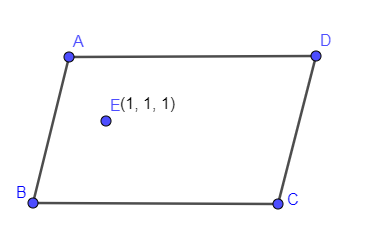
In the above diagram, we have shown the plane by ABCD and the given point by E.
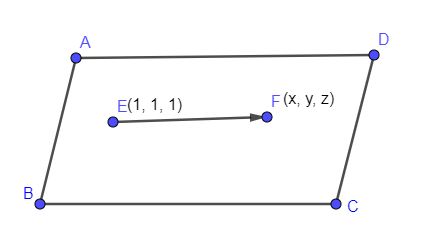
Now, if we let any general point on the plane as F(x, y, z) then a random vector $(x-1,y-1,z-1)$ lies on the plane. We are drawing what we have just said in the below.
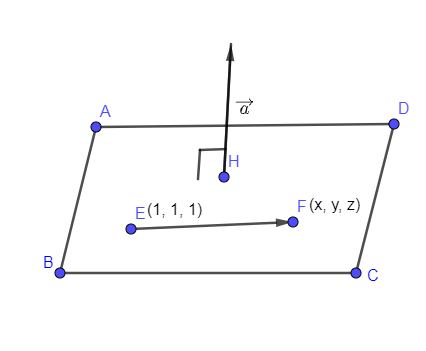
So direction ratio i.e. $\overrightarrow{a}$ and the vector $(x-1,y-1,z-1)$ will be perpendicular to each other as direction ratio represents the direction perpendicular to the plane.
In the below diagram, we have shown the plane with a vector $\overrightarrow{a}$ perpendicular to the plane and the two points E and F.
Hence dot product of both the vectors will be zero, so we get,
\[\left( -14\widehat{i}-2\widehat{j}-15\widehat{k} \right).\left( \left( x-1 \right)\widehat{i}+\left( y-1 \right)\widehat{j}+\left( z-1 \right)\widehat{k} \right)=0\]
$\begin{align}
& \Rightarrow -14\left( x-1 \right)-2\left( y-1 \right)-15\left( z-1 \right)=0 \\
& \Rightarrow -14x-2y-15z+14+2+15=0 \\
& \Rightarrow 14x+2y+15z=31 \\
\end{align}$
Hence we get the equation of the required plane as
$14x+2y+15z=31$.
So we get option (a) as the correct answer.
Note: To solve this kind of problem easily you need to think in 3D how the given planes or vectors will exist in 3D and then try to solve it. Some students may also think that the direction ratio of a plane is the vector parallel to the plane but this is wrong. The direction ratio of the plane is a vector or direction perpendicular to that plane. If you try to analyse this problem in 3D and try to solve it you may find that there are several other ways through which problems related to 3D vectors can be solved.
Complete step-by-step answer:
We are given two planes which are perpendicular to the plane we have to find,
$\begin{align}
& 2x+y-2z=5\,\,and \\
& \,3x-6y-2z=7 \\
\end{align}$
The direction ratios of the above two planes are respectively:
\[\left( 2,1,-2 \right)\And \left( 3,-6,-2 \right)\]
Now, the cross product of the direction ratios of these two planes will give the direction ratio of the required plane.
We know that if we have two direction ratios of the planes $\left( {{x}_{1}},{{y}_{1}},{{z}_{1}} \right)\And \left( {{x}_{2}},{{y}_{2}},{{z}_{2}} \right)$ then cross product of these two vectors is equal to:
\[\left| \begin{matrix}
\overset{\wedge }{\mathop{i}}\, & \overset{\wedge }{\mathop{j}}\, & \overset{\wedge }{\mathop{k}}\, \\
{{x}_{1}} & {{y}_{1}} & {{z}_{1}} \\
{{x}_{2}} & {{y}_{2}} & {{z}_{2}} \\
\end{matrix} \right|\]
Similarly, we can find the cross product of the direction ratios of the two given planes.
Hence direction ratio ($\overrightarrow{a}$) of the plane we get as,
$\overrightarrow{a}=\left| \begin{matrix}
\widehat{i} & \widehat{j} & \widehat{k} \\
2 & 1 & -2 \\
3 & -6 & -2 \\
\end{matrix} \right|$
Now expanding the determinant along first row we get,
$\begin{align}
& \overrightarrow{a}=\overset{\wedge }{\mathop{i}}\,\left( 1\left( -2 \right)-\left( -6 \right)\left( -2 \right) \right)-\overset{\wedge }{\mathop{j}}\,\left( 2\left( -2 \right)-3\left( -2 \right) \right)+\overset{\wedge }{\mathop{k}}\,\left( 2\left( -6 \right)-1\left( 3 \right) \right) \\
& \Rightarrow \overrightarrow{a}=\overset{\wedge }{\mathop{i}}\,\left( -2-12 \right)-\overset{\wedge }{\mathop{j}}\,\left( -4+6 \right)+\overset{\wedge }{\mathop{k}}\,\left( -12-3 \right) \\
& \Rightarrow \overrightarrow{a}=-14\overset{\wedge }{\mathop{i}}\,-2\overset{\wedge }{\mathop{j}}\,-15\overset{\wedge }{\mathop{k}}\, \\
\end{align}$
Now it is also given that the plane also passes through the point (1, 1, 1).
In the below diagram, we have drawn the required plane with a point (1, 1, 1) on it.
In the above diagram, we have shown the plane by ABCD and the given point by E.
Now, if we let any general point on the plane as F(x, y, z) then a random vector $(x-1,y-1,z-1)$ lies on the plane. We are drawing what we have just said in the below.
So direction ratio i.e. $\overrightarrow{a}$ and the vector $(x-1,y-1,z-1)$ will be perpendicular to each other as direction ratio represents the direction perpendicular to the plane.
In the below diagram, we have shown the plane with a vector $\overrightarrow{a}$ perpendicular to the plane and the two points E and F.
Hence dot product of both the vectors will be zero, so we get,
\[\left( -14\widehat{i}-2\widehat{j}-15\widehat{k} \right).\left( \left( x-1 \right)\widehat{i}+\left( y-1 \right)\widehat{j}+\left( z-1 \right)\widehat{k} \right)=0\]
$\begin{align}
& \Rightarrow -14\left( x-1 \right)-2\left( y-1 \right)-15\left( z-1 \right)=0 \\
& \Rightarrow -14x-2y-15z+14+2+15=0 \\
& \Rightarrow 14x+2y+15z=31 \\
\end{align}$
Hence we get the equation of the required plane as
$14x+2y+15z=31$.
So we get option (a) as the correct answer.
Note: To solve this kind of problem easily you need to think in 3D how the given planes or vectors will exist in 3D and then try to solve it. Some students may also think that the direction ratio of a plane is the vector parallel to the plane but this is wrong. The direction ratio of the plane is a vector or direction perpendicular to that plane. If you try to analyse this problem in 3D and try to solve it you may find that there are several other ways through which problems related to 3D vectors can be solved.
Recently Updated Pages
Master Class 12 English: Engaging Questions & Answers for Success

Master Class 12 Social Science: Engaging Questions & Answers for Success
Master Class 12 Maths: Engaging Questions & Answers for Success
Master Class 12 Economics: Engaging Questions & Answers for Success
Master Class 12 Physics: Engaging Questions & Answers for Success
Master Class 12 Business Studies: Engaging Questions & Answers for Success
Trending doubts
Which are the Top 10 Largest Countries of the World?
What are the major means of transport Explain each class 12 social science CBSE
Draw a labelled sketch of the human eye class 12 physics CBSE
Differentiate between insitu conservation and exsitu class 12 biology CBSE
Draw a neat and well labeled diagram of TS of ovary class 12 biology CBSE
RNA and DNA are chiral molecules their chirality is class 12 chemistry CBSE