




The equation of the incircle of the triangle formed by the axes and the line $4x + 3y = 6$ is:-
(A) ${x^2} + {y^2} - 6x - 6y + 9 = 0$
(B) $4\left( {{x^2} + {y^2} - x - y} \right) + 1 = 0$
(C) $4\left( {{x^2} + {y^2} + x + y} \right) + 1 = 0$
(D) None of these
Answer
 Verified
552.3k+ views
Hint:In the given question, we are required to find the equation of incircle of the triangle formed by the axes and the equation of the line given to us. So, to get the equation of incircle which is inscribed by the axes and the line $4x + 3y = 6$ can be determined by using the concept that the x and y coordinate of the centre of the circle touching both the axes will be the same. Also, the radius of the incircle is the same as the perpendicular distance from the centre of the circle to the line.
Complete step by step answer:
We know that the x and y coordinate of a circle that touches both the axes is the same. Also, the radius of the circle will be equal to the perpendicular distance between the centre of the circle and any of the axes.So, Equation of circle touching both the axes is given by:
${\left( {x - h} \right)^2} + {\left( {y - h} \right)^2} = {h^2}$,
where the centre of the circle is $\left( {h,h} \right)$ and the radius equals h units.
Also, we are given that the incircle also touches the line $4x + 3y = 6$.
So, the perpendicular distance from the centre of the circle to the given line is equal to h units.Therefore after using this perpendicular distance formula we get,
$ \Rightarrow h = \left| {\dfrac{{4h + 3h - 6}}{{\sqrt {{{\left( 4 \right)}^2} + {{\left( 3 \right)}^2}} }}} \right|$
$ \Rightarrow h = \left| {\dfrac{{7h - 6}}{5}} \right|$
On simplifying we get,
$ \Rightarrow \pm 5h = 7h - 6$
Shifting all the terms consisting x to the left side of the equation, we get,
\[ \Rightarrow \pm 5h - 7h = - 6\]
So, either \[ - 2h = - 6\] or \[ - 12h = - 6\]
Either \[h = 3\] or \[h = \left( {\dfrac{1}{2}} \right)\]
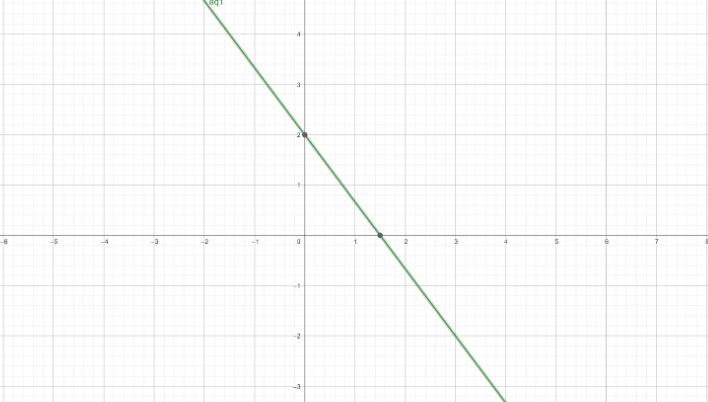
Now, for \[h = 3\], the centre of the circle is $\left( {3,3} \right)$. Hence, the circle won’t lie inside the triangle formed by the axes of the triangle and the line given to us.
So, for \[h = \left( {\dfrac{1}{2}} \right)\], the centre of the circle is $\left( {\dfrac{1}{2},\dfrac{1}{2}} \right)$.
So, the equation of the incircle is ${\left( {x - \dfrac{1}{2}} \right)^2} + {\left( {y - \dfrac{1}{2}} \right)^2} = {\left( {\dfrac{1}{2}} \right)^2}$
$ \Rightarrow {x^2} - x + \dfrac{1}{4} + {y^2} - y + \dfrac{1}{4} = \dfrac{1}{4}$
$ \Rightarrow {x^2} - x + {y^2} - y + \dfrac{1}{4} = 0$
Multiplying both sides of the equation by $4$, we get,
$ \therefore 4\left( {{x^2} + {y^2} - x - y} \right) + 1 = 0$
Hence, the option B is the correct option.
Note: If a circle is inscribed inside a triangle, this means that it touches all the side of the triangles and the perpendicular distance from the centre of the circle will be same for all the sides of triangle and the perpendicular distance will be equal to the radius of the circle.
Complete step by step answer:
We know that the x and y coordinate of a circle that touches both the axes is the same. Also, the radius of the circle will be equal to the perpendicular distance between the centre of the circle and any of the axes.So, Equation of circle touching both the axes is given by:
${\left( {x - h} \right)^2} + {\left( {y - h} \right)^2} = {h^2}$,
where the centre of the circle is $\left( {h,h} \right)$ and the radius equals h units.
Also, we are given that the incircle also touches the line $4x + 3y = 6$.
So, the perpendicular distance from the centre of the circle to the given line is equal to h units.Therefore after using this perpendicular distance formula we get,
$ \Rightarrow h = \left| {\dfrac{{4h + 3h - 6}}{{\sqrt {{{\left( 4 \right)}^2} + {{\left( 3 \right)}^2}} }}} \right|$
$ \Rightarrow h = \left| {\dfrac{{7h - 6}}{5}} \right|$
On simplifying we get,
$ \Rightarrow \pm 5h = 7h - 6$
Shifting all the terms consisting x to the left side of the equation, we get,
\[ \Rightarrow \pm 5h - 7h = - 6\]
So, either \[ - 2h = - 6\] or \[ - 12h = - 6\]
Either \[h = 3\] or \[h = \left( {\dfrac{1}{2}} \right)\]
Now, for \[h = 3\], the centre of the circle is $\left( {3,3} \right)$. Hence, the circle won’t lie inside the triangle formed by the axes of the triangle and the line given to us.
So, for \[h = \left( {\dfrac{1}{2}} \right)\], the centre of the circle is $\left( {\dfrac{1}{2},\dfrac{1}{2}} \right)$.
So, the equation of the incircle is ${\left( {x - \dfrac{1}{2}} \right)^2} + {\left( {y - \dfrac{1}{2}} \right)^2} = {\left( {\dfrac{1}{2}} \right)^2}$
$ \Rightarrow {x^2} - x + \dfrac{1}{4} + {y^2} - y + \dfrac{1}{4} = \dfrac{1}{4}$
$ \Rightarrow {x^2} - x + {y^2} - y + \dfrac{1}{4} = 0$
Multiplying both sides of the equation by $4$, we get,
$ \therefore 4\left( {{x^2} + {y^2} - x - y} \right) + 1 = 0$
Hence, the option B is the correct option.
Note: If a circle is inscribed inside a triangle, this means that it touches all the side of the triangles and the perpendicular distance from the centre of the circle will be same for all the sides of triangle and the perpendicular distance will be equal to the radius of the circle.
Recently Updated Pages
Master Class 10 Computer Science: Engaging Questions & Answers for Success

Master Class 10 General Knowledge: Engaging Questions & Answers for Success
Master Class 10 English: Engaging Questions & Answers for Success
Master Class 10 Social Science: Engaging Questions & Answers for Success
Master Class 10 Maths: Engaging Questions & Answers for Success
Master Class 10 Science: Engaging Questions & Answers for Success
Trending doubts
What is the median of the first 10 natural numbers class 10 maths CBSE
Which women's tennis player has 24 Grand Slam singles titles?
Who is the Brand Ambassador of Incredible India?
Why is there a time difference of about 5 hours between class 10 social science CBSE
Write a letter to the principal requesting him to grant class 10 english CBSE
A moving boat is observed from the top of a 150 m high class 10 maths CBSE