




The equation of the circle which passes through the origin and cuts off chords of length 2 on the lines \[x=y\] and \[x=-y\] is
A.\[{{x}^{2}}+{{y}^{2}}\pm 2\sqrt{2}y=0,{{x}^{2}}+{{y}^{2}}\pm 2\sqrt{2}x=0\]
B.\[{{x}^{2}}+{{y}^{2}}\pm 3\sqrt{3}y=0,{{x}^{2}}+{{y}^{2}}\pm 3\sqrt{3}x=0\]
C.\[{{x}^{2}}+{{y}^{2}}\pm 4\sqrt{2}x=0,{{x}^{2}}+{{y}^{2}}\pm 4\sqrt{2}y=0\]
D.\[{{x}^{2}}+{{y}^{2}}\pm 4\sqrt{2}x=0,{{x}^{2}}+{{y}^{2}}\pm 4\sqrt{3}y=0\]
Answer
 Verified
596.4k+ views
Hint: Assume the equation of the circle \[{{x}^{2}}+{{y}^{2}}+2gx+2fy+c=0\] . Since the given circle is passing through the origin, so the coordinates of origin should satisfy the equation of the circle. After satisfying we get the value of c which is equal to 0. We have two chords whose equations are \[x=y\] and \[x=-y\] . The equation of the chords should satisfy the equation of the circle. After satisfying we will get the coordinates of the points where the chords intersect the circle. Using distance formula get the distance of the chords and make it equal to 2. Now, we get two equations and we have two variables that are g and f. Solve for g and f and get the values of g and f.
Complete step-by-step answer:
First of all, let us assume the equation of the circle \[{{x}^{2}}+{{y}^{2}}+2gx+2fy+c=0\] ………………………..(1)
Since the given circle is passing through the origin, so the coordinates of origin should satisfy the equation of the circle.
Putting the coordinates of the origin \[(0,0)\] in the equation of the circle, we get
\[{{x}^{2}}+{{y}^{2}}+2gx+2fy+c=0\]
\[\begin{align}
& \Rightarrow {{0}^{2}}+{{0}^{2}}+2g0+2f0+c=0 \\
& \Rightarrow 0+0+0+0+c=0 \\
\end{align}\]
\[\Rightarrow c=0\] ………………….(2)
The chord \[x=y\] intersects the circle, so it must satisfy the equation of the circle.
Putting, \[x=y\] in the equation of the circle \[({{x}^{2}}+{{y}^{2}}+2gx+2fy+c=0)\] , we get
\[{{x}^{2}}+{{y}^{2}}+2gx+2fy+c=0\]
\[{{x}^{2}}+{{x}^{2}}+2gx+2fx+c=0\]
Putting the value of c from equation (2) in the above equation, we get
\[{{x}^{2}}+{{x}^{2}}+2gx+2fx+0=0\]
\[\begin{align}
& \Rightarrow 2{{x}^{2}}+2gx+2fx=0 \\
& \Rightarrow 2x\left( x+g+f \right)=0 \\
\end{align}\]
\[x=0\] or \[x+g+f=0\Rightarrow x=-(g+f)\]
Putting, \[x=0\] in the equation \[x=y\] , we get
\[y=0\] .
Putting, \[x=-(g+f)\]in the equation \[x=y\] , we get
\[y=-(g+f)\] .
We have got the points of intersection where the chord \[x=y\] meets the circle and the points are
\[(0,0)\] and \[\left( -(g+f),-(g+f) \right)\] .
The chord \[x=-y\] intersects the circle, so it must satisfy the equation of the circle.
Putting, \[x=-y\] in the equation of the circle \[({{x}^{2}}+{{y}^{2}}+2gx+2fy+c=0)\] , we get
\[{{x}^{2}}+{{y}^{2}}+2gx+2fy+c=0\]
\[{{x}^{2}}+{{(-x)}^{2}}+2gx+2f(-x)+c=0\]
Putting the value of c from equation (2) in the above equation, we get
\[{{x}^{2}}+{{x}^{2}}+2gx-2fx+0=0\]
\[\begin{align}
& \Rightarrow 2{{x}^{2}}+2gx-2fx=0 \\
& \Rightarrow 2x\left( x+g-f \right)=0 \\
\end{align}\]
\[x=0\] or \[x+g-f=0\Rightarrow x=(f-g)\]
Putting, \[x=0\] in the equation \[x=-y\] , we get
\[y=0\] .
Putting, \[x=(f-g)\]in the equation \[x=-y\] , we get
\[y=(g-f)\] .
We have got the points of intersection where the chord \[x=-y\] meets the circle and the points are
\[(0,0)\] and \[\left( f-g,g-f \right)\] .
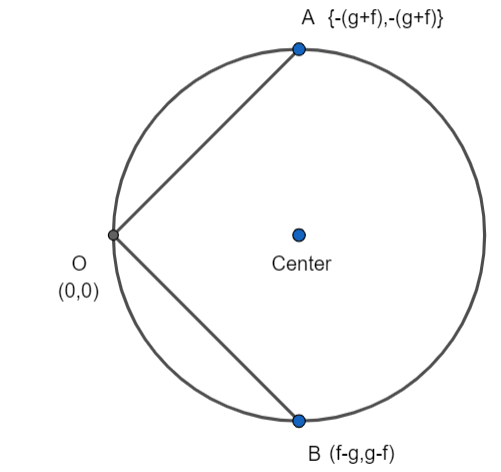
From the figure, we can see that the length of the chords is OA and AB and it is given that the length of the chords is 2.
OA = OB = 2 …………………….(3)
Using distance formula,
\[\begin{align}
& OA=\sqrt{{{\left\{ 0-\left( -(g+f) \right) \right\}}^{2}}+{{\left\{ 0-\left( -(g+f) \right) \right\}}^{2}}} \\
& OA=\sqrt{{{\left( g+f \right)}^{2}}+{{\left( g+f \right)}^{2}}} \\
\end{align}\]
Putting the value of OA=2 and squaring both sides in the above equation, we get
\[\begin{align}
& \Rightarrow O{{A}^{2}}=2{{\left( g+f \right)}^{2}} \\
& \Rightarrow {{2}^{2}}=2{{\left( g+f \right)}^{2}} \\
& \Rightarrow 4=2{{\left( g+f \right)}^{2}} \\
& \Rightarrow 2={{\left( g+f \right)}^{2}} \\
\end{align}\]
\[\Rightarrow \pm \sqrt{2}=(g+f)\] ……………………(4)
Using distance formula,
\[OB=\sqrt{{{\left\{ 0-\left( f-g \right) \right\}}^{2}}+{{\left\{ 0-\left( g-f \right) \right\}}^{2}}}\]
\[OB=\sqrt{{{(-1\left( g-f \right))}^{2}}+{{\left( g-f \right)}^{2}}}\] …………………….(5)
Or, \[OB=\sqrt{{{\left( f-g \right)}^{2}}+{{(-1\left( f-g \right))}^{2}}}\] ……………………..(6)
Putting the value of OB=2 and squaring both sides in equation (5), we get
\[\begin{align}
& \Rightarrow O{{B}^{2}}=2{{\left( g-f \right)}^{2}} \\
& \Rightarrow {{2}^{2}}=2{{\left( g-f \right)}^{2}} \\
& \Rightarrow 4=2{{\left( g-f \right)}^{2}} \\
& \Rightarrow 2={{\left( g-f \right)}^{2}} \\
\end{align}\]
\[\Rightarrow \pm \sqrt{2}=(g-f)\] ……………………(7)
Similarly, putting the value of OB=2 and squaring both sides in equation (6), we get
\[\begin{align}
& \Rightarrow O{{B}^{2}}=2{{\left( f-g \right)}^{2}} \\
& \Rightarrow {{2}^{2}}=2{{\left( f-g \right)}^{2}} \\
& \Rightarrow 4=2{{\left( f-g \right)}^{2}} \\
& \Rightarrow 2={{\left( f-g \right)}^{2}} \\
\end{align}\]
\[\Rightarrow \pm \sqrt{2}=(f-g)\] ………………………….(8)
On adding equation (4) and equation (7), we get
\[\pm \sqrt{2}=(g+f)\]
\[\pm \sqrt{2}=(g-f)\]
\[\begin{align}
& \pm 2\sqrt{2}=2g \\
& \Rightarrow \pm \sqrt{2}=g \\
\end{align}\]
Putting the value of g in equation (4), we get
\[\begin{align}
& \pm \sqrt{2}=(\pm \sqrt{2}+f) \\
& \Rightarrow 0=f \\
\end{align}\]
Here, the values of g and f are \[\pm 2\] and 0 respectively.
Now, putting the values of c, g and f in equation(1), we get
\[{{x}^{2}}+{{y}^{2}}+2gx+2fy+c=0\]
\[\begin{align}
& \Rightarrow {{x}^{2}}+{{y}^{2}}+2\left( \pm \sqrt{2} \right)x+2.0.y+0=0 \\
& \Rightarrow {{x}^{2}}+{{y}^{2}}\pm 2\sqrt{2}x=0 \\
\end{align}\]
On adding equation (4) and equation (8), we get
\[\pm \sqrt{2}=(g+f)\]
\[\pm \sqrt{2}=(f-g)\]
\[\begin{align}
& \pm 2\sqrt{2}=2f \\
& \Rightarrow \pm \sqrt{2}=f \\
\end{align}\]
Putting the value of f in equation (4), we get
\[\begin{align}
& \pm \sqrt{2}=(\pm \sqrt{2}+g) \\
& \Rightarrow 0=g \\
\end{align}\]
Here, the values of g and f are 0 and \[\pm 2\] respectively.
Now, putting the values of c, g and f in equation(1), we get
\[{{x}^{2}}+{{y}^{2}}+2gx+2fy+c=0\]
\[\begin{align}
& \Rightarrow {{x}^{2}}+{{y}^{2}}++2.0.x+2\left( \pm \sqrt{2} \right)y+0=0 \\
& \Rightarrow {{x}^{2}}+{{y}^{2}}\pm 2\sqrt{2}y=0 \\
\end{align}\]
The equation of the circle is \[{{x}^{2}}+{{y}^{2}}\pm 2\sqrt{2}y=0\] , \[{{x}^{2}}+{{y}^{2}}\pm 2\sqrt{2}x=0\] .
Hence, the correct option is option (A).
Note: This question involves a little bit of calculation. So, we have to be attentive to the calculations involved. Also, in this question, one may miss the point that \[OB=\sqrt{{{\left\{ 0-\left( f-g \right) \right\}}^{2}}+{{\left\{ 0-\left( g-f \right) \right\}}^{2}}}\] may also be written as \[OB=\sqrt{{{(-1\left( g-f \right))}^{2}}+{{\left( g-f \right)}^{2}}}\] or \[OB=\sqrt{{{\left( f-g \right)}^{2}}+{{(-1\left( f-g \right))}^{2}}}\] . Here, we have to solve both \[OB=\sqrt{{{(-1\left( g-f \right))}^{2}}+{{\left( g-f \right)}^{2}}}\] and \[OB=\sqrt{{{\left( f-g \right)}^{2}}+{{(-1\left( f-g \right))}^{2}}}\] . If we focus on only one of these two, then we will get only one equation of the circle. But, we can see that every option contains two equations of the circle. So, we require two equations of the circle. Therefore, we have to solve both \[OB=\sqrt{{{(-1\left( g-f \right))}^{2}}+{{\left( g-f \right)}^{2}}}\] and \[OB=\sqrt{{{\left( f-g \right)}^{2}}+{{(-1\left( f-g \right))}^{2}}}\] .
Complete step-by-step answer:
First of all, let us assume the equation of the circle \[{{x}^{2}}+{{y}^{2}}+2gx+2fy+c=0\] ………………………..(1)
Since the given circle is passing through the origin, so the coordinates of origin should satisfy the equation of the circle.
Putting the coordinates of the origin \[(0,0)\] in the equation of the circle, we get
\[{{x}^{2}}+{{y}^{2}}+2gx+2fy+c=0\]
\[\begin{align}
& \Rightarrow {{0}^{2}}+{{0}^{2}}+2g0+2f0+c=0 \\
& \Rightarrow 0+0+0+0+c=0 \\
\end{align}\]
\[\Rightarrow c=0\] ………………….(2)
The chord \[x=y\] intersects the circle, so it must satisfy the equation of the circle.
Putting, \[x=y\] in the equation of the circle \[({{x}^{2}}+{{y}^{2}}+2gx+2fy+c=0)\] , we get
\[{{x}^{2}}+{{y}^{2}}+2gx+2fy+c=0\]
\[{{x}^{2}}+{{x}^{2}}+2gx+2fx+c=0\]
Putting the value of c from equation (2) in the above equation, we get
\[{{x}^{2}}+{{x}^{2}}+2gx+2fx+0=0\]
\[\begin{align}
& \Rightarrow 2{{x}^{2}}+2gx+2fx=0 \\
& \Rightarrow 2x\left( x+g+f \right)=0 \\
\end{align}\]
\[x=0\] or \[x+g+f=0\Rightarrow x=-(g+f)\]
Putting, \[x=0\] in the equation \[x=y\] , we get
\[y=0\] .
Putting, \[x=-(g+f)\]in the equation \[x=y\] , we get
\[y=-(g+f)\] .
We have got the points of intersection where the chord \[x=y\] meets the circle and the points are
\[(0,0)\] and \[\left( -(g+f),-(g+f) \right)\] .
The chord \[x=-y\] intersects the circle, so it must satisfy the equation of the circle.
Putting, \[x=-y\] in the equation of the circle \[({{x}^{2}}+{{y}^{2}}+2gx+2fy+c=0)\] , we get
\[{{x}^{2}}+{{y}^{2}}+2gx+2fy+c=0\]
\[{{x}^{2}}+{{(-x)}^{2}}+2gx+2f(-x)+c=0\]
Putting the value of c from equation (2) in the above equation, we get
\[{{x}^{2}}+{{x}^{2}}+2gx-2fx+0=0\]
\[\begin{align}
& \Rightarrow 2{{x}^{2}}+2gx-2fx=0 \\
& \Rightarrow 2x\left( x+g-f \right)=0 \\
\end{align}\]
\[x=0\] or \[x+g-f=0\Rightarrow x=(f-g)\]
Putting, \[x=0\] in the equation \[x=-y\] , we get
\[y=0\] .
Putting, \[x=(f-g)\]in the equation \[x=-y\] , we get
\[y=(g-f)\] .
We have got the points of intersection where the chord \[x=-y\] meets the circle and the points are
\[(0,0)\] and \[\left( f-g,g-f \right)\] .
From the figure, we can see that the length of the chords is OA and AB and it is given that the length of the chords is 2.
OA = OB = 2 …………………….(3)
Using distance formula,
\[\begin{align}
& OA=\sqrt{{{\left\{ 0-\left( -(g+f) \right) \right\}}^{2}}+{{\left\{ 0-\left( -(g+f) \right) \right\}}^{2}}} \\
& OA=\sqrt{{{\left( g+f \right)}^{2}}+{{\left( g+f \right)}^{2}}} \\
\end{align}\]
Putting the value of OA=2 and squaring both sides in the above equation, we get
\[\begin{align}
& \Rightarrow O{{A}^{2}}=2{{\left( g+f \right)}^{2}} \\
& \Rightarrow {{2}^{2}}=2{{\left( g+f \right)}^{2}} \\
& \Rightarrow 4=2{{\left( g+f \right)}^{2}} \\
& \Rightarrow 2={{\left( g+f \right)}^{2}} \\
\end{align}\]
\[\Rightarrow \pm \sqrt{2}=(g+f)\] ……………………(4)
Using distance formula,
\[OB=\sqrt{{{\left\{ 0-\left( f-g \right) \right\}}^{2}}+{{\left\{ 0-\left( g-f \right) \right\}}^{2}}}\]
\[OB=\sqrt{{{(-1\left( g-f \right))}^{2}}+{{\left( g-f \right)}^{2}}}\] …………………….(5)
Or, \[OB=\sqrt{{{\left( f-g \right)}^{2}}+{{(-1\left( f-g \right))}^{2}}}\] ……………………..(6)
Putting the value of OB=2 and squaring both sides in equation (5), we get
\[\begin{align}
& \Rightarrow O{{B}^{2}}=2{{\left( g-f \right)}^{2}} \\
& \Rightarrow {{2}^{2}}=2{{\left( g-f \right)}^{2}} \\
& \Rightarrow 4=2{{\left( g-f \right)}^{2}} \\
& \Rightarrow 2={{\left( g-f \right)}^{2}} \\
\end{align}\]
\[\Rightarrow \pm \sqrt{2}=(g-f)\] ……………………(7)
Similarly, putting the value of OB=2 and squaring both sides in equation (6), we get
\[\begin{align}
& \Rightarrow O{{B}^{2}}=2{{\left( f-g \right)}^{2}} \\
& \Rightarrow {{2}^{2}}=2{{\left( f-g \right)}^{2}} \\
& \Rightarrow 4=2{{\left( f-g \right)}^{2}} \\
& \Rightarrow 2={{\left( f-g \right)}^{2}} \\
\end{align}\]
\[\Rightarrow \pm \sqrt{2}=(f-g)\] ………………………….(8)
On adding equation (4) and equation (7), we get
\[\pm \sqrt{2}=(g+f)\]
\[\pm \sqrt{2}=(g-f)\]
\[\begin{align}
& \pm 2\sqrt{2}=2g \\
& \Rightarrow \pm \sqrt{2}=g \\
\end{align}\]
Putting the value of g in equation (4), we get
\[\begin{align}
& \pm \sqrt{2}=(\pm \sqrt{2}+f) \\
& \Rightarrow 0=f \\
\end{align}\]
Here, the values of g and f are \[\pm 2\] and 0 respectively.
Now, putting the values of c, g and f in equation(1), we get
\[{{x}^{2}}+{{y}^{2}}+2gx+2fy+c=0\]
\[\begin{align}
& \Rightarrow {{x}^{2}}+{{y}^{2}}+2\left( \pm \sqrt{2} \right)x+2.0.y+0=0 \\
& \Rightarrow {{x}^{2}}+{{y}^{2}}\pm 2\sqrt{2}x=0 \\
\end{align}\]
On adding equation (4) and equation (8), we get
\[\pm \sqrt{2}=(g+f)\]
\[\pm \sqrt{2}=(f-g)\]
\[\begin{align}
& \pm 2\sqrt{2}=2f \\
& \Rightarrow \pm \sqrt{2}=f \\
\end{align}\]
Putting the value of f in equation (4), we get
\[\begin{align}
& \pm \sqrt{2}=(\pm \sqrt{2}+g) \\
& \Rightarrow 0=g \\
\end{align}\]
Here, the values of g and f are 0 and \[\pm 2\] respectively.
Now, putting the values of c, g and f in equation(1), we get
\[{{x}^{2}}+{{y}^{2}}+2gx+2fy+c=0\]
\[\begin{align}
& \Rightarrow {{x}^{2}}+{{y}^{2}}++2.0.x+2\left( \pm \sqrt{2} \right)y+0=0 \\
& \Rightarrow {{x}^{2}}+{{y}^{2}}\pm 2\sqrt{2}y=0 \\
\end{align}\]
The equation of the circle is \[{{x}^{2}}+{{y}^{2}}\pm 2\sqrt{2}y=0\] , \[{{x}^{2}}+{{y}^{2}}\pm 2\sqrt{2}x=0\] .
Hence, the correct option is option (A).
Note: This question involves a little bit of calculation. So, we have to be attentive to the calculations involved. Also, in this question, one may miss the point that \[OB=\sqrt{{{\left\{ 0-\left( f-g \right) \right\}}^{2}}+{{\left\{ 0-\left( g-f \right) \right\}}^{2}}}\] may also be written as \[OB=\sqrt{{{(-1\left( g-f \right))}^{2}}+{{\left( g-f \right)}^{2}}}\] or \[OB=\sqrt{{{\left( f-g \right)}^{2}}+{{(-1\left( f-g \right))}^{2}}}\] . Here, we have to solve both \[OB=\sqrt{{{(-1\left( g-f \right))}^{2}}+{{\left( g-f \right)}^{2}}}\] and \[OB=\sqrt{{{\left( f-g \right)}^{2}}+{{(-1\left( f-g \right))}^{2}}}\] . If we focus on only one of these two, then we will get only one equation of the circle. But, we can see that every option contains two equations of the circle. So, we require two equations of the circle. Therefore, we have to solve both \[OB=\sqrt{{{(-1\left( g-f \right))}^{2}}+{{\left( g-f \right)}^{2}}}\] and \[OB=\sqrt{{{\left( f-g \right)}^{2}}+{{(-1\left( f-g \right))}^{2}}}\] .
Recently Updated Pages
Master Class 11 Computer Science: Engaging Questions & Answers for Success

Master Class 11 Business Studies: Engaging Questions & Answers for Success
Master Class 11 Economics: Engaging Questions & Answers for Success
Master Class 11 English: Engaging Questions & Answers for Success
Master Class 11 Maths: Engaging Questions & Answers for Success
Master Class 11 Biology: Engaging Questions & Answers for Success
Trending doubts
There are 720 permutations of the digits 1 2 3 4 5 class 11 maths CBSE
Discuss the various forms of bacteria class 11 biology CBSE
Explain zero factorial class 11 maths CBSE
What organs are located on the left side of your body class 11 biology CBSE
Draw a diagram of nephron and explain its structur class 11 biology CBSE
How do I convert ms to kmh Give an example class 11 physics CBSE