




The equation of the circle, which is the mirror image of the circle,${x^2} + {y^2} - 2x = 0$ in the line y = 3 – x is:
A.${x^2} + {y^2} - 6x - 8y + 24 = 0$
B.${x^2} + {y^2} - 8x - 6y + 24 = 0$
C.${x^2} + {y^2} - 4x - 6y + 12 = 0$
D.${x^2} + {y^2} - 6x - 4y + 12 = 0$
Answer
 Verified
653.4k+ views
Hint: We will process by drawing a diagram and applying geometry, for that, we need to find the values of radius and centre of the original circle so as to get the same for the image circle and obtain its equation.
The image formed will be exactly opposite, in the same line and plane, and will have the same radius but not the centre with respect to the original circle.
General equation of a circle:
${(x - h)^2} + {(y - k)^2} = {r^2}$
Where h and k are centre and r is radius of the circle.
Complete step-by-step answer:
Given equation of circle is ${x^2} + {y^2} - 2x = 0$
Calculating centre and radius:
${x^2} + {y^2} - 2x$ can be written as ${x^2} + {y^2} - 2x - 1 + 1$ [solving by completing the square]
$({x^2} - 2x + 1) + {y^2} - 1 = 0$
${(x - 1)^2} + {(y - 0)^2} = 1$
Comparing it with general equation of circle, we get:
Centre as (1, 0) and radius as 1.
Let the centre of image circle be ( x , y )
Then the diagram according to the question, can be given as:
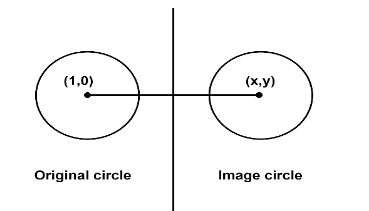
The radius of both the circles is the same (in image the size of the circle will remain same and so does the radius).
Now,
y = 3 – x can be written as x + y – 3
The image of (1, 0) with line is given by:
$\dfrac{{x - {x_1}}}{l} = \dfrac{{y - {y_1}}}{m} = \dfrac{{ - 2(xl + gm + n)}}{{{l^2} + {m^2}}}$
Here, we have
\[{x_1} = 1\] \[l = 1\] \[{y_1} = 0\] \[m = 1\] \[n = - 3\]
Where x and y are the centres of the image circle.
Substituting the values, we get:
$\dfrac{{x - 1}}{1} = \dfrac{{y - 0}}{1} = \dfrac{{ - 2(1 + 0 - 3)}}{{1 + 1}}$
$x = 3$,$y = 2$
Therefore centre of image circle (x,y) is (3,2)
From the general equation of circle, we get the equation of image circle:
${(x - 3)^2} + {(y - 2)^2} = 1$
${x^2} + 9 - 6x + {y^2} + 4 - 4y = 1$ [Simplifying]
${x^2} + {y^2} - 6x - 4y + 12$
Therefore, equation of mirror image of circle \[{x^2} + {y^2} - 2x = 0\] with the line y = 3 – x is ${x^2} + {y^2} - 6x - 4y + 12 = 0$ and the correct option is D).
So, the correct answer is “Option D”.
Note: General equation of a circle can also be
${x^2} + {y^2} + 2gx + 2fy + c = 0$
For this, the centres are (-g , -f) and radius is $\sqrt {{g^2} + {f^2} - c} $
We use either of them according to the question.
Line is generally given as: $y = mx + c$
For this question, the line was y = 3 – x so the values of m and c are:
m=-1 and c=3
The image formed will be exactly opposite, in the same line and plane, and will have the same radius but not the centre with respect to the original circle.
General equation of a circle:
${(x - h)^2} + {(y - k)^2} = {r^2}$
Where h and k are centre and r is radius of the circle.
Complete step-by-step answer:
Given equation of circle is ${x^2} + {y^2} - 2x = 0$
Calculating centre and radius:
${x^2} + {y^2} - 2x$ can be written as ${x^2} + {y^2} - 2x - 1 + 1$ [solving by completing the square]
$({x^2} - 2x + 1) + {y^2} - 1 = 0$
${(x - 1)^2} + {(y - 0)^2} = 1$
Comparing it with general equation of circle, we get:
Centre as (1, 0) and radius as 1.
Let the centre of image circle be ( x , y )
Then the diagram according to the question, can be given as:
The radius of both the circles is the same (in image the size of the circle will remain same and so does the radius).
Now,
y = 3 – x can be written as x + y – 3
The image of (1, 0) with line is given by:
$\dfrac{{x - {x_1}}}{l} = \dfrac{{y - {y_1}}}{m} = \dfrac{{ - 2(xl + gm + n)}}{{{l^2} + {m^2}}}$
Here, we have
\[{x_1} = 1\] \[l = 1\] \[{y_1} = 0\] \[m = 1\] \[n = - 3\]
Where x and y are the centres of the image circle.
Substituting the values, we get:
$\dfrac{{x - 1}}{1} = \dfrac{{y - 0}}{1} = \dfrac{{ - 2(1 + 0 - 3)}}{{1 + 1}}$
$x = 3$,$y = 2$
Therefore centre of image circle (x,y) is (3,2)
From the general equation of circle, we get the equation of image circle:
${(x - 3)^2} + {(y - 2)^2} = 1$
${x^2} + 9 - 6x + {y^2} + 4 - 4y = 1$ [Simplifying]
${x^2} + {y^2} - 6x - 4y + 12$
Therefore, equation of mirror image of circle \[{x^2} + {y^2} - 2x = 0\] with the line y = 3 – x is ${x^2} + {y^2} - 6x - 4y + 12 = 0$ and the correct option is D).
So, the correct answer is “Option D”.
Note: General equation of a circle can also be
${x^2} + {y^2} + 2gx + 2fy + c = 0$
For this, the centres are (-g , -f) and radius is $\sqrt {{g^2} + {f^2} - c} $
We use either of them according to the question.
Line is generally given as: $y = mx + c$
For this question, the line was y = 3 – x so the values of m and c are:
m=-1 and c=3
Recently Updated Pages
If x a + bt + ct2 where x is in meters and t is in class 11 physics CBSE

A car covers the first half distance between two places class 11 physics CBSE
The resultant of two vectors overrightarrow P and overrightarrow class 11 physics CBSE
Find the value of cos 135 class 11 maths CBSE
A mass M is held in place by an applied force F and class 11 physics CBSE
A solution of glucose in water is labelled as 10 dfracwv class 11 chemistry CBSE
Trending doubts
Find the value of the expression given below sin 30circ class 11 maths CBSE
What is the maximum height of a projectile class 11 physics CBSE
Derive an expression for maximum height and range of class 11 physics CBSE
Describe various types of epithelial tissues with the class 11 biology CBSE
Lysosomes are known as suicidal bags of cell why class 11 biology CBSE
State and derive law of conservation of momentum class 11 physics CBSE