




The equation of incircle of the triangle formed by the axes and the line $4x + 3y = 6$
A.${x^2} + {y^2} - 6x - 6y = 0$
B.\[4\left( {{x^2} + {y^2} - x - y} \right) + 1 = 0\]
C.\[4\left( {{x^2} + {y^2} + x + y} \right) + 1 = 0\]
D.None of these
Answer
 Verified
629.1k+ views
Hint: First we calculate the end point of the coordinate axes by putting $x = y = 0$ in the given equation, so we get the coordinates. Then we calculate the radius of the inscribed circle by using the formula. After that we get the equation of radius of circle and then solve the equation we get the value of radius.
Formula: $\dfrac{{ - b \pm \sqrt {{b^2} - 4ac} }}{{2a}}$
Complete step-by-step answer:
Given equation is $4x + 3y = 6$
Consider the diagram
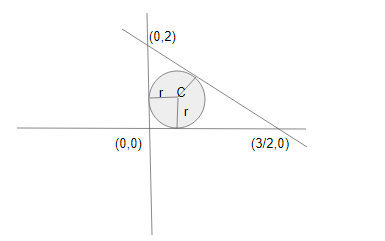
Find the endpoints of the coordinate axes:
Put
$
x = 0 \\
0 + 3y = 6 \\
\Rightarrow 3y = 6 \\
\Rightarrow y = 2 \\
$
Now put
$
y = 0 \\
4x + 0 = 6 \\
\Rightarrow 4x = 6 \\
\Rightarrow x = \dfrac{3}{2} \\
$
Now we get three coordinate axes
$
\left( {0,0} \right) \\
\left( {0,2} \right) \\
\left( {\dfrac{3}{2},0} \right) \\
$
Now the coordinate of circle centre is C$\left( {r,r} \right)$
\[
\dfrac{{\left| {4r + 3r - 6} \right|}}{5} = r \\
\Rightarrow {\left( {7r - 6} \right)^2} = 25{r^2} \\
\Rightarrow 49{r^2} - 84r + 36 = 25{r^2} \\
\Rightarrow 24{r^2} - 84r + 36 = 0 \\
{\text{On dividing the equation by 6}} \\
\Rightarrow {\text{4}}{{\text{r}}^2} - 14r + 6 = 0 \\
{\text{on dividing the equation by 2}} \\
\Rightarrow {\text{2}}{{\text{r}}^2} - 7r + 3 = 0 \\
\]
This is the final equation, now get the value of r
using the formula
\[
\dfrac{{ - b \pm \sqrt {{b^2} - 4ac} }}{{2a}} \\
a = 2 \\
b = - 7 \\
c = 3 \\
\dfrac{{ + 7 \pm \sqrt {{7^2} - 4 \times 2 \times 3} }}{{2 \times 2}} \\
\Rightarrow \dfrac{{ + 7 \pm \sqrt {49 - 24} }}{4} \\
\Rightarrow \dfrac{{7 \pm \sqrt {25} }}{4} \\
\Rightarrow \dfrac{{7 \pm 5}}{4} \\
\Rightarrow {r_1} = \dfrac{{7 + 5}}{4} = \dfrac{{12}}{4} = 3 \\
\Rightarrow {r_2} = \dfrac{{7 - 5}}{4} = \dfrac{2}{4} = \dfrac{1}{2} \\
\] $r = 3$
Now put the values $r = 3,\dfrac{1}{2},0$ as the value of $x,y$ in given equation
\[
4x + 3y - 6 = 0 \\
{\text{put r}} = 3 \\
4 \times 3 + 3 \times 3 - 6 = 12 + 9 - 6 = 15 \\
{\text{put r}} = \dfrac{1}{2} \\
4x + 3y - 6 = 0 \\
4 \times \dfrac{1}{2} + 3 \times \dfrac{1}{2} - 6 = 2 + 1.5 - 6 = - 2.5 \\
{\text{put r}} = 0 \\
4x + 3y - 6 = 0 \\
4 \times 0 + 3 \times 0 - 6 = - 6 \\
\]
Only gives positive result rest are negative terms so ignore them
Put $r = 3$ in circle equation
\[
{\left( {x - \dfrac{1}{2}} \right)^2} + {\left( {y - \dfrac{1}{2}} \right)^2} = \dfrac{1}{4} \\
\Rightarrow {x^2} + \dfrac{1}{4} - x + {y^2} + \dfrac{1}{4} - y = \dfrac{1}{4} \\
\Rightarrow \left( {{x^2} + {y^2} - x - y} \right) + 2/4 = \dfrac{1}{4} \\
\Rightarrow 4\left( {{x^2} + {y^2} - x - y} \right) + 1=0 \\
\]
This is our answer
Hence Option B is the right answer.
Note: First we have calculated all the coordinate axes of \[x,y\], then put these values in the original equation then find the coordinates of centre r , after that calculate all the values of r by using the formula. And finally put these values in the equation of the circle. Hence we get our answer.
Formula: $\dfrac{{ - b \pm \sqrt {{b^2} - 4ac} }}{{2a}}$
Complete step-by-step answer:
Given equation is $4x + 3y = 6$
Consider the diagram
Find the endpoints of the coordinate axes:
Put
$
x = 0 \\
0 + 3y = 6 \\
\Rightarrow 3y = 6 \\
\Rightarrow y = 2 \\
$
Now put
$
y = 0 \\
4x + 0 = 6 \\
\Rightarrow 4x = 6 \\
\Rightarrow x = \dfrac{3}{2} \\
$
Now we get three coordinate axes
$
\left( {0,0} \right) \\
\left( {0,2} \right) \\
\left( {\dfrac{3}{2},0} \right) \\
$
Now the coordinate of circle centre is C$\left( {r,r} \right)$
\[
\dfrac{{\left| {4r + 3r - 6} \right|}}{5} = r \\
\Rightarrow {\left( {7r - 6} \right)^2} = 25{r^2} \\
\Rightarrow 49{r^2} - 84r + 36 = 25{r^2} \\
\Rightarrow 24{r^2} - 84r + 36 = 0 \\
{\text{On dividing the equation by 6}} \\
\Rightarrow {\text{4}}{{\text{r}}^2} - 14r + 6 = 0 \\
{\text{on dividing the equation by 2}} \\
\Rightarrow {\text{2}}{{\text{r}}^2} - 7r + 3 = 0 \\
\]
This is the final equation, now get the value of r
using the formula
\[
\dfrac{{ - b \pm \sqrt {{b^2} - 4ac} }}{{2a}} \\
a = 2 \\
b = - 7 \\
c = 3 \\
\dfrac{{ + 7 \pm \sqrt {{7^2} - 4 \times 2 \times 3} }}{{2 \times 2}} \\
\Rightarrow \dfrac{{ + 7 \pm \sqrt {49 - 24} }}{4} \\
\Rightarrow \dfrac{{7 \pm \sqrt {25} }}{4} \\
\Rightarrow \dfrac{{7 \pm 5}}{4} \\
\Rightarrow {r_1} = \dfrac{{7 + 5}}{4} = \dfrac{{12}}{4} = 3 \\
\Rightarrow {r_2} = \dfrac{{7 - 5}}{4} = \dfrac{2}{4} = \dfrac{1}{2} \\
\] $r = 3$
Now put the values $r = 3,\dfrac{1}{2},0$ as the value of $x,y$ in given equation
\[
4x + 3y - 6 = 0 \\
{\text{put r}} = 3 \\
4 \times 3 + 3 \times 3 - 6 = 12 + 9 - 6 = 15 \\
{\text{put r}} = \dfrac{1}{2} \\
4x + 3y - 6 = 0 \\
4 \times \dfrac{1}{2} + 3 \times \dfrac{1}{2} - 6 = 2 + 1.5 - 6 = - 2.5 \\
{\text{put r}} = 0 \\
4x + 3y - 6 = 0 \\
4 \times 0 + 3 \times 0 - 6 = - 6 \\
\]
Only gives positive result rest are negative terms so ignore them
Put $r = 3$ in circle equation
\[
{\left( {x - \dfrac{1}{2}} \right)^2} + {\left( {y - \dfrac{1}{2}} \right)^2} = \dfrac{1}{4} \\
\Rightarrow {x^2} + \dfrac{1}{4} - x + {y^2} + \dfrac{1}{4} - y = \dfrac{1}{4} \\
\Rightarrow \left( {{x^2} + {y^2} - x - y} \right) + 2/4 = \dfrac{1}{4} \\
\Rightarrow 4\left( {{x^2} + {y^2} - x - y} \right) + 1=0 \\
\]
This is our answer
Hence Option B is the right answer.
Note: First we have calculated all the coordinate axes of \[x,y\], then put these values in the original equation then find the coordinates of centre r , after that calculate all the values of r by using the formula. And finally put these values in the equation of the circle. Hence we get our answer.
Recently Updated Pages
Master Class 12 Economics: Engaging Questions & Answers for Success

Master Class 12 English: Engaging Questions & Answers for Success
Master Class 12 Social Science: Engaging Questions & Answers for Success
Master Class 12 Maths: Engaging Questions & Answers for Success
Master Class 12 Physics: Engaging Questions & Answers for Success
Master Class 11 Social Science: Engaging Questions & Answers for Success
Trending doubts
One Metric ton is equal to kg A 10000 B 1000 C 100 class 11 physics CBSE
Difference Between Prokaryotic Cells and Eukaryotic Cells
Two of the body parts which do not appear in MRI are class 11 biology CBSE
1 ton equals to A 100 kg B 1000 kg C 10 kg D 10000 class 11 physics CBSE
Draw a diagram of nephron and explain its structur class 11 biology CBSE
10 examples of friction in our daily life