




The equation of a stationary wave is $y = sin\left(\dfrac{\pi}{3}x\right)cos(10\pi t)$, where x and y are in cm. What is the distance between adjacent nodes?
A. 2 cm
B. 3 cm
C. 6 cm
D. 4 cm
Answer
 Verified
601.8k+ views
Hint: Compare the given equation with the standard stationary wave equation and deduce what the value of the propagation constant is. Using the relation between the propagation constant and wavelength over an entire cycle of vibration, determine the wavelength of the vibration. Now, using the fact that the distance between adjacent nodes is half the wavelength of a vibration, numerically arrive at the appropriate solution.
Formula used:
propagation constant $k =\dfrac{2\pi}{\lambda}$
Distance between adjacent nodes: $d =\dfrac{\lambda}{2}$
Complete answer:
Let us begin by understanding what stationary waves are.
Stationary waves, also known as standing waves, are formed as a result of an interference of two progressive waves of the same type, same amplitude and same frequency, travelling in opposite directions along the same line of propagation.
Due to this stationary wave formation, particles at some points of the medium do not vibrate at all. These points of zero amplitude are called nodes. However, particles at some other points of the medium vibrate with maximum amplitude. These points of maximum amplitude are called antinodes.
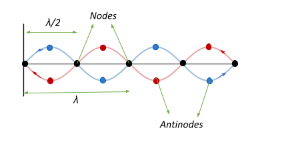
In a stationary wave, the distance between two successive nodes (or antinodes) is $\lambda/2$, where $\lambda$ is the wavelength of the wave.
Now, the general form of a stationary wave equation is:
$y = asin(kx)cos(\omega t)$, where a is the amplitude of vibration, k is the propagation constant, $\omega$ is the angular frequency and t is the instantaneous time.
The given stationary wave equation is:
$y = sin\left(\dfrac{\pi}{3}x\right)cos(10\pi t)$
Comparing the two equations, we see that $k = \dfrac{\pi}{3}$.
The propagation constant k is generally expressed in terms of wavelength as: $k = \dfrac{2\pi}{\lambda}$
Equating the two, we get:
$\dfrac{\pi}{3} = \dfrac{2\pi}{\lambda} \Rightarrow \lambda = 6\;cm$
The distance between consecutive nodes is thus, $\dfrac{\lambda}{2} = \dfrac{6}{2} = 3\;cm$
So, the correct answer is “Option B”.
Note:
Always remember that for a standing wave, the nodes and antinodes are alternately produced with a distance between a node and an antinode being $\lambda/4$, and the distance between two successive nodes (or antinodes) is $\lambda/2$.
Formula used:
propagation constant $k =\dfrac{2\pi}{\lambda}$
Distance between adjacent nodes: $d =\dfrac{\lambda}{2}$
Complete answer:
Let us begin by understanding what stationary waves are.
Stationary waves, also known as standing waves, are formed as a result of an interference of two progressive waves of the same type, same amplitude and same frequency, travelling in opposite directions along the same line of propagation.
Due to this stationary wave formation, particles at some points of the medium do not vibrate at all. These points of zero amplitude are called nodes. However, particles at some other points of the medium vibrate with maximum amplitude. These points of maximum amplitude are called antinodes.
In a stationary wave, the distance between two successive nodes (or antinodes) is $\lambda/2$, where $\lambda$ is the wavelength of the wave.
Now, the general form of a stationary wave equation is:
$y = asin(kx)cos(\omega t)$, where a is the amplitude of vibration, k is the propagation constant, $\omega$ is the angular frequency and t is the instantaneous time.
The given stationary wave equation is:
$y = sin\left(\dfrac{\pi}{3}x\right)cos(10\pi t)$
Comparing the two equations, we see that $k = \dfrac{\pi}{3}$.
The propagation constant k is generally expressed in terms of wavelength as: $k = \dfrac{2\pi}{\lambda}$
Equating the two, we get:
$\dfrac{\pi}{3} = \dfrac{2\pi}{\lambda} \Rightarrow \lambda = 6\;cm$
The distance between consecutive nodes is thus, $\dfrac{\lambda}{2} = \dfrac{6}{2} = 3\;cm$
So, the correct answer is “Option B”.
Note:
Always remember that for a standing wave, the nodes and antinodes are alternately produced with a distance between a node and an antinode being $\lambda/4$, and the distance between two successive nodes (or antinodes) is $\lambda/2$.
Recently Updated Pages
Master Class 11 Social Science: Engaging Questions & Answers for Success

Master Class 11 Physics: Engaging Questions & Answers for Success
Master Class 11 Maths: Engaging Questions & Answers for Success
Master Class 11 Economics: Engaging Questions & Answers for Success
Master Class 11 Computer Science: Engaging Questions & Answers for Success
Master Class 11 Chemistry: Engaging Questions & Answers for Success
Trending doubts
One Metric ton is equal to kg A 10000 B 1000 C 100 class 11 physics CBSE
How many bones are in the spine class 11 biology CBSE
1 Quintal is equal to a 110 kg b 10 kg c 100kg d 1000 class 11 physics CBSE
There are 720 permutations of the digits 1 2 3 4 5 class 11 maths CBSE
State and prove Bernoullis theorem class 11 physics CBSE
Difference Between Prokaryotic Cells and Eukaryotic Cells