




The ellipse $\dfrac{{{x}^{2}}}{25}+\dfrac{{{y}^{2}}}{16}=1$ and the hyperbola $\dfrac{{{x}^{2}}}{25}-\dfrac{{{y}^{2}}}{16}=1$, have in common
A. centre only
B. centre, foci and directrices
C. centre, foci and vertices
D. centre and vertices only
Answer
 Verified
599.1k+ views
Hint: We first define the general equation of ellipse and hyperbola and their different parts. We then equate that with the given equations. Using the values, we find out the common characteristics of those two conics.
Complete step by step answer:
We have been given two conics, one of ellipse and one hyperbola.
We first define the general equation of ellipse and its different parts.
General equation of ellipse is $\dfrac{{{\left( x-\alpha \right)}^{2}}}{{{a}^{2}}}+\dfrac{{{\left( y-\beta \right)}^{2}}}{{{b}^{2}}}=1$. The eccentricity of the ellipse is \[e=\sqrt{1-\dfrac{{{b}^{2}}}{{{a}^{2}}}}\].
The centre will be $\left( \alpha ,\beta \right)$. Coordinates of vertices are $\left( \alpha \pm a,\beta \right)$. Coordinates of foci are $\left( \alpha \pm ae,\beta \right)$. Equations of the directrices are $x=\alpha \pm \dfrac{a}{e}$.
Now for our given equation $\dfrac{{{x}^{2}}}{25}+\dfrac{{{y}^{2}}}{16}=1$. Equating we get $\alpha =0,\beta =0,a=5,b=4$.
The eccentricity of the ellipse is \[e=\sqrt{1-\dfrac{{{4}^{2}}}{{{5}^{2}}}}=\dfrac{3}{5}\].
The centre will be $\left( 0,0 \right)$. Coordinates of vertices are $\left( \pm 5,0 \right)$. Coordinates of foci are $\left( \pm 3,0 \right)$. Equations of the directrices are $x=\pm \dfrac{25}{3}$.
We now define the general equation of hyperbola and its different parts.
General equation of ellipse is $\dfrac{{{\left( x-\alpha \right)}^{2}}}{{{a}^{2}}}-\dfrac{{{\left( y-\beta \right)}^{2}}}{{{b}^{2}}}=1$. The eccentricity of the ellipse is \[e=\sqrt{1+\dfrac{{{b}^{2}}}{{{a}^{2}}}}\].
The centre will be $\left( \alpha ,\beta \right)$. Coordinates of vertices are $\left( \alpha \pm a,\beta \right)$. Coordinates of foci are $\left( \alpha \pm ae,\beta \right)$. Equations of the directrices are $x=\alpha \pm \dfrac{a}{e}$.
Now for our given equation $\dfrac{{{x}^{2}}}{25}-\dfrac{{{y}^{2}}}{16}=1$. Equating we get $\alpha =0,\beta =0,a=5,b=4$.
The eccentricity of the ellipse is \[e=\sqrt{1+\dfrac{{{4}^{2}}}{{{5}^{2}}}}=\dfrac{\sqrt{41}}{5}\].
The centre will be $\left( 0,0 \right)$. Coordinates of vertices are $\left( \pm 5,0 \right)$. Coordinates of foci are $\left( \pm \sqrt{41},0 \right)$. Equations of the directrices are $x=\pm \dfrac{25}{\sqrt{41}}$.
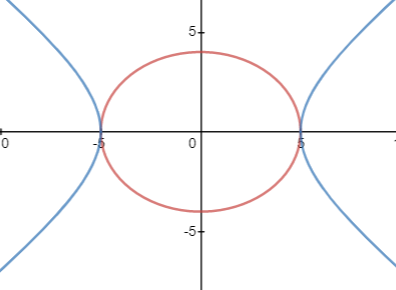
So, we can see for the ellipse $\dfrac{{{x}^{2}}}{25}+\dfrac{{{y}^{2}}}{16}=1$ and the hyperbola $\dfrac{{{x}^{2}}}{25}-\dfrac{{{y}^{2}}}{16}=1$, they have their centre and vertices in common.
So, the correct answer is “Option D”.
Note: The changes happened because of the value of the eccentricity. It has been used in cases of Coordinates of foci and equations of the directrices which are $\left( \alpha \pm ae,\beta \right)$ and $x=\alpha \pm \dfrac{a}{e}$ respectively.
Complete step by step answer:
We have been given two conics, one of ellipse and one hyperbola.
We first define the general equation of ellipse and its different parts.
General equation of ellipse is $\dfrac{{{\left( x-\alpha \right)}^{2}}}{{{a}^{2}}}+\dfrac{{{\left( y-\beta \right)}^{2}}}{{{b}^{2}}}=1$. The eccentricity of the ellipse is \[e=\sqrt{1-\dfrac{{{b}^{2}}}{{{a}^{2}}}}\].
The centre will be $\left( \alpha ,\beta \right)$. Coordinates of vertices are $\left( \alpha \pm a,\beta \right)$. Coordinates of foci are $\left( \alpha \pm ae,\beta \right)$. Equations of the directrices are $x=\alpha \pm \dfrac{a}{e}$.
Now for our given equation $\dfrac{{{x}^{2}}}{25}+\dfrac{{{y}^{2}}}{16}=1$. Equating we get $\alpha =0,\beta =0,a=5,b=4$.
The eccentricity of the ellipse is \[e=\sqrt{1-\dfrac{{{4}^{2}}}{{{5}^{2}}}}=\dfrac{3}{5}\].
The centre will be $\left( 0,0 \right)$. Coordinates of vertices are $\left( \pm 5,0 \right)$. Coordinates of foci are $\left( \pm 3,0 \right)$. Equations of the directrices are $x=\pm \dfrac{25}{3}$.
We now define the general equation of hyperbola and its different parts.
General equation of ellipse is $\dfrac{{{\left( x-\alpha \right)}^{2}}}{{{a}^{2}}}-\dfrac{{{\left( y-\beta \right)}^{2}}}{{{b}^{2}}}=1$. The eccentricity of the ellipse is \[e=\sqrt{1+\dfrac{{{b}^{2}}}{{{a}^{2}}}}\].
The centre will be $\left( \alpha ,\beta \right)$. Coordinates of vertices are $\left( \alpha \pm a,\beta \right)$. Coordinates of foci are $\left( \alpha \pm ae,\beta \right)$. Equations of the directrices are $x=\alpha \pm \dfrac{a}{e}$.
Now for our given equation $\dfrac{{{x}^{2}}}{25}-\dfrac{{{y}^{2}}}{16}=1$. Equating we get $\alpha =0,\beta =0,a=5,b=4$.
The eccentricity of the ellipse is \[e=\sqrt{1+\dfrac{{{4}^{2}}}{{{5}^{2}}}}=\dfrac{\sqrt{41}}{5}\].
The centre will be $\left( 0,0 \right)$. Coordinates of vertices are $\left( \pm 5,0 \right)$. Coordinates of foci are $\left( \pm \sqrt{41},0 \right)$. Equations of the directrices are $x=\pm \dfrac{25}{\sqrt{41}}$.
So, we can see for the ellipse $\dfrac{{{x}^{2}}}{25}+\dfrac{{{y}^{2}}}{16}=1$ and the hyperbola $\dfrac{{{x}^{2}}}{25}-\dfrac{{{y}^{2}}}{16}=1$, they have their centre and vertices in common.
So, the correct answer is “Option D”.
Note: The changes happened because of the value of the eccentricity. It has been used in cases of Coordinates of foci and equations of the directrices which are $\left( \alpha \pm ae,\beta \right)$ and $x=\alpha \pm \dfrac{a}{e}$ respectively.
Recently Updated Pages
Master Class 11 English: Engaging Questions & Answers for Success

Master Class 11 Maths: Engaging Questions & Answers for Success
Class 11 Question and Answer - Your Ultimate Solutions Guide
Master Class 11 Biology: Engaging Questions & Answers for Success
Master Class 11 Physics: Engaging Questions & Answers for Success
Master Class 11 Accountancy: Engaging Questions & Answers for Success
Trending doubts
Differentiate between an exothermic and an endothermic class 11 chemistry CBSE
One Metric ton is equal to kg A 10000 B 1000 C 100 class 11 physics CBSE
There are 720 permutations of the digits 1 2 3 4 5 class 11 maths CBSE
In what year Guru Nanak Dev ji was born A15 April 1469 class 11 social science CBSE
Difference Between Prokaryotic Cells and Eukaryotic Cells
Draw a diagram of a plant cell and label at least eight class 11 biology CBSE