




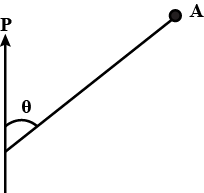
The electric field at a point A is perpendicular to the direction of dipole moment $\overrightarrow{P}$ of a short electric dipole. The angle $\theta $ is equal to:
$\begin{align}
& (1){{0}^{0}} \\
& (2){{90}^{0}} \\
& (3){{\tan }^{-1}}(2) \\
& (4){{\tan }^{-1}}(\sqrt{2}) \\
\end{align}$
Answer
 Verified
589.2k+ views
Hint: Since, it has been given to us in the problem that the electric field is perpendicular to the direction of short dipole, then we will use the property of the dipole which states the relation between the angles made by the dipole at A and the angle made by the direction of net electric field with the line joining the dipole to the respective point.
Complete answer:
We have, the angle made by the dipole with the point at which the electric field is perpendicular is given by $\theta $ .
Now, also let us assume the angle made by the direction of the net electric field with the line joining the dipole to the respective point is given by $\alpha $.
Then from the property of a very small dipole moment, these angles can be related as:
$\Rightarrow \tan \alpha =\dfrac{\tan \theta }{2}$ [Let this expression be equation number (1)]
Also, we know that:
$\begin{align}
& \Rightarrow \alpha +\theta ={{90}^{0}} \\
& \Rightarrow \alpha ={{(90-\theta )}^{0}} \\
\end{align}$
Taking tangent both side, we get the new equation as:
$\Rightarrow \tan \alpha =\tan (90-\theta )$
From the trigonometric properties of tangent and cotangent, we know that:
$\Rightarrow \tan (90-\theta )=\cot \theta $
Thus, our above equation is further reduced to:
$\Rightarrow \tan \alpha =\cot \theta $
$\Rightarrow \tan \alpha =\dfrac{1}{\tan \theta }$ [Let this expression be equation number (2)]
Then, using the value of $\tan \alpha $ from equation number (2) in to equation number (1), we get the new equation as:
$\begin{align}
& \Rightarrow \dfrac{1}{\tan \theta }=\dfrac{\tan \theta }{2} \\
& \Rightarrow {{\tan }^{2}}\theta =2 \\
\end{align}$
Taking square roots both sides, we get:
$\Rightarrow \tan \theta =\sqrt{2}$
Now, taking tan inverse both sides, we get the value of $\theta $ as:
$\Rightarrow \theta ={{\tan }^{-1}}\sqrt{2}$
Hence, the value of $\theta $ comes out to be ${{\tan }^{-1}}\sqrt{2}$ .
Hence, option (d) is the correct option.
Note:
The basic properties of a very short dipole is a very useful concept. Also, we should always keep in mind the derivations behind all these properties and under what assumptions and conditions do these properties work accurately.
Complete answer:
We have, the angle made by the dipole with the point at which the electric field is perpendicular is given by $\theta $ .
Now, also let us assume the angle made by the direction of the net electric field with the line joining the dipole to the respective point is given by $\alpha $.
Then from the property of a very small dipole moment, these angles can be related as:
$\Rightarrow \tan \alpha =\dfrac{\tan \theta }{2}$ [Let this expression be equation number (1)]
Also, we know that:
$\begin{align}
& \Rightarrow \alpha +\theta ={{90}^{0}} \\
& \Rightarrow \alpha ={{(90-\theta )}^{0}} \\
\end{align}$
Taking tangent both side, we get the new equation as:
$\Rightarrow \tan \alpha =\tan (90-\theta )$
From the trigonometric properties of tangent and cotangent, we know that:
$\Rightarrow \tan (90-\theta )=\cot \theta $
Thus, our above equation is further reduced to:
$\Rightarrow \tan \alpha =\cot \theta $
$\Rightarrow \tan \alpha =\dfrac{1}{\tan \theta }$ [Let this expression be equation number (2)]
Then, using the value of $\tan \alpha $ from equation number (2) in to equation number (1), we get the new equation as:
$\begin{align}
& \Rightarrow \dfrac{1}{\tan \theta }=\dfrac{\tan \theta }{2} \\
& \Rightarrow {{\tan }^{2}}\theta =2 \\
\end{align}$
Taking square roots both sides, we get:
$\Rightarrow \tan \theta =\sqrt{2}$
Now, taking tan inverse both sides, we get the value of $\theta $ as:
$\Rightarrow \theta ={{\tan }^{-1}}\sqrt{2}$
Hence, the value of $\theta $ comes out to be ${{\tan }^{-1}}\sqrt{2}$ .
Hence, option (d) is the correct option.
Note:
The basic properties of a very short dipole is a very useful concept. Also, we should always keep in mind the derivations behind all these properties and under what assumptions and conditions do these properties work accurately.
Recently Updated Pages
Basicity of sulphurous acid and sulphuric acid are

Master Class 12 Economics: Engaging Questions & Answers for Success
Master Class 12 Biology: Engaging Questions & Answers for Success
Master Class 11 English: Engaging Questions & Answers for Success
Master Class 11 Physics: Engaging Questions & Answers for Success
Master Class 11 Computer Science: Engaging Questions & Answers for Success
Trending doubts
Draw a labelled sketch of the human eye class 12 physics CBSE
The chemical formula of tear gas is A CO Cl 2 B C 10 class 12 chemistry CBSE
Draw ray diagrams each showing i myopic eye and ii class 12 physics CBSE
Which are the Top 10 Largest Countries of the World?
Differentiate between homogeneous and heterogeneous class 12 chemistry CBSE
Which is the correct genotypic ratio of mendel dihybrid class 12 biology CBSE