




The egg of placental mammals are
A . Microlecithal
B. Alecithal
C . Mesolecithal
D . Homolecithal
Answer
 Verified
645.3k+ views
Hint:-
Since the embryo obtains maternal nutritional support throughout most of its development that is why Mammalian eggs have very little yolk so Placental mammals like humans have alecithal eggs.
Complete step-by-step solution:-Most of the animal contains yolk it is a mixture of proteins, phospholipids and fats which serves nutrition for the developing embryo. The amount of yolk and the distribution of yolk vary among different animal groups it depends on the need of embryo
Mammalian eggs contain very less amount of yolk and it is called alecithal eggs. While some other animal eggs contain sufficient yolk like birds and reptiles must contain sufficient yolk to sustain the embryo until hatching.
Since in humans the developing embryo remains connected to the mother and obtains nutrition from the mother through the placenta. That is why their egg has a negligible amount of yolk and they are alecithal.
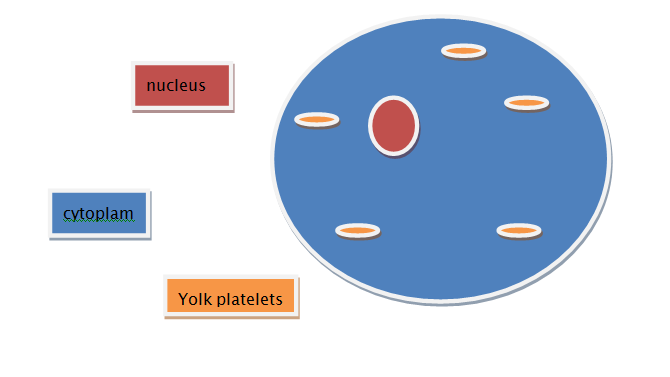
Alecithal contain negligible yolk as you can see in the fig
So option B is correct
Note:-
Microlecithal-These eggs contain small amounts of yolk or reserved food. These types of eggs are called 'Microlecithal eggs'. Some examples- these eggs are found in Amphioxus, Cephalochordates, Tunicates and Eutherian mammals.
Mesolicithal-This type of egg contains an enormous (large) amount of yolk such eggs are known as 'Macrolecithal eggs'. These eggs are found in cartilaginous and bony fishes, reptiles, birds, prototherian mammals and insects.
Homolecithal- in these types of eggs the total amount of yolk is small and fairly uniformly distributed throughout the cytoplasm. Homolecithal eggs are found in amphioxus, tunicates and mammals, sea urchin.
Since the embryo obtains maternal nutritional support throughout most of its development that is why Mammalian eggs have very little yolk so Placental mammals like humans have alecithal eggs.
Complete step-by-step solution:-Most of the animal contains yolk it is a mixture of proteins, phospholipids and fats which serves nutrition for the developing embryo. The amount of yolk and the distribution of yolk vary among different animal groups it depends on the need of embryo
Mammalian eggs contain very less amount of yolk and it is called alecithal eggs. While some other animal eggs contain sufficient yolk like birds and reptiles must contain sufficient yolk to sustain the embryo until hatching.
Since in humans the developing embryo remains connected to the mother and obtains nutrition from the mother through the placenta. That is why their egg has a negligible amount of yolk and they are alecithal.
Alecithal contain negligible yolk as you can see in the fig
So option B is correct
Note:-
Microlecithal-These eggs contain small amounts of yolk or reserved food. These types of eggs are called 'Microlecithal eggs'. Some examples- these eggs are found in Amphioxus, Cephalochordates, Tunicates and Eutherian mammals.
Mesolicithal-This type of egg contains an enormous (large) amount of yolk such eggs are known as 'Macrolecithal eggs'. These eggs are found in cartilaginous and bony fishes, reptiles, birds, prototherian mammals and insects.
Homolecithal- in these types of eggs the total amount of yolk is small and fairly uniformly distributed throughout the cytoplasm. Homolecithal eggs are found in amphioxus, tunicates and mammals, sea urchin.
Recently Updated Pages
Which of the following graphs shows the variation of class 12 physics CBSE

Draw a labelled diagram of the human male reproductive class 12 biology CBSE
Describe the experiment to compare the emf of two cells class 12 physics CBSE
What is standard hydrogen electrode
What is conventional current and electric current class 12 physics CBSE
2Bromopentane is treated with an alcoholic KOH solution class 12 chemistry CBSE
Trending doubts
Draw a labelled sketch of the human eye class 12 physics CBSE
Which are the Top 10 Largest Countries of the World?
Draw ray diagrams each showing i myopic eye and ii class 12 physics CBSE
Give one example of a reptile that is viviparous class 12 biology CBSE
Which is the correct genotypic ratio of mendel dihybrid class 12 biology CBSE
Give 10 examples of unisexual and bisexual flowers