




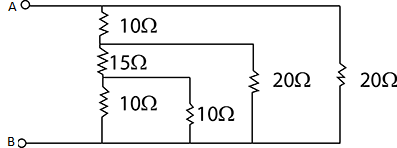
The effective resistance between A and B is:
(A) $ 10\Omega $
(B) $ 20\Omega $
(C) $ 30\Omega $
(D) $ 20.2\Omega $
Answer
 Verified
526.8k+ views
Hint: In order to solve this question, we will be using the laws of addition of resistances in series as well as in parallel. We will be solving the question step by step and find the equivalent resistance between A and B.
The formulae to add the resistances in series and parallel are given respectively as
$ R={{R}_{1}}+{{R}_{2}} $
And $ \dfrac{1}{R}=\dfrac{1}{{{R}_{1}}}+\dfrac{1}{{{R}_{2}}} $ .
Complete step by step answer:
Now using the law of addition of resistances, we will be dividing the circuits and then solving.
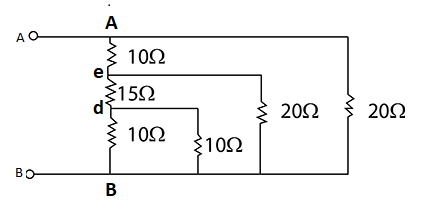
Therefore, first of all we will name the points d and e in the circuit as shown in the figure.
Now, our first step will be calculating the equivalent resistance across B-d. The two resistances connecting the points B and d are in parallel with each other and so, using the law for addition of resistances who are in parallel, we get
$ \begin{align}
& \dfrac{1}{{{R}_{eq}}}=\dfrac{1}{{{R}_{1}}}+\dfrac{1}{{{R}_{2}}} \\
& \Rightarrow \dfrac{1}{{{R}_{eBd}}}=\dfrac{1}{10}+\dfrac{1}{10} \\
& \Rightarrow \dfrac{1}{{{R}_{eBd}}}=\dfrac{1}{5} \\
& \Rightarrow {{R}_{eBd}}=5\Omega \\
\end{align} $
Now, our next step will be to calculate the equivalent resistance across B-e. The two resistances that will be in series with each other, i.e., $ {{R}_{ed}} $ is in series with $ {{R}_{eBd}} $ . And these two resistances are in parallel with the other resistance in B-e. Therefore, calculating the equivalent resistance of B-e, we get
$ \begin{align}
& {{R}_{Be}}={{R}_{eBd}}+{{R}_{de}} \\
& \Rightarrow {{R}_{eB}}=5+15 \\
& \Rightarrow {{R}_{eB}}=20\Omega \\
\end{align} $
And
$ \begin{align}
& \dfrac{1}{{{R}_{eq}}}=\dfrac{1}{{{R}_{1}}}+\dfrac{1}{{{R}_{2}}} \\
& \Rightarrow \dfrac{1}{{{R}_{eBe}}}=\dfrac{1}{20}+\dfrac{1}{20} \\
& \Rightarrow \dfrac{1}{{{R}_{eBe}}}=\dfrac{2}{20} \\
& \Rightarrow {{R}_{eBe}}=10\Omega \\
\end{align} $
Now, the third and our final step will be to calculate the equivalent resistance across B-A. The two resistances that will be in series with each other, i.e., $ {{R}_{Ae}} $ are in series with $ {{R}_{eBe}} $ . And these two resistances are in parallel with the other resistance in B-A. Therefore, calculating the equivalent resistance of B-A, we get
$ \begin{align}
& {{R}_{BA}}={{R}_{eBe}}+{{R}_{Ae}} \\
& \Rightarrow {{R}_{BA}}=10+10 \\
& \Rightarrow {{R}_{BA}}=20\Omega \\
\end{align} $
And
$ \begin{align}
& \dfrac{1}{{{R}_{eq}}}=\dfrac{1}{{{R}_{1}}}+\dfrac{1}{{{R}_{2}}} \\
& \Rightarrow \dfrac{1}{{{R}_{eBA}}}=\dfrac{1}{20}+\dfrac{1}{20} \\
& \Rightarrow \dfrac{1}{{{R}_{eBA}}}=\dfrac{2}{20} \\
& \Rightarrow {{R}_{eBA}}=10\Omega \\
& \\
\end{align} $
Therefore, the answer to our question will be option (A).
Note:
Keep in mind to use the equivalent resistance calculated for each part in the following next calculation and also to look and evaluate the figure according to the calculations. The subscript $ e $ in the calculation is for the equivalent resistance.
The formulae to add the resistances in series and parallel are given respectively as
$ R={{R}_{1}}+{{R}_{2}} $
And $ \dfrac{1}{R}=\dfrac{1}{{{R}_{1}}}+\dfrac{1}{{{R}_{2}}} $ .
Complete step by step answer:
Now using the law of addition of resistances, we will be dividing the circuits and then solving.
Therefore, first of all we will name the points d and e in the circuit as shown in the figure.
Now, our first step will be calculating the equivalent resistance across B-d. The two resistances connecting the points B and d are in parallel with each other and so, using the law for addition of resistances who are in parallel, we get
$ \begin{align}
& \dfrac{1}{{{R}_{eq}}}=\dfrac{1}{{{R}_{1}}}+\dfrac{1}{{{R}_{2}}} \\
& \Rightarrow \dfrac{1}{{{R}_{eBd}}}=\dfrac{1}{10}+\dfrac{1}{10} \\
& \Rightarrow \dfrac{1}{{{R}_{eBd}}}=\dfrac{1}{5} \\
& \Rightarrow {{R}_{eBd}}=5\Omega \\
\end{align} $
Now, our next step will be to calculate the equivalent resistance across B-e. The two resistances that will be in series with each other, i.e., $ {{R}_{ed}} $ is in series with $ {{R}_{eBd}} $ . And these two resistances are in parallel with the other resistance in B-e. Therefore, calculating the equivalent resistance of B-e, we get
$ \begin{align}
& {{R}_{Be}}={{R}_{eBd}}+{{R}_{de}} \\
& \Rightarrow {{R}_{eB}}=5+15 \\
& \Rightarrow {{R}_{eB}}=20\Omega \\
\end{align} $
And
$ \begin{align}
& \dfrac{1}{{{R}_{eq}}}=\dfrac{1}{{{R}_{1}}}+\dfrac{1}{{{R}_{2}}} \\
& \Rightarrow \dfrac{1}{{{R}_{eBe}}}=\dfrac{1}{20}+\dfrac{1}{20} \\
& \Rightarrow \dfrac{1}{{{R}_{eBe}}}=\dfrac{2}{20} \\
& \Rightarrow {{R}_{eBe}}=10\Omega \\
\end{align} $
Now, the third and our final step will be to calculate the equivalent resistance across B-A. The two resistances that will be in series with each other, i.e., $ {{R}_{Ae}} $ are in series with $ {{R}_{eBe}} $ . And these two resistances are in parallel with the other resistance in B-A. Therefore, calculating the equivalent resistance of B-A, we get
$ \begin{align}
& {{R}_{BA}}={{R}_{eBe}}+{{R}_{Ae}} \\
& \Rightarrow {{R}_{BA}}=10+10 \\
& \Rightarrow {{R}_{BA}}=20\Omega \\
\end{align} $
And
$ \begin{align}
& \dfrac{1}{{{R}_{eq}}}=\dfrac{1}{{{R}_{1}}}+\dfrac{1}{{{R}_{2}}} \\
& \Rightarrow \dfrac{1}{{{R}_{eBA}}}=\dfrac{1}{20}+\dfrac{1}{20} \\
& \Rightarrow \dfrac{1}{{{R}_{eBA}}}=\dfrac{2}{20} \\
& \Rightarrow {{R}_{eBA}}=10\Omega \\
& \\
\end{align} $
Therefore, the answer to our question will be option (A).
Note:
Keep in mind to use the equivalent resistance calculated for each part in the following next calculation and also to look and evaluate the figure according to the calculations. The subscript $ e $ in the calculation is for the equivalent resistance.
Recently Updated Pages
Master Class 12 Business Studies: Engaging Questions & Answers for Success

Master Class 12 Biology: Engaging Questions & Answers for Success
Master Class 12 Chemistry: Engaging Questions & Answers for Success
Class 12 Question and Answer - Your Ultimate Solutions Guide
Complete reduction of benzene diazonium chloride with class 12 chemistry CBSE
How can you identify optical isomers class 12 chemistry CBSE
Trending doubts
Which are the Top 10 Largest Countries of the World?
What are the major means of transport Explain each class 12 social science CBSE
Draw a labelled sketch of the human eye class 12 physics CBSE
Differentiate between insitu conservation and exsitu class 12 biology CBSE
Draw a neat and well labeled diagram of TS of ovary class 12 biology CBSE
Differentiate between homogeneous and heterogeneous class 12 chemistry CBSE