




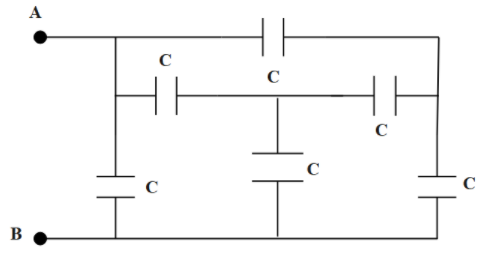
The effective capacitance between A and B will be
A. 6C
B. 4C
C. 2C
D. none of the above
Answer
 Verified
586.5k+ views
Hint: We are given a circuit which consists of capacitors connected to it. In order to find the solution, let us make two portions of the circuit. We can see that the bottom portion is the Wheatstone bridge network. It is a simple circuit used for measuring an unknown resistance by connecting it in order to form a quadrilateral with three known resistances and applying a voltage between a pair of opposite corners.
Complete answer:
So, we will apply the balancing condition to calculate the equivalent capacitance of the bottom part. Then, to calculate the capacitance between A and B we will take the parallel combination.
Let us name each capacitor in order to make the solution easy,
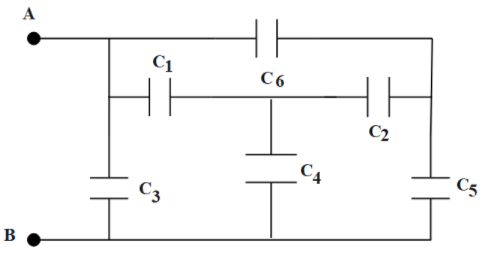
From the circuit, ${C_4}$ is connected parallelly with the rest of the combined capacitors. So, we will draw a simplified circuit
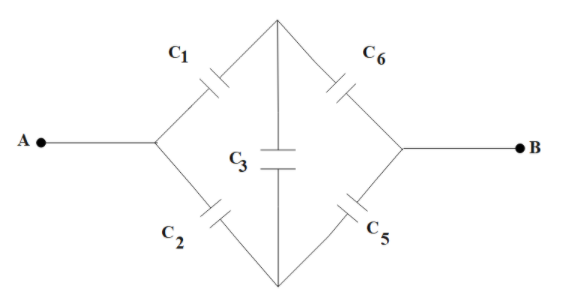
Here, $C'$is the combined capacitance of the capacitors excluding ${C_4}$.
Now, we see that the rest of the circuit is equivalent to the Wheatstone bridge network. So, when we will apply the balance condition to the Wheatstone network, then ${C_3}$ could be neglected.
Now, the resulting circuit we will get is,
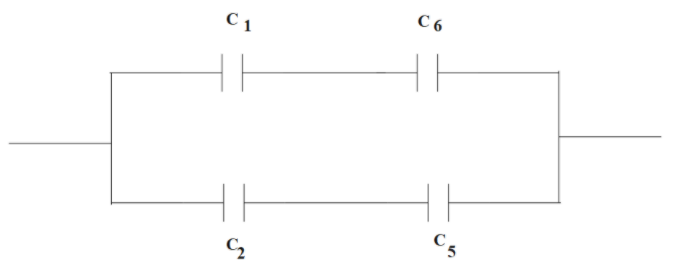
Using the series combination in the upper portion we will find the equivalent capacitance,
$\eqalign{
& \dfrac{1}{{C''}} = \dfrac{1}{{{C_1}}} + \dfrac{1}{{{C_6}}} \cr
& \Rightarrow \dfrac{1}{{C''}} = \dfrac{{{C_1} + {C_6}}}{{{C_1} \times {C_6}}} \cr
& \Rightarrow C'' = \dfrac{{{C_1} \times {C_6}}}{{{C_1} + {C_6}}} \cr} $
Similarly, using the series combination in the bottom portion we will find the equivalent capacitance,
$\eqalign{
& \dfrac{1}{{C'''}} = \dfrac{1}{{{C_2}}} + \dfrac{1}{{{C_5}}} \cr
& \Rightarrow \dfrac{1}{{C'''}} = \dfrac{{{C_2} + {C_5}}}{{{C_2} \times {C_5}}} \cr
& \Rightarrow C''' = \dfrac{{{C_2} \times {C_5}}}{{{C_2} + {C_5}}} \cr} $
As we can see that $C''$ and $C'''$are in series so equivalent capacitance is given as,
$\eqalign{
& C' = C'' + C''' \cr
& \Rightarrow C' = \dfrac{{{C_1}{C_6}}}{{{C_1} + {C_6}}} + \dfrac{{{C_2}{C_5}}}{{{C_2} + {C_5}}} \cr} $
Since, ${C_1} = {C_6} = {C_2} = {C_5} = C$
$\eqalign{
& C' = \dfrac{{C.C}}{{C + C}} + \dfrac{{C.C}}{{C + C}} \cr
& \Rightarrow C' = \dfrac{{{C^2}}}{{2C}} + \dfrac{{{C^2}}}{{2C}} \cr
& \Rightarrow C' = \dfrac{C}{2} + \dfrac{C}{2} \cr
& \Rightarrow C' = C \cr} $
$\therefore {C_{eq}} = {C_4} + C = C + C = 2C$
Thus, the effective capacitance between A and B will be 2C.
Hence, option (C) is the correct answer.
Note:
A capacitor is defined as an electrical component which connects the circuit. It is used to store the charge and also to accumulate the charge. It is a system which consists of two conductors.
Complete answer:
So, we will apply the balancing condition to calculate the equivalent capacitance of the bottom part. Then, to calculate the capacitance between A and B we will take the parallel combination.
Let us name each capacitor in order to make the solution easy,
From the circuit, ${C_4}$ is connected parallelly with the rest of the combined capacitors. So, we will draw a simplified circuit
Here, $C'$is the combined capacitance of the capacitors excluding ${C_4}$.
Now, we see that the rest of the circuit is equivalent to the Wheatstone bridge network. So, when we will apply the balance condition to the Wheatstone network, then ${C_3}$ could be neglected.
Now, the resulting circuit we will get is,
Using the series combination in the upper portion we will find the equivalent capacitance,
$\eqalign{
& \dfrac{1}{{C''}} = \dfrac{1}{{{C_1}}} + \dfrac{1}{{{C_6}}} \cr
& \Rightarrow \dfrac{1}{{C''}} = \dfrac{{{C_1} + {C_6}}}{{{C_1} \times {C_6}}} \cr
& \Rightarrow C'' = \dfrac{{{C_1} \times {C_6}}}{{{C_1} + {C_6}}} \cr} $
Similarly, using the series combination in the bottom portion we will find the equivalent capacitance,
$\eqalign{
& \dfrac{1}{{C'''}} = \dfrac{1}{{{C_2}}} + \dfrac{1}{{{C_5}}} \cr
& \Rightarrow \dfrac{1}{{C'''}} = \dfrac{{{C_2} + {C_5}}}{{{C_2} \times {C_5}}} \cr
& \Rightarrow C''' = \dfrac{{{C_2} \times {C_5}}}{{{C_2} + {C_5}}} \cr} $
As we can see that $C''$ and $C'''$are in series so equivalent capacitance is given as,
$\eqalign{
& C' = C'' + C''' \cr
& \Rightarrow C' = \dfrac{{{C_1}{C_6}}}{{{C_1} + {C_6}}} + \dfrac{{{C_2}{C_5}}}{{{C_2} + {C_5}}} \cr} $
Since, ${C_1} = {C_6} = {C_2} = {C_5} = C$
$\eqalign{
& C' = \dfrac{{C.C}}{{C + C}} + \dfrac{{C.C}}{{C + C}} \cr
& \Rightarrow C' = \dfrac{{{C^2}}}{{2C}} + \dfrac{{{C^2}}}{{2C}} \cr
& \Rightarrow C' = \dfrac{C}{2} + \dfrac{C}{2} \cr
& \Rightarrow C' = C \cr} $
$\therefore {C_{eq}} = {C_4} + C = C + C = 2C$
Thus, the effective capacitance between A and B will be 2C.
Hence, option (C) is the correct answer.
Note:
A capacitor is defined as an electrical component which connects the circuit. It is used to store the charge and also to accumulate the charge. It is a system which consists of two conductors.
Recently Updated Pages
Master Class 11 Social Science: Engaging Questions & Answers for Success

Master Class 11 Physics: Engaging Questions & Answers for Success
Master Class 11 Maths: Engaging Questions & Answers for Success
Master Class 11 Economics: Engaging Questions & Answers for Success
Master Class 11 Computer Science: Engaging Questions & Answers for Success
Master Class 11 Chemistry: Engaging Questions & Answers for Success
Trending doubts
One Metric ton is equal to kg A 10000 B 1000 C 100 class 11 physics CBSE
There are 720 permutations of the digits 1 2 3 4 5 class 11 maths CBSE
1 Quintal is equal to a 110 kg b 10 kg c 100kg d 1000 class 11 physics CBSE
State and prove Bernoullis theorem class 11 physics CBSE
Difference Between Prokaryotic Cells and Eukaryotic Cells
Which among the following are examples of coming together class 11 social science CBSE