




The effect of temperature on the value of Young’s modulus of elasticity for various substances in general is
A. It increases with increase in temperature
B. It remains constant
C. It decreases with rise in temperature
D. It sometimes increases and sometimes decrease with temperature
Answer
 Verified
627.3k+ views
Hint: Young’s modulus of material gives the measure of up to what limit we can expand or compress a body in which the body will retain its original form again. This property is due to the atomic forces between the atoms in a material. With change in temperature some internal properties of the material changes and with it the young’s modulus also changes.
Complete step by step answer:
Elasticity of a material can be defined as the ability of the material to resist a distorting influence on the material by an external force and to return to its original shape when the external influence is removed.
Young’s modulus is a mechanical property of solids which gives the stiffness of the material. It can also be defined as the ability of the material to withstand changes in the shape of the material under expansion or compression.
The Young’s modulus of a material depends on the temperature of the material. When the temperature of material increases, the atomic vibrations in the crystal structure also increases. This increase in the atomic vibration also increases the atomic distances in the crystal and with the atomic force decreases. This decrease in atomic forces leads to decrease in the young’s modulus of the material.
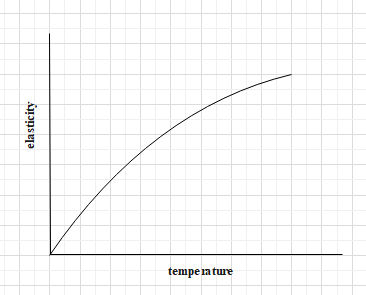
So, the effect of temperature on the value of Young’s modulus of elasticity for various substances in general is that it decreases with rise in temperature.
The correct option is (C).
Note:
When we increase the temperature of a material, up to the temperature of 400K, Young’s modulus decreases appreciably. When the temperature rises above the 400K, it decreases with a lower rate and at a very high temperature it is almost constant.
Complete step by step answer:
Elasticity of a material can be defined as the ability of the material to resist a distorting influence on the material by an external force and to return to its original shape when the external influence is removed.
Young’s modulus is a mechanical property of solids which gives the stiffness of the material. It can also be defined as the ability of the material to withstand changes in the shape of the material under expansion or compression.
The Young’s modulus of a material depends on the temperature of the material. When the temperature of material increases, the atomic vibrations in the crystal structure also increases. This increase in the atomic vibration also increases the atomic distances in the crystal and with the atomic force decreases. This decrease in atomic forces leads to decrease in the young’s modulus of the material.
So, the effect of temperature on the value of Young’s modulus of elasticity for various substances in general is that it decreases with rise in temperature.
The correct option is (C).
Note:
When we increase the temperature of a material, up to the temperature of 400K, Young’s modulus decreases appreciably. When the temperature rises above the 400K, it decreases with a lower rate and at a very high temperature it is almost constant.
Recently Updated Pages
Master Class 11 English: Engaging Questions & Answers for Success

Master Class 11 Social Science: Engaging Questions & Answers for Success
Master Class 11 Maths: Engaging Questions & Answers for Success
Master Class 11 Biology: Engaging Questions & Answers for Success
Master Class 11 Physics: Engaging Questions & Answers for Success
Master Class 11 Chemistry: Engaging Questions & Answers for Success
Trending doubts
One Metric ton is equal to kg A 10000 B 1000 C 100 class 11 physics CBSE
Difference Between Prokaryotic Cells and Eukaryotic Cells
Difference between physical and chemical change class 11 chemistry CBSE
Find the value of the expression given below sin 30circ class 11 maths CBSE
Two of the body parts which do not appear in MRI are class 11 biology CBSE
Draw a diagram of a plant cell and label at least eight class 11 biology CBSE