




The edges of a cube are 20 cm. How many small cubes of 5 cm can be formed from this cube?
(A) 4
(B) 32
(C) 64
(D) 100
Answer
 Verified
624.6k+ views
Hint: Use the formula of volume of a cube, \[\text{Volume = }\left( \text{edge} \right)\times \left( \text{edge} \right)\times \left( \text{edge} \right)\] . Using this formula, get the volume of the bigger cube and the smaller cube. Assume the number of smaller cubes be x. The, calculate the volume of x number of smaller cubes. Since the smaller cubes are formed from the bigger cube, the volume of all smaller cubes is equal to the volume of the bigger cube. Now, solve it further.
Complete step by step solution:
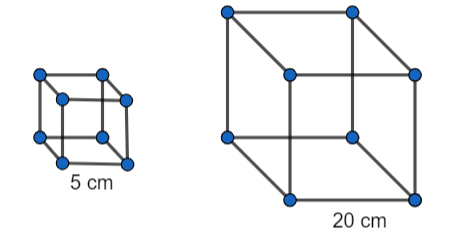
According to the question, it is given that the edges of the cube are equal to 20 cm. We have to find the number of cubes whose edges are equal to 5 cm that can be formed from the bigger cube.
The edges of the bigger cube = 20 cm ………………(1)
The edges of the smaller cube = 5 cm ………………….(2)
We know the formula to get the volume of a cube, \[\text{Volume = }\left( \text{edge} \right)\times \left( \text{edge} \right)\times \left( \text{edge} \right)\]………………..(3)
From equation (1), we have the edges of a bigger cube.
Now, putting the value of edges of the bigger cube in equation (3), we get
\[\text{Volume of bigger cube= }\left( \text{edge} \right)\times \left( \text{edge} \right)\times \left( \text{edge} \right)\]
\[\Rightarrow \text{Volume of bigger cube=}\left( 20\text{ cm} \right)\times \left( 20\text{ cm} \right)\times \left( 20\text{ cm} \right)\] …………………………(4)
From equation (2), we have the edges of a smaller cube.
Now, putting the value of edges of the smaller cube in equation (3), we get
\[\text{Volume = }\left( \text{edge} \right)\times \left( \text{edge} \right)\times \left( \text{edge} \right)\]
\[\Rightarrow \text{Volume =}\left( 5\text{ cm} \right)\times \left( 5\text{ cm} \right)\times \left( \text{5 cm} \right)\] …………………………(5)
Let the number of smaller cubes be x.
From equation (5), we have
The volume of 1 smaller cube = \[\left( 5\text{ cm} \right)\times \left( 5\text{ cm} \right)\times \left( \text{5 cm} \right)\] .
The volume of x number of smaller cubes = \[x\left( 5\text{ cm} \right)\times \left( 5\text{ cm} \right)\times \left( \text{5 cm} \right)\] ……………………………(6)
Since the smaller cubes are formed from the bigger cube, the volume of all smaller cubes is equal to the volume of the bigger cube. So,
Volume of the bigger cube = Volume of all smaller cubes ………………….(7)
From equation (4), equation (6), and equation (7), we have
Volume of the bigger cube = Total volume of all smaller cubes
\[\begin{align}
& \Rightarrow \left( 20\text{ cm} \right)\times \left( 20\text{ cm} \right)\times \left( 20\text{ cm} \right)=x\left( 5\text{ cm} \right)\times \left( 5\text{ cm} \right)\times \left( \text{5 cm} \right) \\
& \Rightarrow \dfrac{\left( 20\text{ cm} \right)\times \left( 20\text{ cm} \right)\times \left( 20\text{ cm} \right)}{\left( 5\text{ cm} \right)\times \left( 5\text{ cm} \right)\times \left( \text{5 cm} \right)}=x \\
& \Rightarrow 4\times 4\times 4=x \\
& \Rightarrow 64=x \\
\end{align}\]
Therefore, the number of smaller cubes is 64.
Hence, the correct option is (C).
Note: We can also solve this question directly by using the formula.
\[\text{Number of smaller cubes=}\dfrac{\text{Volume of bigger cube}}{\text{Total volume of smaller cube}}\]
The volume of smaller cube = \[\left( 5\text{ cm} \right)\times \left( 5\text{ cm} \right)\times \left( \text{5 cm} \right)\] .
The volume of bigger cube = \[\left( 20\text{ cm} \right)\times \left( 20\text{ cm} \right)\times \left( 20\text{ cm} \right)\] .
Now, the number of smaller cubes = \[\dfrac{\left( 20\text{ cm} \right)\times \left( 20\text{ cm} \right)\times \left( 20\text{ cm} \right)}{\left( 5\text{ cm} \right)\times \left( 5\text{ cm} \right)\times \left( \text{5 cm} \right)}=4\times 4\times 4=64\] .
Therefore, the number of smaller cubes is 64.
Hence, the correct option is (C).
Complete step by step solution:
According to the question, it is given that the edges of the cube are equal to 20 cm. We have to find the number of cubes whose edges are equal to 5 cm that can be formed from the bigger cube.
The edges of the bigger cube = 20 cm ………………(1)
The edges of the smaller cube = 5 cm ………………….(2)
We know the formula to get the volume of a cube, \[\text{Volume = }\left( \text{edge} \right)\times \left( \text{edge} \right)\times \left( \text{edge} \right)\]………………..(3)
From equation (1), we have the edges of a bigger cube.
Now, putting the value of edges of the bigger cube in equation (3), we get
\[\text{Volume of bigger cube= }\left( \text{edge} \right)\times \left( \text{edge} \right)\times \left( \text{edge} \right)\]
\[\Rightarrow \text{Volume of bigger cube=}\left( 20\text{ cm} \right)\times \left( 20\text{ cm} \right)\times \left( 20\text{ cm} \right)\] …………………………(4)
From equation (2), we have the edges of a smaller cube.
Now, putting the value of edges of the smaller cube in equation (3), we get
\[\text{Volume = }\left( \text{edge} \right)\times \left( \text{edge} \right)\times \left( \text{edge} \right)\]
\[\Rightarrow \text{Volume =}\left( 5\text{ cm} \right)\times \left( 5\text{ cm} \right)\times \left( \text{5 cm} \right)\] …………………………(5)
Let the number of smaller cubes be x.
From equation (5), we have
The volume of 1 smaller cube = \[\left( 5\text{ cm} \right)\times \left( 5\text{ cm} \right)\times \left( \text{5 cm} \right)\] .
The volume of x number of smaller cubes = \[x\left( 5\text{ cm} \right)\times \left( 5\text{ cm} \right)\times \left( \text{5 cm} \right)\] ……………………………(6)
Since the smaller cubes are formed from the bigger cube, the volume of all smaller cubes is equal to the volume of the bigger cube. So,
Volume of the bigger cube = Volume of all smaller cubes ………………….(7)
From equation (4), equation (6), and equation (7), we have
Volume of the bigger cube = Total volume of all smaller cubes
\[\begin{align}
& \Rightarrow \left( 20\text{ cm} \right)\times \left( 20\text{ cm} \right)\times \left( 20\text{ cm} \right)=x\left( 5\text{ cm} \right)\times \left( 5\text{ cm} \right)\times \left( \text{5 cm} \right) \\
& \Rightarrow \dfrac{\left( 20\text{ cm} \right)\times \left( 20\text{ cm} \right)\times \left( 20\text{ cm} \right)}{\left( 5\text{ cm} \right)\times \left( 5\text{ cm} \right)\times \left( \text{5 cm} \right)}=x \\
& \Rightarrow 4\times 4\times 4=x \\
& \Rightarrow 64=x \\
\end{align}\]
Therefore, the number of smaller cubes is 64.
Hence, the correct option is (C).
Note: We can also solve this question directly by using the formula.
\[\text{Number of smaller cubes=}\dfrac{\text{Volume of bigger cube}}{\text{Total volume of smaller cube}}\]
The volume of smaller cube = \[\left( 5\text{ cm} \right)\times \left( 5\text{ cm} \right)\times \left( \text{5 cm} \right)\] .
The volume of bigger cube = \[\left( 20\text{ cm} \right)\times \left( 20\text{ cm} \right)\times \left( 20\text{ cm} \right)\] .
Now, the number of smaller cubes = \[\dfrac{\left( 20\text{ cm} \right)\times \left( 20\text{ cm} \right)\times \left( 20\text{ cm} \right)}{\left( 5\text{ cm} \right)\times \left( 5\text{ cm} \right)\times \left( \text{5 cm} \right)}=4\times 4\times 4=64\] .
Therefore, the number of smaller cubes is 64.
Hence, the correct option is (C).
Recently Updated Pages
Master Class 12 Business Studies: Engaging Questions & Answers for Success

Master Class 12 Biology: Engaging Questions & Answers for Success
Master Class 12 Chemistry: Engaging Questions & Answers for Success
Class 12 Question and Answer - Your Ultimate Solutions Guide
Master Class 11 Social Science: Engaging Questions & Answers for Success
Master Class 11 English: Engaging Questions & Answers for Success
Trending doubts
Explain the Treaty of Vienna of 1815 class 10 social science CBSE
Who Won 36 Oscar Awards? Record Holder Revealed
What is the median of the first 10 natural numbers class 10 maths CBSE
Why is it 530 pm in india when it is 1200 afternoon class 10 social science CBSE
What is the full form of POSCO class 10 social science CBSE
The highest temperature in Karnataka is recorded in class 10 social science CBSE