




The eccentric angle of the point where the line, \[5x3y=8\sqrt{2}\] is a normal to the ellipse $\dfrac{{{x}^{2}}}{25}+\dfrac{{{y}^{2}}}{9}=1$ is
(A). $\dfrac{3\pi }{4}$
(B). $\dfrac{\pi }{4}$
(C). $\dfrac{\pi }{6}$
(D). ${{\tan }^{-1}}\left( 2 \right)$
Answer
 Verified
628.2k+ views
Hint: As we know that the general equation of ellipse is $\dfrac{{{x}^{2}}}{{{a}^{2}}}+\dfrac{{{y}^{2}}}{{{b}^{2}}}=1$ and normal to the ellipse at the point $P\left( a\cos \theta ,b\sin \theta \right)\text{ is }ax\sec \theta -by\csc \theta ={{a}^{2}}-{{b}^{2}}$. By comparing the given ellipse and actual ellipse equation, we get the length of major axis and length of minor axis. Then, we compare the normal equation given in the question with the general normal equation to get the angle $\theta $ which is the required answer.
Complete step-by-step solution -
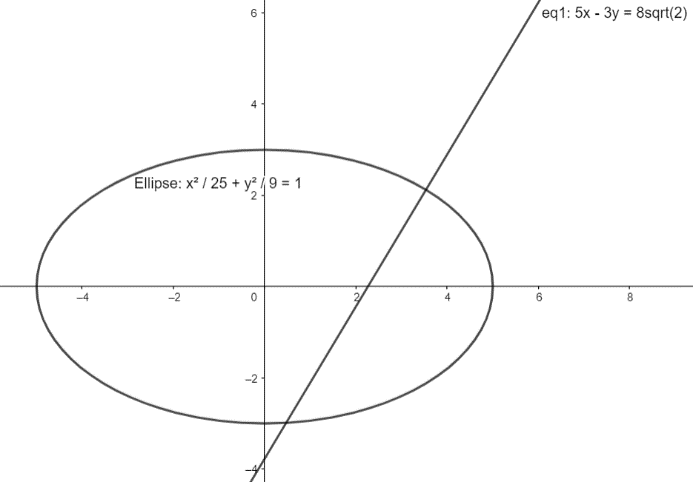
The general equation of the ellipse is at the point $P\left( a\cos \theta ,b\sin \theta \right)$ is $\dfrac{{{x}^{2}}}{{{a}^{2}}}+\dfrac{{{y}^{2}}}{{{b}^{2}}}=1$.
According to the problem statement, we are given an ellipse equation as $\dfrac{{{x}^{2}}}{{{5}^{2}}}+\dfrac{{{y}^{2}}}{{{3}^{2}}}=1$.
By comparing it with the general equation, we get the length of the major axis, a = 5 and the length of minor axis, b = 3.
Putting the values of major and minor axis in equation $ax\sec \theta -by\csc \theta ={{a}^{2}}-{{b}^{2}}$, the required equation of normal can be given as:
$\begin{align}
& \Rightarrow 5x\sec \theta -3y\csc \theta ={{5}^{2}}-{{3}^{2}} \\
& \Rightarrow 5x\sec \theta -3y\csc \theta =16...\left( 1 \right) \\
\end{align}$
Also, the given normal equation in question:
$\Rightarrow 5x-3y=8\sqrt{2}\ldots \left( 2 \right)$
Multiplying the equation (2) with $\sqrt{2}$, we get:
$\Rightarrow 5\sqrt{2}x-3\sqrt{2}y=16...\left( 3 \right)$
By comparing both the equation (1) and equation (3), the value of $\sec \theta $ is $\sqrt{2}$ and $\csc \theta $ is $\sqrt{2}$.
We know that the value of $\sec \theta \text{ is }\sqrt{2}$ and $\csc \theta \text{ is }\sqrt{2}$ respectively, when the value of $\theta \text{ is }\dfrac{\pi }{4}$.
$\therefore \theta =\dfrac{\pi }{4}$
Hence, the eccentric angle of the point where the line, \[5x3y=8\sqrt{2}\] is a normal to the ellipse $\dfrac{{{x}^{2}}}{25}+\dfrac{{{y}^{2}}}{9}=1$ is $\dfrac{\pi }{4}.$
Hence, option (b) is correct.
Note: The key steps involved in solving this problem is the conversion of given problem equations into standard form. By doing so, we can obtain the values of variables, and thus obtain the desired angle. The knowledge of trigonometric ratio at standard angles is also required to determine the final value.
Complete step-by-step solution -
The general equation of the ellipse is at the point $P\left( a\cos \theta ,b\sin \theta \right)$ is $\dfrac{{{x}^{2}}}{{{a}^{2}}}+\dfrac{{{y}^{2}}}{{{b}^{2}}}=1$.
According to the problem statement, we are given an ellipse equation as $\dfrac{{{x}^{2}}}{{{5}^{2}}}+\dfrac{{{y}^{2}}}{{{3}^{2}}}=1$.
By comparing it with the general equation, we get the length of the major axis, a = 5 and the length of minor axis, b = 3.
Putting the values of major and minor axis in equation $ax\sec \theta -by\csc \theta ={{a}^{2}}-{{b}^{2}}$, the required equation of normal can be given as:
$\begin{align}
& \Rightarrow 5x\sec \theta -3y\csc \theta ={{5}^{2}}-{{3}^{2}} \\
& \Rightarrow 5x\sec \theta -3y\csc \theta =16...\left( 1 \right) \\
\end{align}$
Also, the given normal equation in question:
$\Rightarrow 5x-3y=8\sqrt{2}\ldots \left( 2 \right)$
Multiplying the equation (2) with $\sqrt{2}$, we get:
$\Rightarrow 5\sqrt{2}x-3\sqrt{2}y=16...\left( 3 \right)$
By comparing both the equation (1) and equation (3), the value of $\sec \theta $ is $\sqrt{2}$ and $\csc \theta $ is $\sqrt{2}$.
We know that the value of $\sec \theta \text{ is }\sqrt{2}$ and $\csc \theta \text{ is }\sqrt{2}$ respectively, when the value of $\theta \text{ is }\dfrac{\pi }{4}$.
$\therefore \theta =\dfrac{\pi }{4}$
Hence, the eccentric angle of the point where the line, \[5x3y=8\sqrt{2}\] is a normal to the ellipse $\dfrac{{{x}^{2}}}{25}+\dfrac{{{y}^{2}}}{9}=1$ is $\dfrac{\pi }{4}.$
Hence, option (b) is correct.
Note: The key steps involved in solving this problem is the conversion of given problem equations into standard form. By doing so, we can obtain the values of variables, and thus obtain the desired angle. The knowledge of trigonometric ratio at standard angles is also required to determine the final value.
Recently Updated Pages
Master Class 11 Social Science: Engaging Questions & Answers for Success

Master Class 11 Physics: Engaging Questions & Answers for Success
Master Class 11 Maths: Engaging Questions & Answers for Success
Master Class 11 Economics: Engaging Questions & Answers for Success
Master Class 11 Computer Science: Engaging Questions & Answers for Success
Master Class 11 Chemistry: Engaging Questions & Answers for Success
Trending doubts
One Metric ton is equal to kg A 10000 B 1000 C 100 class 11 physics CBSE
There are 720 permutations of the digits 1 2 3 4 5 class 11 maths CBSE
1 Quintal is equal to a 110 kg b 10 kg c 100kg d 1000 class 11 physics CBSE
State and prove Bernoullis theorem class 11 physics CBSE
Difference Between Prokaryotic Cells and Eukaryotic Cells
Which among the following are examples of coming together class 11 social science CBSE