




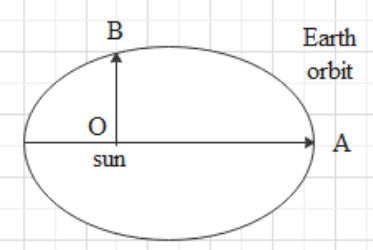
The earth moves around the Sun in an elliptical orbit as shown in the given figure. The ratio $\dfrac{OA}{OB}=x$ . The ratio of the speed of the earth at B to that at A is nearly:
(A). $\sqrt{x}$
(B). x
(C). $x\sqrt{x}$
(D). ${{x}^{2}}$
Answer
 Verified
645.3k+ views
Hint: Try to understand the motion of earth around the sun and learn about how gravitational effects this motion. Try to understand where we can use the conservation laws. Here we are applying the law of conservation of momentum. So, try to study about it.
Complete step by step answer:
The earth is moving around the sun in an elliptical orbit.
Given, the ration of the distance from the sun to earth in two positions A and B is
$\dfrac{OA}{OB}=x$
Now, we need to find the ratio of velocities of earth at the two points.
The earth and the sun are connected by the gravitational force.
To find the ratio of velocities at the two points we can use the law of conservation of angular momentum, because in this system external torque is zero.
From the laws of conservation of angular momentum,
Angular momentum of earth at point B is equal to the angular momentum of earth at point A.
$\begin{align}
& m{{v}_{B}}{{r}_{B}}=m{{v}_{A}}{{r}_{A}} \\
& {{v}_{B}}{{r}_{B}}={{v}_{A}}{{r}_{A}} \\
& \dfrac{{{v}_{B}}}{{{v}_{A}}}=\dfrac{{{r}_{A}}}{{{r}_{B}}} \\
& \dfrac{{{v}_{B}}}{{{v}_{A}}}=\dfrac{OA}{OB} \\
& \dfrac{{{v}_{B}}}{{{v}_{A}}}=x \\
\end{align}$
So, the ratio of velocity of earth at point B to the point A is x.
The correct option is (B).
Note: The earth orbits the sun in an elliptical orbit. The external torque on the earth in its orbit is zero. It is because the gravitational force on the earth is towards the sun and the direction of position vector is also along the direction of earth to sun. Since, torque is defined as the cross product of the force and position vector and the force and position vectors are parallel here, the total external torque on earth is also zero.
Complete step by step answer:
The earth is moving around the sun in an elliptical orbit.
Given, the ration of the distance from the sun to earth in two positions A and B is
$\dfrac{OA}{OB}=x$
Now, we need to find the ratio of velocities of earth at the two points.
The earth and the sun are connected by the gravitational force.
To find the ratio of velocities at the two points we can use the law of conservation of angular momentum, because in this system external torque is zero.
From the laws of conservation of angular momentum,
Angular momentum of earth at point B is equal to the angular momentum of earth at point A.
$\begin{align}
& m{{v}_{B}}{{r}_{B}}=m{{v}_{A}}{{r}_{A}} \\
& {{v}_{B}}{{r}_{B}}={{v}_{A}}{{r}_{A}} \\
& \dfrac{{{v}_{B}}}{{{v}_{A}}}=\dfrac{{{r}_{A}}}{{{r}_{B}}} \\
& \dfrac{{{v}_{B}}}{{{v}_{A}}}=\dfrac{OA}{OB} \\
& \dfrac{{{v}_{B}}}{{{v}_{A}}}=x \\
\end{align}$
So, the ratio of velocity of earth at point B to the point A is x.
The correct option is (B).
Note: The earth orbits the sun in an elliptical orbit. The external torque on the earth in its orbit is zero. It is because the gravitational force on the earth is towards the sun and the direction of position vector is also along the direction of earth to sun. Since, torque is defined as the cross product of the force and position vector and the force and position vectors are parallel here, the total external torque on earth is also zero.
Recently Updated Pages
Master Class 5 English: Engaging Questions & Answers for Success

Master Class 5 Maths: Engaging Questions & Answers for Success
Master Class 5 Social Science: Engaging Questions & Answers for Success
Master Class 5 Science: Engaging Questions & Answers for Success
Class 5 Question and Answer - Your Ultimate Solutions Guide
Master Class 9 General Knowledge: Engaging Questions & Answers for Success
Trending doubts
One Metric ton is equal to kg A 10000 B 1000 C 100 class 11 physics CBSE
What is cell theory Who formulated it class 11 biology CBSE
Phyllotaxy is the arrangement of ALeaflets BLeaves class 11 biology CBSE
Difference Between Prokaryotic Cells and Eukaryotic Cells
The symbiotic association of fungi and algae is called class 11 biology CBSE
Cell theory was formulated by A Schleiden and Schwann class 11 biology CBSE