




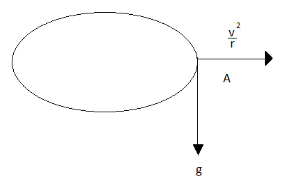
The ear-ring of a lady shown in figure $ \left( {12 - E18} \right) $ has a $ 3cm $ long light suspension wire. (a) Find the time period of small oscillations if the lady is standing on the ground. (b) The lady now sits in a merry-go-round moving at $ 4m{s^{ - 1}} $ in a circle of radius $ 2m $ . Find the time period of small oscillations of the ear-ring.

Answer
 Verified
533.4k+ views
Hint :In order to solve this question, we are going to first find the time period of the earrings for the lady standing on the ground from the formula based on length and acceleration. And in the second part also, we first find the total acceleration from gravity and the centripetal acceleration and then, the time period.
The time period of the oscillations is calculated as
$ T = 2\pi \sqrt {\dfrac{l}{a}} $
Where, $ a $ is acceleration
Centripetal force
$ F = \dfrac{{m{v^2}}}{r} $
Complete Step By Step Answer:
It is given that the length of the light suspension wire is
$ l = 3cm $
Converting the length into meter, we get
$ l = 0.03m $
The time period of the oscillations is calculated as
$ T = 2\pi \sqrt {\dfrac{l}{g}} $
Putting the values, we get
$ T = 2\pi \sqrt {\dfrac{{0.03}}{{9.8}}} = 0.34\sec $
(b) Now, when this lady sits on a merry-go-round, one more force that acts on the earring now is the centripetal force
$ F = \dfrac{{m{v^2}}}{r} $
Thus, the acceleration is calculated as
$ a = \dfrac{{{v^2}}}{r} $
Putting the values, we get
$ a = \dfrac{{{4^2}}}{2} = 8m{s^{ - 2}} $
Net acceleration due to the gravity and the centripetal acceleration is:
$ A = \sqrt {{g^2} + {a^2}} $
Putting values, we get
$ A = \sqrt {100 + 64} = 12.8m{s^{ - 2}} $
Now, the time period is given by
$ T = 2\pi \sqrt {\dfrac{l}{A}} $
Putting values, we get
$ T = 2\pi \sqrt {\dfrac{{0.03}}{{12.8}}} = 0.30\sec $
Note :
A centripetal force is a force that makes a body follow a curved path. Its direction is always orthogonal to the motion of the body and towards the fixed point of the instantaneous center of curvature of the path. The net acceleration consists of two components, gravity and centripetal acceleration.
The time period of the oscillations is calculated as
$ T = 2\pi \sqrt {\dfrac{l}{a}} $
Where, $ a $ is acceleration
Centripetal force
$ F = \dfrac{{m{v^2}}}{r} $
Complete Step By Step Answer:
It is given that the length of the light suspension wire is
$ l = 3cm $
Converting the length into meter, we get
$ l = 0.03m $
The time period of the oscillations is calculated as
$ T = 2\pi \sqrt {\dfrac{l}{g}} $
Putting the values, we get
$ T = 2\pi \sqrt {\dfrac{{0.03}}{{9.8}}} = 0.34\sec $
(b) Now, when this lady sits on a merry-go-round, one more force that acts on the earring now is the centripetal force
$ F = \dfrac{{m{v^2}}}{r} $
Thus, the acceleration is calculated as
$ a = \dfrac{{{v^2}}}{r} $
Putting the values, we get
$ a = \dfrac{{{4^2}}}{2} = 8m{s^{ - 2}} $
Net acceleration due to the gravity and the centripetal acceleration is:
$ A = \sqrt {{g^2} + {a^2}} $
Putting values, we get
$ A = \sqrt {100 + 64} = 12.8m{s^{ - 2}} $
Now, the time period is given by
$ T = 2\pi \sqrt {\dfrac{l}{A}} $
Putting values, we get
$ T = 2\pi \sqrt {\dfrac{{0.03}}{{12.8}}} = 0.30\sec $
Note :
A centripetal force is a force that makes a body follow a curved path. Its direction is always orthogonal to the motion of the body and towards the fixed point of the instantaneous center of curvature of the path. The net acceleration consists of two components, gravity and centripetal acceleration.
Recently Updated Pages
Master Class 11 Computer Science: Engaging Questions & Answers for Success

Master Class 11 Business Studies: Engaging Questions & Answers for Success
Master Class 11 Economics: Engaging Questions & Answers for Success
Master Class 11 English: Engaging Questions & Answers for Success
Master Class 11 Maths: Engaging Questions & Answers for Success
Master Class 11 Biology: Engaging Questions & Answers for Success
Trending doubts
One Metric ton is equal to kg A 10000 B 1000 C 100 class 11 physics CBSE
There are 720 permutations of the digits 1 2 3 4 5 class 11 maths CBSE
Discuss the various forms of bacteria class 11 biology CBSE
Draw a diagram of a plant cell and label at least eight class 11 biology CBSE
State the laws of reflection of light
10 examples of friction in our daily life