




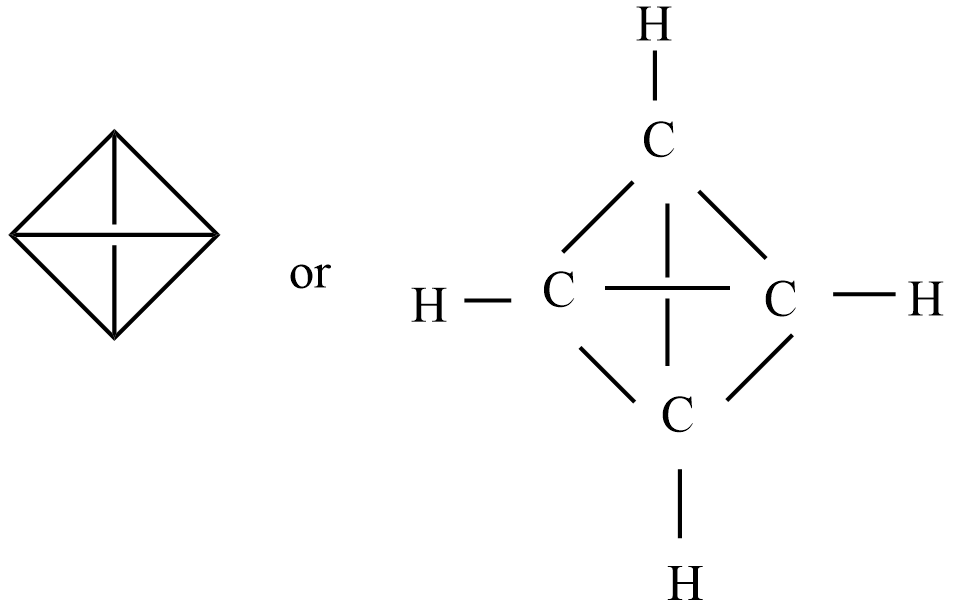
The double bond equivalent for tetrahedron
(A) 2
(B) 3
(C) 4
(D) 5
Answer
 Verified
608.7k+ views
Hint: The number of unsaturation present in the molecule is known as DBE or double bond equivalent. In a ring system or double bond referrers the term unsaturation. For example, benzene has 3 double bonds and 1 ring which gives double bond equivalent value 4. If an organic compound has the presence of an oxygen atom does not influence the double bond equivalent calculation.
Complete step by step solution:
A double bond equivalent for an organic compound can be calculated by the given formula.
$DBE=C+1-\dfrac{H}{2}-\dfrac{X}{2}+\dfrac{N}{2}$ --- (1)
DBE = double bond equivalent of unsaturation
C = number of carbon atoms present in the organic compound
H = number of hydrogen atoms present in the given organic compound
X = number of halogens atoms present like Cl, Br, or I
N = number of nitrogen atoms present in the given organic compound.
Given organic compound – tetrahedrane and chemical formula is ${{C}_{4}}{{H}_{4}}$
The number of carbons present in the given organic compound = 4
Then the number of hydrogen atoms present in the given organic compound = 4
There is no number of nitrogen and halogen atoms.
From equation (1),
$DBE=4+1-\dfrac{4}{2}-\dfrac{0}{2}+\dfrac{0}{2}$= 3
Hence, the double bond equivalent for tetrahedron is 3.
So, the correct answer is option B.
Note: The arrangement of atoms and the chemical bonds that hold the atoms together in the chemical structure of this tetrahedrane contains a total of 10 bonds. There are 4 three-membered rings, 3 four-membered rings, and 6 non-H bonds.
Complete step by step solution:
A double bond equivalent for an organic compound can be calculated by the given formula.
$DBE=C+1-\dfrac{H}{2}-\dfrac{X}{2}+\dfrac{N}{2}$ --- (1)
DBE = double bond equivalent of unsaturation
C = number of carbon atoms present in the organic compound
H = number of hydrogen atoms present in the given organic compound
X = number of halogens atoms present like Cl, Br, or I
N = number of nitrogen atoms present in the given organic compound.
Given organic compound – tetrahedrane and chemical formula is ${{C}_{4}}{{H}_{4}}$
The number of carbons present in the given organic compound = 4
Then the number of hydrogen atoms present in the given organic compound = 4
There is no number of nitrogen and halogen atoms.
From equation (1),
$DBE=4+1-\dfrac{4}{2}-\dfrac{0}{2}+\dfrac{0}{2}$= 3
Hence, the double bond equivalent for tetrahedron is 3.
So, the correct answer is option B.
Note: The arrangement of atoms and the chemical bonds that hold the atoms together in the chemical structure of this tetrahedrane contains a total of 10 bonds. There are 4 three-membered rings, 3 four-membered rings, and 6 non-H bonds.
Recently Updated Pages
Master Class 12 Economics: Engaging Questions & Answers for Success

Master Class 12 English: Engaging Questions & Answers for Success
Master Class 12 Social Science: Engaging Questions & Answers for Success
Master Class 12 Maths: Engaging Questions & Answers for Success
Master Class 12 Physics: Engaging Questions & Answers for Success
Master Class 11 Social Science: Engaging Questions & Answers for Success
Trending doubts
One Metric ton is equal to kg A 10000 B 1000 C 100 class 11 physics CBSE
Difference Between Prokaryotic Cells and Eukaryotic Cells
Two of the body parts which do not appear in MRI are class 11 biology CBSE
1 ton equals to A 100 kg B 1000 kg C 10 kg D 10000 class 11 physics CBSE
Draw a diagram of nephron and explain its structur class 11 biology CBSE
10 examples of friction in our daily life