




The d-orbitals involved in \[s{{p}^{3}}{{d}^{2}}\] or \[{{d}^{2}}s{{p}^{3}}\] hybridization of the central metal ion are:
(this question has multiple correct options)
a.) \[{{d}_{{{x}^{2}}-{{y}^{2}}}}\]
b.) \[{{d}_{xy}}\]
c.) \[{{d}_{yz}}\]
d.) \[{{d}_{{{z}^{2}}}}\]
Answer
 Verified
646.5k+ views
Hint: From the given hybridization we can say that the geometry of the compound has octahedral. So, to solve this question, consider the splitting of d-orbitals in an octahedral complex, when approached by a ligand.
Complete step by step solution:
When any negatively charged species or ligand approaches a metal, the energy of the orbitals increases. This leads to the splitting of orbitals as –
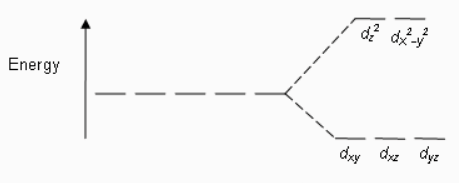
In octahedral complexes, the splitting of orbitals always takes place in this manner.
The electron first goes to the lower energy orbital, i.e. \[{{d}_{xy}}\].\[{{d}_{yz}}\],\[{{d}_{{{z}^{2}}}}\]and then to the higher energy orbital, i.e., \[{{d}_{{{x}^{2}}-{{y}^{2}}}}\]and \[{{d}_{{{z}^{2}}}}\]. Therefore, bonding electrons go to the high energy orbitals which decide the hybridization of the compound.
In case of \[s{{p}^{3}}{{d}^{2}}\] hybridization, nd (outermost) orbitals are involved. The compound is therefore also known as outer-orbital complex.
In case of \[{{d}^{2}}s{{p}^{3}}\] hybridization, (n-1)d (next to outermost) orbitals are involved. The compound is therefore also known as inner-orbital complex.
Therefore, the answer is – option (a) and option (d).
Additional information: In short, if inner d-orbital is used for bonding, the hybridization will be \[{{d}^{2}}s{{p}^{3}}\]. Similarly, if outer d-orbital is used, the hybridization will be \[s{{p}^{3}}{{d}^{2}}\].
Note: Irrespective of the differences between \[s{{p}^{3}}{{d}^{2}}\] and \[{{d}^{2}}s{{p}^{3}}\], there are certain similarities, such as –
Both hybridization results in octahedral geometry.
Both have six hybrid orbitals.
There is an angle of 90 degrees between hybrid orbitals.
Complete step by step solution:
When any negatively charged species or ligand approaches a metal, the energy of the orbitals increases. This leads to the splitting of orbitals as –
In octahedral complexes, the splitting of orbitals always takes place in this manner.
The electron first goes to the lower energy orbital, i.e. \[{{d}_{xy}}\].\[{{d}_{yz}}\],\[{{d}_{{{z}^{2}}}}\]and then to the higher energy orbital, i.e., \[{{d}_{{{x}^{2}}-{{y}^{2}}}}\]and \[{{d}_{{{z}^{2}}}}\]. Therefore, bonding electrons go to the high energy orbitals which decide the hybridization of the compound.
In case of \[s{{p}^{3}}{{d}^{2}}\] hybridization, nd (outermost) orbitals are involved. The compound is therefore also known as outer-orbital complex.
In case of \[{{d}^{2}}s{{p}^{3}}\] hybridization, (n-1)d (next to outermost) orbitals are involved. The compound is therefore also known as inner-orbital complex.
Therefore, the answer is – option (a) and option (d).
Additional information: In short, if inner d-orbital is used for bonding, the hybridization will be \[{{d}^{2}}s{{p}^{3}}\]. Similarly, if outer d-orbital is used, the hybridization will be \[s{{p}^{3}}{{d}^{2}}\].
Note: Irrespective of the differences between \[s{{p}^{3}}{{d}^{2}}\] and \[{{d}^{2}}s{{p}^{3}}\], there are certain similarities, such as –
Both hybridization results in octahedral geometry.
Both have six hybrid orbitals.
There is an angle of 90 degrees between hybrid orbitals.
Recently Updated Pages
Basicity of sulphurous acid and sulphuric acid are

Master Class 11 English: Engaging Questions & Answers for Success
Master Class 11 Physics: Engaging Questions & Answers for Success
Master Class 11 Computer Science: Engaging Questions & Answers for Success
Master Class 11 Chemistry: Engaging Questions & Answers for Success
Master Class 11 Social Science: Engaging Questions & Answers for Success
Trending doubts
Difference Between Prokaryotic Cells and Eukaryotic Cells
Two of the body parts which do not appear in MRI are class 11 biology CBSE
One Metric ton is equal to kg A 10000 B 1000 C 100 class 11 physics CBSE
10 examples of friction in our daily life
Draw a diagram of nephron and explain its structur class 11 biology CBSE
What will happen if the mucus is not secreted by the class 11 biology CBSE