




The distribution of molecules with velocity is represented by the curve. Velocity corresponding to point $ A $ is:
A. $ \sqrt {\dfrac{{3RT}}{M}} $
B. $ \sqrt {\dfrac{{2RT}}{M}} $
C. $ \sqrt {\dfrac{{8RT}}{{\pi M}}} $
D. $ \sqrt {\dfrac{{RT}}{M}} $
Answer
 Verified
557.1k+ views
Hint: The Maxwell-Boltzmann Distribution describes the distribution of molecular speeds. A gas, according to the Kinetic Molecular Theory of Gases, has a vast number of particles moving at high speeds. Each particle has its own speed, and each interaction between particles alters the particle speeds.
Complete step by step answer:
Individual molecules in a gas move with random speeds in magnitude and direction, while a gas with numerous molecules has a predictable distribution of molecular speeds. The Maxwell-Boltzmann distribution, named after its creators who derived it using kinetic theory, is a predictable distribution of molecular speed.
Now, coming to the question
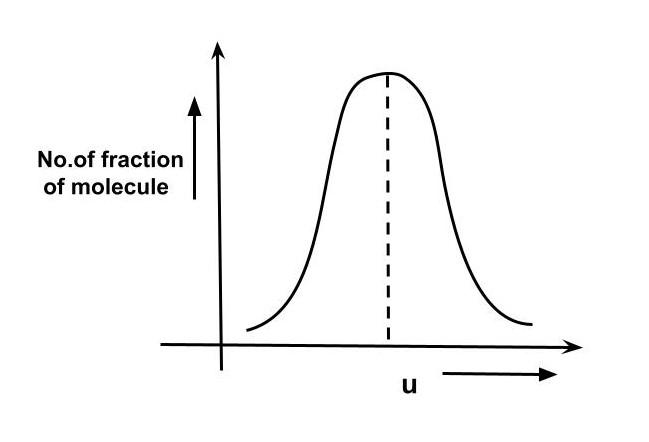
We can see in the graph that point $ A $ represents the most probable distribution of molecules hence the most probable velocity is $ \sqrt {\dfrac{{2RT}}{M}} $
So the correct option is B. $ \sqrt {\dfrac{{2RT}}{M}} $ .
Additional Information:
The temperature and mass of the particles affect the velocity distributions. The particles get more kinetic energy as the temperature rises. When we plot this, we can observe that as the temperature rises, the Boltzmann plot expands and the relative maximum shifts to the right.
Note:
Remember that, according to the Maxwell-Boltzmann distribution law of molecular velocities of gases, all gas molecules, regardless of mass, have the same average translational kinetic energy of $ \dfrac{3}{2}KT $ per molecule at any given temperature.
Complete step by step answer:
Individual molecules in a gas move with random speeds in magnitude and direction, while a gas with numerous molecules has a predictable distribution of molecular speeds. The Maxwell-Boltzmann distribution, named after its creators who derived it using kinetic theory, is a predictable distribution of molecular speed.
Now, coming to the question
We can see in the graph that point $ A $ represents the most probable distribution of molecules hence the most probable velocity is $ \sqrt {\dfrac{{2RT}}{M}} $
So the correct option is B. $ \sqrt {\dfrac{{2RT}}{M}} $ .
Additional Information:
The temperature and mass of the particles affect the velocity distributions. The particles get more kinetic energy as the temperature rises. When we plot this, we can observe that as the temperature rises, the Boltzmann plot expands and the relative maximum shifts to the right.
Note:
Remember that, according to the Maxwell-Boltzmann distribution law of molecular velocities of gases, all gas molecules, regardless of mass, have the same average translational kinetic energy of $ \dfrac{3}{2}KT $ per molecule at any given temperature.
Recently Updated Pages
Master Class 11 Social Science: Engaging Questions & Answers for Success

Master Class 11 English: Engaging Questions & Answers for Success
Master Class 11 Accountancy: Engaging Questions & Answers for Success
Master Class 11 Physics: Engaging Questions & Answers for Success
Master Class 11 Computer Science: Engaging Questions & Answers for Success
Master Class 11 Business Studies: Engaging Questions & Answers for Success
Trending doubts
Find the value of the expression given below sin 30circ class 11 maths CBSE
One Metric ton is equal to kg A 10000 B 1000 C 100 class 11 physics CBSE
Draw a diagram of nephron and explain its structur class 11 biology CBSE
10 examples of friction in our daily life
Proton was discovered by A Thomson B Rutherford C Chadwick class 11 chemistry CBSE
The teeth used for biting and cutting food are called class 11 biology CBSE