




The distance $ x $ (in $ \mu m $ ) covered by the molecule starting from point A at time $ t = 0 $ and stopping at another Point B is given by the equation $ x = {t^2}\left( {2 - \dfrac{t}{3}} \right) $ the distance between A and B ( in $ \mu m $ ) is closed to:
(A) $ 10.7 $
(B) $ 20.7 $
(C) $ 40.7 $
(D) $ 50.7 $
Answer
 Verified
532.8k+ views
Hint: Here, we have been given the starting and ending point of the motion of molecule in a straight line and also the distance is given in the form of equation on solving this equation at time $ t $ we can be able to find the value of $ x $ . First from $ x $ find velocity of the particle and then the required distance would be easier to find.
Complete answer:
Here, the equation of distance between A and B is given by
$ x = {t^2}\left( {2 - \dfrac{t}{3}} \right) $ …. $ (1) $
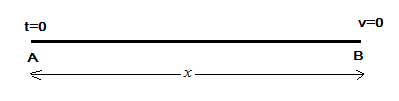
Let us plot the points A and B, velocity at point B $ v = 0 $
To find velocity of molecule at $ t $ is given by:
$ (1) $ $ \Rightarrow $ $ x = {t^2}\left( {2 - \dfrac{t}{3}} \right) \Rightarrow x = 2{t^2} - \dfrac{{{t^3}}}{3} $
$ v = \dfrac{{dx}}{{dt}} $
$ \Rightarrow v = \dfrac{d}{{dt}}\left[ {2{t^2} - \dfrac{{{t^3}}}{3}} \right] $
$ \Rightarrow v = 4t - {t^2} $ ….. $ (2) $
At point B; $ v = 0 $
$ (2) \Rightarrow 0 = 4t - {t^2} $
$ \Rightarrow t(4 - t) = 0 $
But, $ t\cancel{ = }0 $
Hence, $ (4 - t) = 0 $
$ \therefore t = 4\sec $
So, we have to put this value in equation $ (1) $ as:
$ eq(1) \Rightarrow x = {(4)^2}\left( {2 - \dfrac{4}{3}} \right) $
$ \Rightarrow x = 16\left( {2 - \dfrac{4}{3}} \right) $
$ \Rightarrow x = 16 \times \dfrac{2}{3} $
$ \Rightarrow x = 10.67 $
Thus, here we have calculated the distance as $ 10.67\mu m $
Precisely, it is $ 10.7\mu m $
Therefore, the correct answer is option A.
Note:
Here, the distance is already given from that on differentiating it with respect to time we can calculate the velocity of the molecule. With the help of velocity we can calculate time and then the actual distance between two points of the movement of the molecule. Be careful about the concept used here and also have good calculation.
Complete answer:
Here, the equation of distance between A and B is given by
$ x = {t^2}\left( {2 - \dfrac{t}{3}} \right) $ …. $ (1) $
Let us plot the points A and B, velocity at point B $ v = 0 $
To find velocity of molecule at $ t $ is given by:
$ (1) $ $ \Rightarrow $ $ x = {t^2}\left( {2 - \dfrac{t}{3}} \right) \Rightarrow x = 2{t^2} - \dfrac{{{t^3}}}{3} $
$ v = \dfrac{{dx}}{{dt}} $
$ \Rightarrow v = \dfrac{d}{{dt}}\left[ {2{t^2} - \dfrac{{{t^3}}}{3}} \right] $
$ \Rightarrow v = 4t - {t^2} $ ….. $ (2) $
At point B; $ v = 0 $
$ (2) \Rightarrow 0 = 4t - {t^2} $
$ \Rightarrow t(4 - t) = 0 $
But, $ t\cancel{ = }0 $
Hence, $ (4 - t) = 0 $
$ \therefore t = 4\sec $
So, we have to put this value in equation $ (1) $ as:
$ eq(1) \Rightarrow x = {(4)^2}\left( {2 - \dfrac{4}{3}} \right) $
$ \Rightarrow x = 16\left( {2 - \dfrac{4}{3}} \right) $
$ \Rightarrow x = 16 \times \dfrac{2}{3} $
$ \Rightarrow x = 10.67 $
Thus, here we have calculated the distance as $ 10.67\mu m $
Precisely, it is $ 10.7\mu m $
Therefore, the correct answer is option A.
Note:
Here, the distance is already given from that on differentiating it with respect to time we can calculate the velocity of the molecule. With the help of velocity we can calculate time and then the actual distance between two points of the movement of the molecule. Be careful about the concept used here and also have good calculation.
Recently Updated Pages
Master Class 11 English: Engaging Questions & Answers for Success

Master Class 11 Maths: Engaging Questions & Answers for Success
Master Class 11 Biology: Engaging Questions & Answers for Success
Master Class 11 Physics: Engaging Questions & Answers for Success
Master Class 11 Accountancy: Engaging Questions & Answers for Success
Class 11 Question and Answer - Your Ultimate Solutions Guide
Trending doubts
Explain zero factorial class 11 maths CBSE
There are 720 permutations of the digits 1 2 3 4 5 class 11 maths CBSE
Why is 1 molar aqueous solution more concentrated than class 11 chemistry CBSE
What is the difference between biodegradable and nonbiodegradable class 11 biology CBSE
How do I convert ms to kmh Give an example class 11 physics CBSE
SiO2GeO2 SnOand PbOare respectively A acidic amphoteric class 11 chemistry CBSE