




The distance between the rails of the track can be written as $1.67m$. How much the outer rail is to be elevated for the curve of $0.5km$ radius, so that a train moving with speed of $54km{{h}^{-1}}$ can take a safe turn on track?
$\begin{align}
& A.80mm \\
& B.75mm \\
& C.60mm \\
& D.75cm \\
\end{align}$
Answer
 Verified
573k+ views
Hint: The height of the elevation can be found by taking the ratio of the product of the distance between the rails of the track and the square of the speed of the train to the product of the acceleration due to gravity and the radius of the elevated curve. Substitute the values in the equation. This will help you in answering this question.
Complete step by step solution:
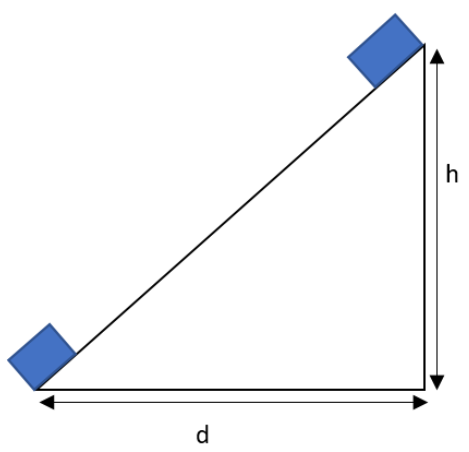
let us assume that the height at which the elevation of outer rail over inner rail will be given as $h$. This height of the elevation can be found by taking the ratio of the product of the distance between the rails of the track and the square of the speed of the train to the product of the acceleration due to gravity and the radius of the elevated curve. This can be written as,
$h=\dfrac{d{{v}^{2}}}{rg}$
Where $d$ be the distance between the rails of the track, $v$ be the velocity of the train, \[r\]be the radius of the elevated curve and \[g\]be the acceleration due to gravity.
The distance between the rails of the track has been given as,
$d=1.67m$
The velocity of the train can be shown as,
$v=54\times \dfrac{5}{18}=15m{{s}^{-1}}$
The radius of the elevated curve will be,
$r=0.5km=0.5\times {{10}^{3}}m$
And the acceleration due to gravity can be written as,
$g=9.8m{{s}^{-2}}$
Substituting these values in the equation will give,
\[h=\dfrac{1.67\times {{\left( 15 \right)}^{2}}}{10\times 0.5\times 1000}=0.075m=75mm\]
Therefore the height of the elevation has been calculated. The answer has been mentioned as option B.
Note: The units of the quantities mentioned in the question are to be taken care of well. The speed has been mentioned in the units of kilometers per hour. For getting the answer in SI units, the speed has to be in meter per second. In order to convert the kilometer per hour into meters per second, the speed should be multiplied by five first and then divide by eighteen.
Complete step by step solution:
let us assume that the height at which the elevation of outer rail over inner rail will be given as $h$. This height of the elevation can be found by taking the ratio of the product of the distance between the rails of the track and the square of the speed of the train to the product of the acceleration due to gravity and the radius of the elevated curve. This can be written as,
$h=\dfrac{d{{v}^{2}}}{rg}$
Where $d$ be the distance between the rails of the track, $v$ be the velocity of the train, \[r\]be the radius of the elevated curve and \[g\]be the acceleration due to gravity.
The distance between the rails of the track has been given as,
$d=1.67m$
The velocity of the train can be shown as,
$v=54\times \dfrac{5}{18}=15m{{s}^{-1}}$
The radius of the elevated curve will be,
$r=0.5km=0.5\times {{10}^{3}}m$
And the acceleration due to gravity can be written as,
$g=9.8m{{s}^{-2}}$
Substituting these values in the equation will give,
\[h=\dfrac{1.67\times {{\left( 15 \right)}^{2}}}{10\times 0.5\times 1000}=0.075m=75mm\]
Therefore the height of the elevation has been calculated. The answer has been mentioned as option B.
Note: The units of the quantities mentioned in the question are to be taken care of well. The speed has been mentioned in the units of kilometers per hour. For getting the answer in SI units, the speed has to be in meter per second. In order to convert the kilometer per hour into meters per second, the speed should be multiplied by five first and then divide by eighteen.
Recently Updated Pages
Master Class 11 English: Engaging Questions & Answers for Success

Master Class 11 Maths: Engaging Questions & Answers for Success
Master Class 11 Biology: Engaging Questions & Answers for Success
Master Class 11 Social Science: Engaging Questions & Answers for Success
Master Class 11 Physics: Engaging Questions & Answers for Success
Master Class 11 Accountancy: Engaging Questions & Answers for Success
Trending doubts
One Metric ton is equal to kg A 10000 B 1000 C 100 class 11 physics CBSE
There are 720 permutations of the digits 1 2 3 4 5 class 11 maths CBSE
Discuss the various forms of bacteria class 11 biology CBSE
Draw a diagram of a plant cell and label at least eight class 11 biology CBSE
State the laws of reflection of light
Explain zero factorial class 11 maths CBSE